
Reviewed · WALKING TOURS
Vienna: Private Jewish Walking Tour
Vienna’s Jewish story reaches far beyond one memorial. This private 150-minute walk connects Salomon, the Jewish thinkers of 1900s Vienna, Holocaust history, and the city’s present-day community. I like the personal guide format, which lets you ask questions and shape the pace. I also like the mix of major sights and less familiar Jewish landmarks, including Palais Ephrussi and Judenplatz.
The main drawback is the price: $530 per group up to 20 is a serious charge for a walking tour. It can make good sense for a family or full group, but it is poor value for one or two people unless private guiding is a high priority. The Seitenstettengasse Synagogue is viewed from outside only, so you should not book this expecting an interior synagogue visit.
In This Review
- Key points to know before booking
- Why Jewish Vienna needs a guided walk
- Starting at Helmut Zilk Platz and the Memorial against War and Fascism
- Salomon and the earliest chapter of Jewish life
- University of Vienna and the intellectual city
- Café Landtmann and Freud’s Vienna
- Palais Ephrussi and the people behind grand buildings
- Seitenstettengasse Synagogue from the outside
- Judenplatz and the weight of memory
- Joseph’s Square, the Opera, and Vienna’s public face
- The final section: Holocaust history and Jewish Vienna today
- What the private format and $530 price mean
- Who should choose this Vienna Jewish history tour?
- Should you book it?
- FAQ
- Where does the Vienna Jewish walking tour begin?
- How will I recognize the guide?
- How long does the tour last?
- Where does the tour finish?
- Is hotel pickup available?
- What languages are offered?
- Is the tour wheelchair accessible?
- Can I go inside Seitenstettengasse Synagogue?
Key points to know before booking
- Salomon gives the tour an unusual starting point: You learn about the first Jewish person in Austria named in the tour, rather than beginning with only the best-known modern figures.
- The route links culture with persecution: Artists, doctors, scientists, and thinkers appear alongside the expulsions, Holocaust, and later return of Jewish life.
- Café Landtmann adds a human detail: You see the coffee house associated with Sigmund Freud, a useful way to picture how intellectual life worked in Vienna.
- The guide makes the difference: Lisa received especially warm praise for her friendly, adaptable style, while Dr. Reinhard Travnicek and Horlando were also singled out for clear, strong presentations.
- The synagogue stop is exterior only: You can see Seitenstettengasse Synagogue, but the tour does not include entry.
- The private format suits questions: A 150-minute walk is easier to tailor when you are traveling with your own family, friends, or study group.
Why Jewish Vienna needs a guided walk
Vienna’s Jewish past is not confined to one neighborhood or one period. The tour traces a long arc, from Salomon and early Jewish life in Austria to the cultural and intellectual flowering of Jewish Vienna around 1900, then through expulsion, the Holocaust, and the present-day community.
That range matters. Without a guide, you might pass the grand buildings of central Vienna and see only imperial wealth, famous composers, and elegant cafés. A Jewish history walk asks you to read the same streets differently. A palace can reveal the story of a Jewish family. A university can open a discussion about Jewish scholars and public life. A memorial can force the city’s darker past into view.
I like that the tour does not treat Jewish Vienna as a single, frozen subject. It gives attention to achievement and suffering, exclusion and return. That makes the experience more useful than a sightseeing circuit that simply names old buildings.
The subject is serious, but the format is not a lecture hall. You walk through central Vienna with a live guide, stopping often enough to connect places with people and events. The guide can answer questions as they arise, which is particularly helpful if you already know some European Jewish history and want more detail about Austria.
More Walking Tours in Vienna
- Vienna: Guided Walking Tour of City Center Highlights
★ 4.7 · 4,989 reviews - Vienna: Vienna Central Cemetery Guided Walking Tour
★ 4.8 · 3,307 reviews - Vienna: Guided Walking Tour of City Highlights & Hidden Gems
★ 4.9 · 2,180 reviews
Starting at Helmut Zilk Platz and the Memorial against War and Fascism
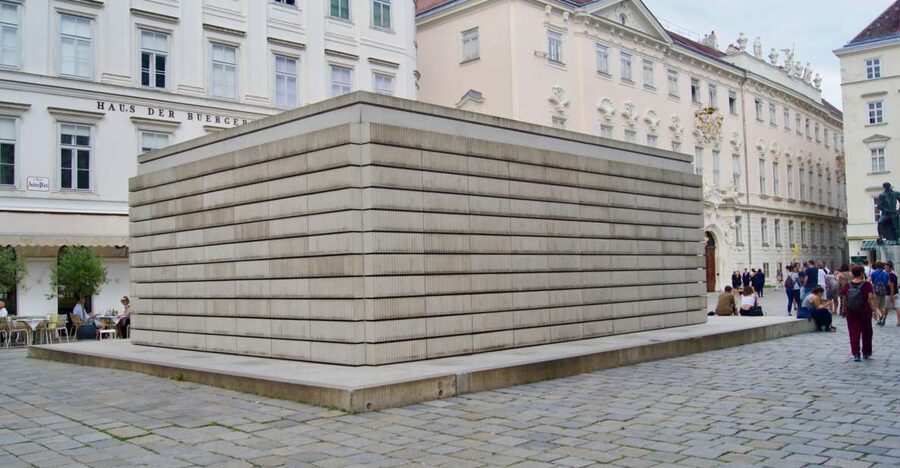
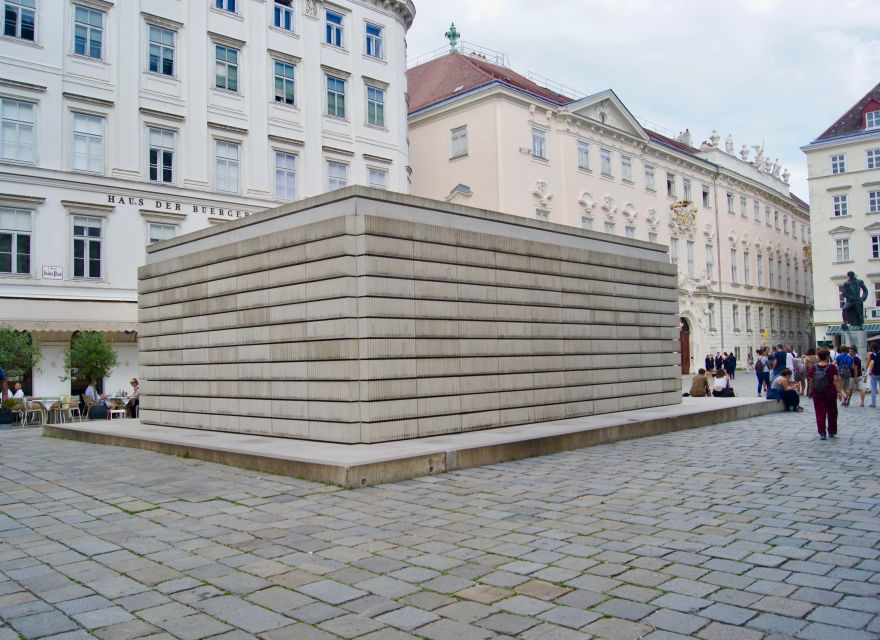
The meeting point is Helmut Zilk Platz, in front of the Memorial against War and Fascism. Your guide carries a red and white striped umbrella, making the meeting easier in a busy central area.
Beginning here gives the walk an immediate moral and historical frame. The memorial addresses war and fascism, so the tour starts with the consequences of dictatorship rather than easing in with decorative architecture. That is fitting for a route that later examines the destruction of Vienna’s Jewish community.
This is also a practical meeting point for a city-center walk. If you arrange pickup, hotel collection and return are available within Vienna’s inner city. Still, confirm the exact pickup details when booking, since the stated public meeting point remains Helmut Zilk Platz.
The opening conversation introduces the broad story. You can expect the guide to place early Jewish life, the modern community, and the Holocaust within Vienna’s wider development. Ask questions early if your interests lean toward family history, architecture, religion, politics, or the intellectual life of 1900 Vienna.
Salomon and the earliest chapter of Jewish life
One of the tour’s distinctive promises is a look at Salomon, described as the first Jewish person in Austria. That detail gives the walk a person-centered beginning. Instead of starting with a broad label such as Jewish Vienna, you start with an individual and then follow the community that developed over time.
The value here is perspective. Jewish life in Austria did not begin with Sigmund Freud, the famous cafés, or the cultural figures of the early twentieth century. Those names matter, but they belong to a much later chapter. The discussion of Salomon helps you see the long span of Jewish presence in Austria before the era most tourists recognize.
The supplied information does not specify exactly where this part of the story is told or how much time it receives. I would expect it to function as historical groundwork rather than a long standalone stop. If Salomon is important to your family or academic interests, ask the guide for more context while the topic is fresh.
University of Vienna and the intellectual city
The University of Vienna is one of the listed highlights. Its role in the route is important because the tour presents Jewish Vienna not only through religious sites, but also through education, science, medicine, and public thought.
The 1900s were a major period for Vienna’s artists, doctors, and scientists, many of them Jewish or from Jewish families. The tour connects these people to the city’s intellectual life, helping you understand why Vienna became such an important center of ideas and culture.
A university building can look like just another grand piece of architecture when you pass it on your own. With context, it becomes a place where questions of access, discrimination, achievement, and belonging come into view. The subject is not simply who succeeded, but also who was allowed to study, teach, work, and take part in civic life.
This part should appeal to you if you enjoy social history more than a list of dates. It also gives the tour balance. Jewish Vienna is presented as a community that helped shape the city, not only as a community acted upon by later persecution.
A completely different kind of day:
- Vienna: Vivaldi’s Four Seasons Concert in Karlskirche
★ 4.7 · 14,951 reviews - Vienna: Spanish Riding School Training
★ 3.9 · 9,281 reviews - Vienna: Schönbrunn Palace & Gardens Skip-the-Line Tour
★ 4.7 · 7,739 reviews - Vienna: Light of Creation Votive Church Immersive Light Show
★ 4.8 · 6,779 reviews
Café Landtmann and Freud’s Vienna
Café Landtmann is included as the coffee house associated with Sigmund Freud. The stop offers a small but memorable detail about daily life among Vienna’s intellectual circles.
I like coffee houses as historical stops because they make abstract cultural history easier to picture. You can think about writers, doctors, artists, and thinkers meeting in public places, exchanging ideas, and building reputations. The café connection gives the tour a more ordinary human scale after the larger discussion of universities and institutions.
The information provided says you will see Café Landtmann, not that you will sit down for coffee or receive a reserved table. Treat it as a sightseeing stop, not a café break. If you want to drink there afterward, plan that separately and allow extra time beyond the 150-minute tour.
Freud’s connection also helps explain why this route includes famous Viennese culture without becoming a general Freud tour. The focus remains Jewish Vienna and the city shaped by its Jewish community. Freud is one doorway into that story, not the whole subject.
Palais Ephrussi and the people behind grand buildings
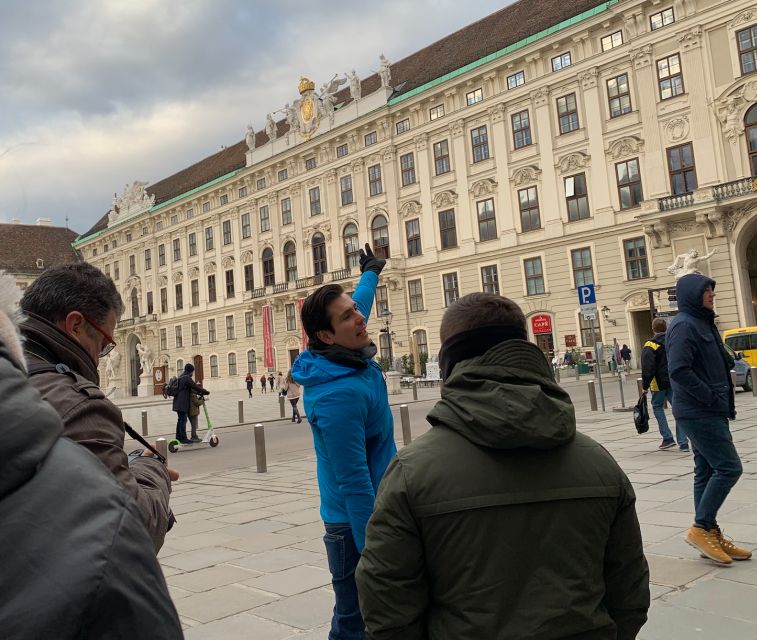
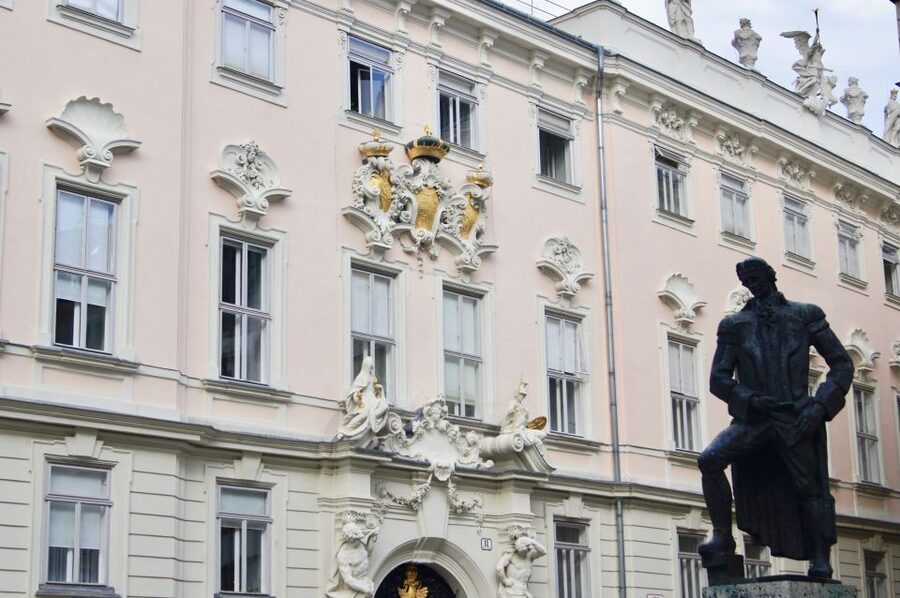
Palais Ephrussi adds an architectural and family dimension to the walk. Grand palaces can make Vienna’s history seem remote, but a Jewish walking tour asks you to notice who commissioned, owned, designed, financed, or inhabited these places.
The palace is especially useful in a route about Jewish participation in Viennese public life. It lets the guide discuss wealth, status, assimilation, and the complicated place of Jewish families in imperial and modern Vienna. The building itself is likely to attract your eye, but the human story is the reason to stop.
The supplied details do not specify whether the tour enters Palais Ephrussi. You should expect to see and discuss the landmark from the walking route unless your guide tells you otherwise. As with the other stops, the point is the connection between a visible building and the community behind it.
This is one reason a private guide can add value. You can ask whether the Ephrussi story connects with other families, cultural institutions, or political changes discussed along the way. In a large group, that kind of question can be harder to fit into the schedule.
Seitenstettengasse Synagogue from the outside
The Seitenstettengasse Synagogue is a key stop, but the tour specifies outside viewing only. That distinction matters. You will learn about the synagogue and its place in Vienna’s Jewish life, but you should not expect an interior visit, a service, or a separate synagogue entry procedure.
Even from outside, the stop helps show that Jewish life in Vienna is not only a historical subject. A synagogue is a living religious and community site, so the guide can connect past events with the present-day community mentioned throughout the tour.
Please dress and behave as you would at any active place of worship, even though this experience does not take you inside. The tour details do not state any special clothing rules, so do not assume there is an entry requirement. Simply approach the site respectfully and follow your guide’s instructions.
If visiting a synagogue interior is essential to your plans, pair this walk with a separate visit that specifically offers entry. This tour’s strength is its wider city story, not access to the building itself.
Judenplatz and the weight of memory
Judenplatz is one of the most important places on the route. It brings the history of Vienna’s Jewish community into a concentrated urban setting, where the past is marked in the middle of the modern city.
The square allows the guide to discuss Jewish life, persecution, memory, and the way Vienna presents difficult history today. It is a place where the city’s beautiful center and its painful past sit close together. That contrast is one of the most powerful features of a walking tour.
You should expect the tone here to become more solemn. The tour’s subject includes the banishment of Jewish people from Vienna and the Holocaust, so this is not a light sightseeing outing. I appreciate that the experience makes room for the darker periods rather than treating them as a brief footnote after the cultural highlights.
Give yourself mental space for this section. The guide’s role is especially important here, since dates and names alone can feel cold. The strongest parts of the tour are likely to be the moments when the guide connects the physical square with individual lives and the wider fate of the community.
Joseph’s Square, the Opera, and Vienna’s public face
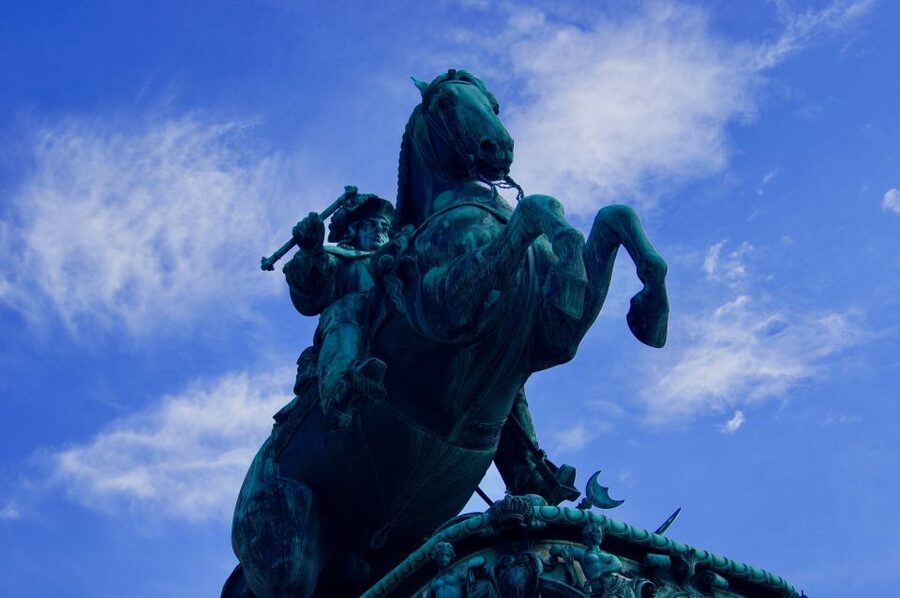
Joseph’s Square and the Vienna State Opera broaden the route beyond specifically Jewish landmarks. These places show the imperial and cultural center in which Jewish residents worked, studied, created, and built lives.
The Opera is a familiar Vienna sight, but the tour changes the question you ask when you see it. Instead of only considering music and architecture, you can consider who helped make the city’s cultural life possible, who was welcomed into it, and who was later excluded.
Joseph’s Square brings another recognizable central setting into the story. The benefit is variety: you are not moving from one memorial to another without seeing the surrounding city. The route places Jewish history inside Vienna’s major civic and cultural spaces.
The tradeoff is time. Two and a half hours sounds generous, but the route includes the University of Vienna, Café Landtmann, Palais Ephrussi, Seitenstettengasse Synagogue, Judenplatz, Joseph’s Square, the Memorial against War and Fascism, the State Opera, and other stops. Expect focused explanations rather than long visits at every location.
The final section: Holocaust history and Jewish Vienna today
The tour does not stop with the cultural achievements of 1900 Vienna. It also covers the banishment of the Jewish community, the Holocaust, and the present-day Jewish community.
That progression is essential. A tour about Jewish Vienna should not create a polished story of doctors, artists, scientists, and cafés while skipping the forces that destroyed so much of that community. Here, the difficult history is part of the main route.
At the same time, the story does not end in destruction. The present-day community gives the tour a living endpoint. You come away with a picture of Jewish Vienna as something that existed before the Holocaust, was devastated by it, and continues in the city today.
The exact balance depends on your guide and your questions. Lisa has been praised for being friendly, engaging, and able to adapt the tour to different audiences. Dr. Reinhard Travnicek was described as an experienced Vienna expert with broad historical understanding, and Horlando was praised for clear explanations and thoughtful answers. Guides are not guaranteed by name, but these comments suggest a strong pool of presenters.
What the private format and $530 price mean
The tour costs $530 for a private group of up to 20 people. That is not a budget walking tour, so the value depends heavily on your group size.
For 15 to 20 people, the per-person cost becomes much more reasonable. You are paying for a private guide, a route focused on your interests, and the chance to ask questions without strangers setting the agenda. For two people, the same price is much harder to justify unless you strongly prefer private guiding or have a special connection to Jewish Vienna.
The 150-minute length is well judged for a central walking tour with serious subject matter. It is long enough to cover the major chapters, but short enough to fit into a busy Vienna day. You should wear comfortable shoes and expect to remain on foot for most of the experience, even though the tour is listed as wheelchair accessible.
English and German are available. Hotel pickup and drop-off within the inner city add convenience, particularly if your hotel is close to the center. The tour finishes in central Vienna at 1010 Vienna, Austria, so you can continue sightseeing afterward.
Free cancellation is available up to 24 hours before the start time, and you can reserve now and pay later. Those policies help if your schedule is still taking shape, but they do not change the basic price question.
Who should choose this Vienna Jewish history tour?
I would recommend it most strongly to:
- Families or friend groups who can share the private group cost
- People with a strong interest in Jewish history, culture, or genealogy
- First-time visitors who want central Vienna explained through a different lens
- Students and educators who value the chance to ask follow-up questions
- Anyone who prefers a serious, human history tour over a general city walk
It may be less suitable if you want a relaxed café stroll, a synagogue interior visit, or a tour focused only on architecture. The Holocaust and persecution sections also mean you should choose this experience when you have the attention and emotional energy for difficult subjects.
The guide’s ability to adapt is a major part of the value. Lisa’s warm and flexible approach received particularly strong praise, while the comments about Dr. Reinhard Travnicek and Horlando point to a team comfortable with detailed historical questions. Since the guide is not fixed in the details provided, I would ask at booking if a particular guide or language is important to you.
Should you book it?
Book this tour if you want Vienna’s famous center explained through the lives, achievements, persecution, and continuing presence of its Jewish community. The route has strong variety, the private structure encourages questions, and the guide can connect Salomon, Freud, the Ephrussi family, Judenplatz, the Holocaust, and modern Jewish Vienna in one coherent walk.
Think twice if you are a solo visitor or couple watching costs closely. At $530, the tour becomes much better value when divided among a larger group. Also remember that Seitenstettengasse Synagogue is viewed from outside only.
For the right group, this is a thoughtful way to understand Vienna beyond palaces and café culture. It gives you famous sights, difficult history, and the people who helped make the city what it is.
FAQ
Where does the Vienna Jewish walking tour begin?
The tour begins at Helmut Zilk Platz, in front of the Memorial against War and Fascism.
How will I recognize the guide?
The guide will be holding a red and white striped umbrella at the meeting point.
How long does the tour last?
The guided walking tour lasts 150 minutes, or two and a half hours.
Where does the tour finish?
The tour finishes in central Vienna at 1010 Vienna, Austria.
Is hotel pickup available?
Yes. Hotel pickup and drop-off are available within Vienna’s inner city.
What languages are offered?
The tour is available in English and German.
Is the tour wheelchair accessible?
Yes. The activity is listed as wheelchair accessible.
Can I go inside Seitenstettengasse Synagogue?
No. The synagogue is included as an outside-only stop.
Just added in Vienna
- Vienna: Austrian Wine Tasting Experience★ 4.2 · 2 reviews
- World War II History Vienna Old Town Private Walking Tour★ 4.8 · 9 reviews
- Vienna_ Meet Beethoven Life Private Guided Walking Tour★ 5.0 · 1 review
- Vienna: Wine Tasting Tour★ 4.8 · 61 reviews
- Vienna: Wine Tasting at Schönbrunn Palace★ 4.3 · 71 reviews
- Vienna: Winery and Wine Tasting Tour with a Wine Expert★ 5.0 · 5 reviews
- Vienna: Wine Tasting E-Bike Tour★ 4.9 · 46 reviews
- Vienna: Concert by the Vienna Baroque Orchestra★ 4.6 · 56 reviews
Walking Tours, compared.
Guided Walking Tour of City Center Highlights
Read our review →
Guided Walking Tour of City Highlights & Hidden Gems
Read our review →
Vienna Historic Center Small Group Walking Tour
Read our review →
Browse the lists this tour appears in