
Reviewed · SPANISH RIDING SCHOOL TOURS
Vienna: Spanish Riding School Training
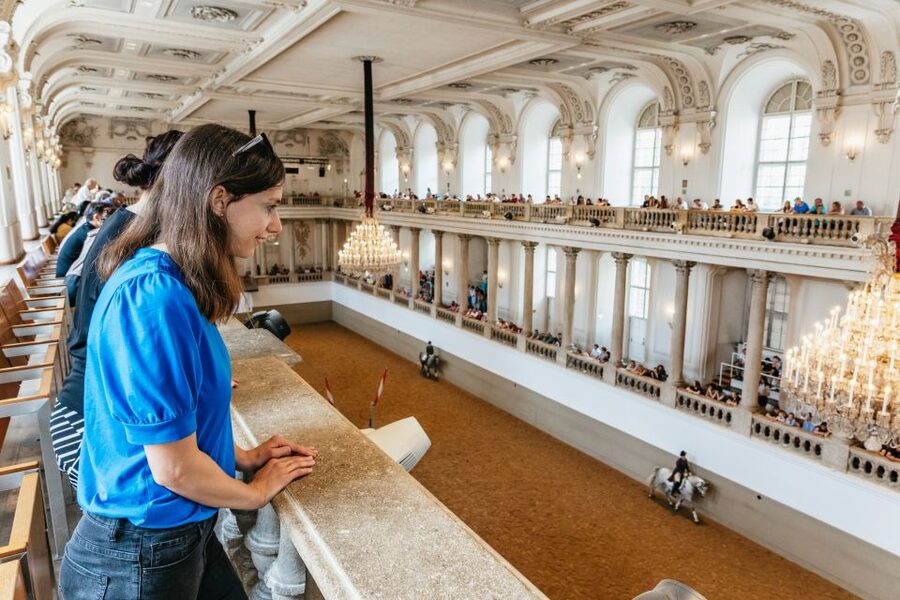
Vienna’s most graceful morning lesson awaits. The Spanish Riding School training session lets you watch Lipizzaner stallions and their riders work inside the grand Winter Riding Academy, a setting that can feel almost as impressive as the horses. I especially like the chance to see the quiet, repetitive work behind the famous performances, and the $20 price makes this a smart choice when full performance tickets are unavailable. The main catch is simple: this is training, not a full show, so you may see plenty of trotting and basic exercises rather than dramatic leaps.
I also like the one-hour length. It is long enough to appreciate the horses, music, riders, and Baroque interior without asking too much from younger children or anyone with limited patience for equestrian detail. Photography and video are forbidden, and some seating requires stairs or a forward lean to see clearly, so plan with care.
In This Review
- Key points to know before you go
- Entering Vienna’s Winter Riding Academy
- What the morning training actually shows
- Two groups, one hour, and changing levels of skill
- The famous jumps are a bonus, not the promise
- Classical music and the spoken explanation
- Choosing between standing and seated tickets
- The no-photo rule is part of the visit
- Is this suitable for children and non-riders?
- Practical comfort and access details
- How the training compares with a full performance
- Should you book the Spanish Riding School training?
- FAQ
- How long does the Spanish Riding School training session last?
- How much does the training session cost?
- Where does the training take place?
- What will I see during the training?
- Are the famous school jumps guaranteed?
- Is classical music played during the session?
- Can I take photographs or videos inside?
- Are children allowed to attend?
- Is the building accessible by elevator?
- How do I use my voucher?
Key points to know before you go
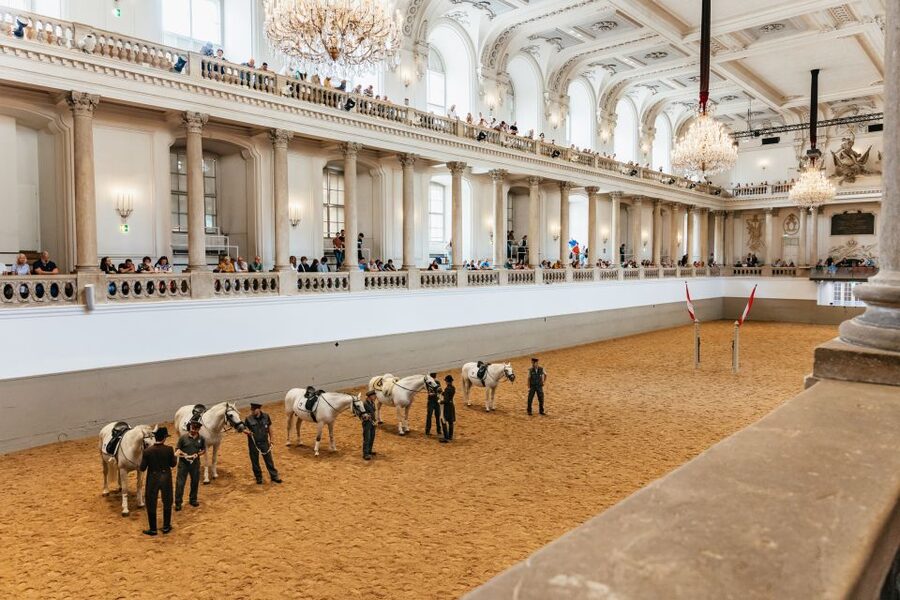
- The setting is part of the experience: Training takes place beneath chandeliers in Vienna’s Baroque Winter Riding Academy.
- You see real daily work: Exercises can include relaxation, trotting, sidestepping, lead changes, lunging, and muscle-building movements.
- Classical Viennese music accompanies the hour: The music adds atmosphere, though commentary may be difficult to hear from upper seating.
- The famous jumps are not guaranteed: Levade, courbette, and capriole are practiced only occasionally during morning exercise.
- Standing tickets can save money: They offer good value, but an hour on your feet may be tiring.
- Arrive early for the ticket exchange: Present your voucher at the entrance and collect the paper ticket no earlier than one hour before the activity.
Entering Vienna’s Winter Riding Academy
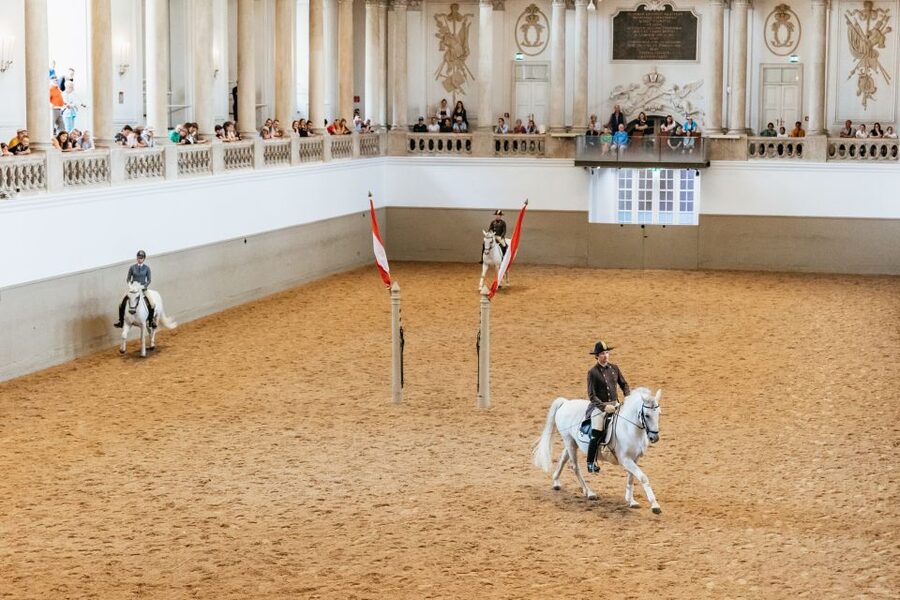
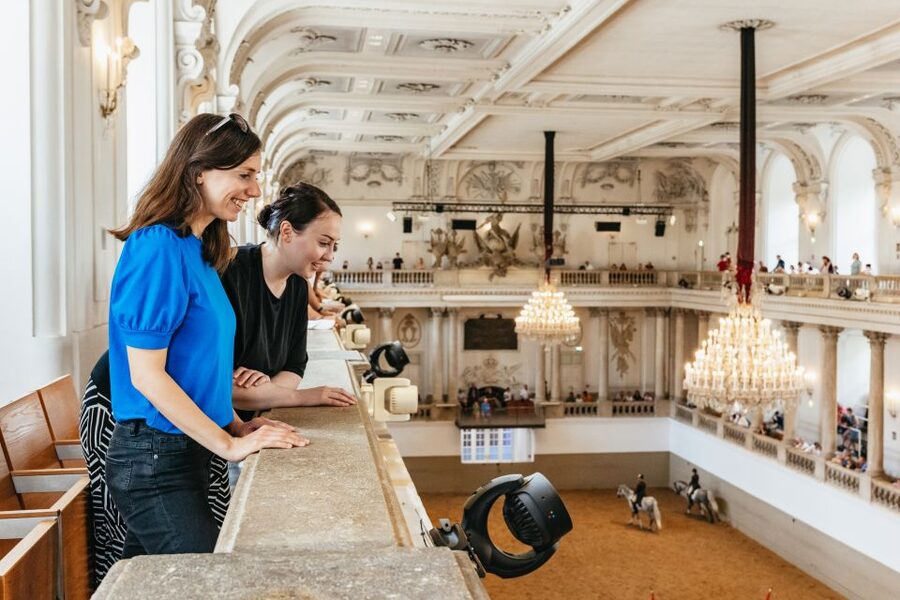
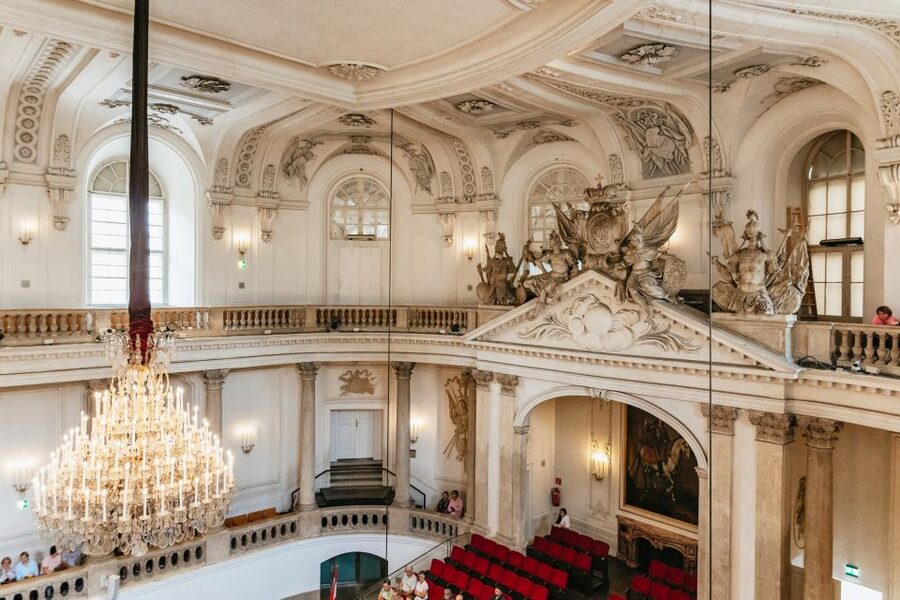
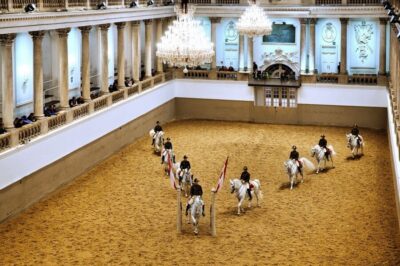
The Spanish Riding School is in central Vienna, inside a building designed for ceremony. The Winter Riding Academy has a formal Baroque interior, chandeliers, balconies, and a sand-covered riding area. Even before a horse enters, the room gives the session a sense of occasion.
You do not go straight from a phone voucher into the arena. Present your voucher at the Spanish Riding School entrance and exchange it for a ticket. Ticket collection opens at the earliest one hour before the activity, so leave time for this step. One person arrived early but nearly missed the start after discovering they had to queue and run around the building to exchange the voucher.
I would arrive comfortably before the scheduled time. This is especially useful if you have a standing ticket and want to choose a reasonable viewing place. The entrance can become crowded, and finding your way through the historic building is easier before everyone is trying to get inside at once.
The building’s age also affects access. There is no elevator because of monument protection. You may need to manage stairs, and upper seating can involve a high wall that forces you to lean forward or stand for much of the hour. If you use a wheelchair or have trouble walking, send a request in advance rather than assuming that standard seating will meet your needs.
More Spanish Riding School tickets:
- Vienna Spanish Riding School Guided Tour
★ 4.7 · 6,765 reviews - Performance Of The Lipizzans At Spanish Riding School
4,190 reviews - Vienna: Spanish Riding School 45-Minute Performance Show
★ 3.9 · 731 reviews
What the morning training actually shows
The morning exercise is not a staged performance with a fixed sequence. It is a working session built around the health, fitness, and education of the Lipizzaner stallions and their riders.
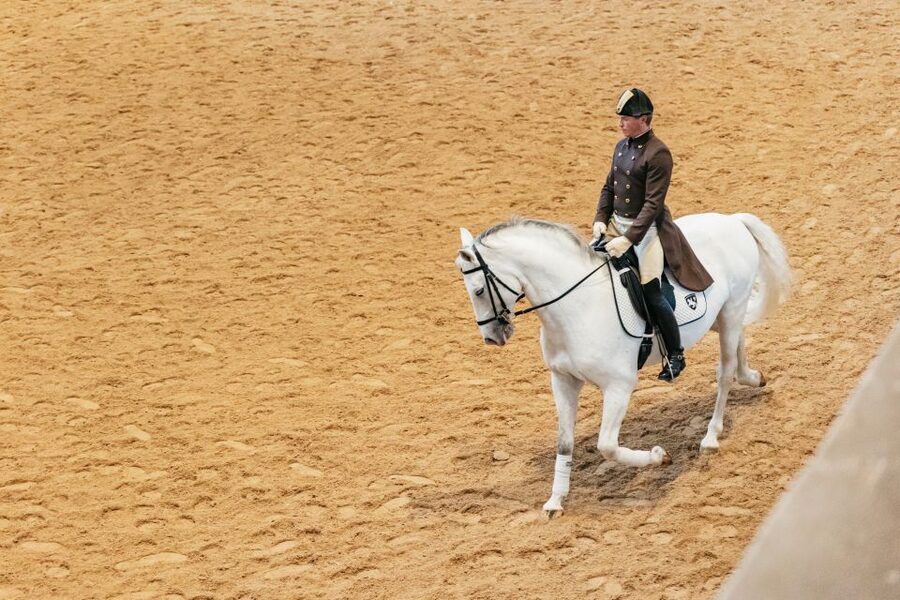
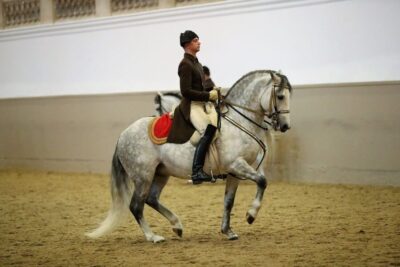
The horses may be asked to relax, improve their balance, strengthen particular muscle groups, or refine a movement. You might see a horse and rider travel around the arena at a steady pace, repeat a movement, or work on small changes that look modest but require great control.
That distinction matters. The point is not to fill every minute with spectacular tricks. The primary aim is to maintain the horses’ athletic condition and prepare the muscles needed for the school’s haute école work. You are seeing part of a long training process, not a greatest-hits display.
Several horses and riders may work in the arena at the same time. This gives you a useful sense of the different stages of training, but it can also make it hard to focus on one pair. A younger rider may receive closer instruction, while a more experienced team works through familiar exercises.
The program can change. On one morning, you might see more ground work. On another, you may see mostly ridden exercises and steady movement around the arena. That unpredictability is part of the bargain.
Two groups, one hour, and changing levels of skill
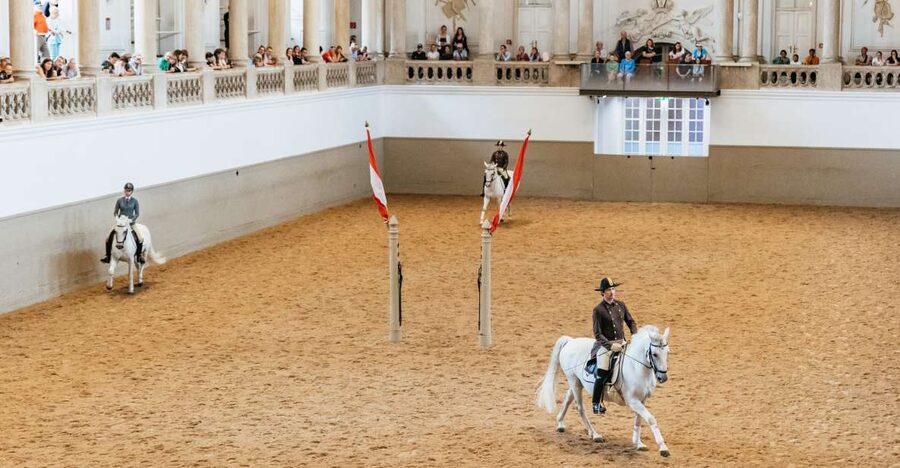
The session commonly includes two groups of horses during the hour, though the exact program is subject to change. Seeing more than one group helps show the range of work taking place at the school.
You may notice differences in the riders’ clothing and equipment. A rider still in training can look different from a more experienced rider, and the contrast helps you understand that both horse and human are still learning. The instruction is not only about teaching a horse to respond. It is also about developing a rider’s timing, balance, and ability to communicate clearly.
For a horse lover, repeated practice can be the best part. You can watch a rider ask for a movement, make a correction, and repeat the exercise. For someone unfamiliar with riding, the session may seem slower than expected because small changes are easy to miss from a balcony.
I recommend paying attention to the relationship between rider and horse rather than waiting only for a dramatic movement. The rider’s posture, the horse’s rhythm, and the quiet corrections show why this tradition takes years to master.
The famous jumps are a bonus, not the promise
The Spanish Riding School is famous for high-level movements and school jumps. Levade, courbette, and capriole are associated with its performances, but they are not practiced every day.
You might see one of these movements during the morning exercise, but you should not buy this ticket expecting a complete display of rearing and jumping. Several people enjoyed the training but wished they had seen more advanced work. That reaction is understandable if you arrive expecting the full spectacle.
Think of the session as a look behind the performance. You may see the foundation that supports the grand movements: controlled transitions, balance, collected movement, strengthening exercises, and careful repetition. If you want the famous jumps, book an actual performance when possible. If performance tickets are sold out, this training hour remains a worthwhile and much less expensive alternative.
A few more options to weigh up in Vienna
- Vienna: Vivaldi’s Four Seasons Concert in Karlskirche
★ 4.7 · 14,951 reviews - Vienna: Schönbrunn Palace & Gardens Skip-the-Line Tour
★ 4.7 · 7,739 reviews - Vienna: Light of Creation Votive Church Immersive Light Show
★ 4.8 · 6,779 reviews - Vienna: Classical Concert in the World-Famous Musikverein
★ 4.6 · 6,673 reviews
Classical music and the spoken explanation
Classical Viennese music plays during the exercise. It fits the setting beautifully, giving the hour a calm, formal rhythm rather than the feel of a noisy sporting event.
There is also commentary explaining the horses, riders, training stages, and techniques. The spoken information can add real value, particularly if you do not ride. Unfortunately, the sound is not equally clear from every location. People seated high in the building have found the narration muffled or too difficult to follow, and a fast-speaking commentator can make this worse.
If the history and training explanation matter to you, try to choose a middle section rather than the highest tier. A lower or central position may also make it easier to follow which horse and rider the commentator is describing.
If you cannot hear every word, you can still watch the practical details. Look for the rider in training, changes in pace, the way an instructor guides a less experienced pair, and the contrast between relaxed movements and more precise work.
Choosing between standing and seated tickets
At about $20 per person, the training session is priced well for Vienna. The value is strongest if you already want to see the Winter Riding Academy and cannot justify, or cannot find, a ticket for a full performance.
Standing tickets can be a particularly good deal. They may give you a broad view from one side of the arena, and some people find standing easier than squeezing into the narrow upper seating. But an hour on your feet is not ideal for everyone, especially if you have knee, back, or balance problems.
Seated tickets cost more, but the extra comfort may be worthwhile. Do not assume that every seat gives the same view. Upper balcony positions can have a high wall in front, forcing you to lean over or stand. Some side positions also limit your view of the entire riding area.
If you are booking online, check exactly what type of admission you are buying. Standing and seated options are not interchangeable, and an upgrade may not be available at the entrance. Families with older relatives should think about stairs, legroom, and the need to look over a balcony wall before choosing the cheapest option.
The no-photo rule is part of the visit
Photography and video recording are not allowed inside. Staff repeat the rule, but some people still use their phones, which can distract from the quiet concentration of the horses and riders.
You should follow the policy and keep your phone away. It is disappointing not to take a picture of the white stallions beneath the chandeliers, but the restriction keeps the session closer to a working school than a phone-heavy attraction.
The best way to remember the experience is to study the room and the movement while you are there. Notice the scale of the academy, the sound of hooves on the sand, and the difference between a horse moving loosely and one being asked for greater precision.
Is this suitable for children and non-riders?
The training session works well for children who enjoy horses, especially because it lasts only one hour. Children aged 3 to 5 can enter free but must sit on an adult’s lap. Children aged 6 to 18 receive discounted admission. Children under 3 are not admitted.
You do not need to know how to ride to enjoy the visit. One of the pleasures is seeing how much skill goes into movements that may look simple. Still, people with no interest in horses may find the repetition less exciting than a traditional performance.
I would choose this for an equestrian enthusiast, a family looking for an affordable Vienna activity, or anyone who wants a quieter cultural experience in an extraordinary room. It is also a sensible backup when performance tickets are unavailable.
Practical comfort and access details
There is no hotel pickup or drop-off, so you make your own way to the Spanish Riding School entrance. The activity lasts one hour, with starting times depending on the day’s schedule.
The program can change, so treat the advertised exercise as a guide rather than a strict promise. You may see several horses at once, two groups during the hour, or a mix of ground and ridden work.
Mobility deserves serious attention. The building has no elevator, and some areas require a substantial number of stairs. Upper seating may not be comfortable for anyone who cannot stand or lean forward for long. Contact the school in advance if you use a wheelchair or have walking difficulties, and do not rely on a last-minute request at the ticket desk.
The school’s staff try to manage the flow of people, but the building is historic rather than modern. That is part of its charm, but also part of the practical cost of visiting.
How the training compares with a full performance
A full Spanish Riding School performance is the polished result. The training session shows the work that comes before it.
At training, you may see a horse repeat a basic exercise several times, a rider receive instruction, or a group move at an ordinary pace. The famous school jumps may not appear. In return, you get a more relaxed look at the partnership between rider and horse, often for a fraction of a performance ticket.
I find this format more rewarding if you are curious about horsemanship. You see that the dazzling movements are not magic tricks. They depend on patience, fitness, communication, and years of practice.
If you want drama, music, and a carefully planned presentation, save for the full show. If you want value and a glimpse of the daily routine, the morning exercise is the better choice.
Should you book the Spanish Riding School training?
Book it if you like horses, historic interiors, or affordable cultural activities. The combination of Lipizzaner stallions, classical music, skilled riders, and the Winter Riding Academy gives you a distinctly Viennese hour for around $20.
Go with realistic expectations. You are not promised rearing, jumping, or a parade of signature movements. You may see mostly basic exercises, and commentary can be hard to hear from the highest seats.
My best advice is to arrive early, exchange your voucher in good time, choose your viewing position carefully, and treat the session as a real lesson rather than a shortened show. If that sounds appealing, this is a strong buy. If you need nonstop spectacle, book the performance instead.
FAQ
How long does the Spanish Riding School training session last?
The training session lasts one hour.
How much does the training session cost?
The listed price is $20 per person.
Where does the training take place?
It takes place in the Baroque Winter Riding Academy at the Spanish Riding School in Vienna.
What will I see during the training?
You may see relaxation exercises, movement refinement, muscle-strengthening work, ground work, and ridden exercises. The exact program can change.
Are the famous school jumps guaranteed?
No. Levade, courbette, and capriole are not practiced every day and may only occasionally be seen during morning exercise.
Is classical music played during the session?
Yes. The morning exercise is accompanied by classical Viennese music.
Can I take photographs or videos inside?
No. Photography and video recording are not allowed inside.
Are children allowed to attend?
Children aged 3 to 5 may attend free but must sit on an adult’s lap. Children aged 6 to 18 receive discounted admission. Children under 3 are not admitted.
Is the building accessible by elevator?
No. There is no elevator due to monument protection. Wheelchair users and people with walking difficulties should send a request in advance.
How do I use my voucher?
Present your voucher at the Spanish Riding School entrance and exchange it for a ticket. Tickets can be collected no earlier than one hour before the activity.
Just added in Vienna
- Vienna: Austrian Wine Tasting Experience★ 4.2 · 2 reviews
- World War II History Vienna Old Town Private Walking Tour★ 4.8 · 9 reviews
- Vienna_ Meet Beethoven Life Private Guided Walking Tour★ 5.0 · 1 review
- Vienna: Wine Tasting Tour★ 4.8 · 61 reviews
- Vienna: Wine Tasting E-Bike Tour★ 4.9 · 46 reviews
- Vienna: Wine Tasting at Schönbrunn Palace★ 4.3 · 71 reviews
- Vienna: Winery and Wine Tasting Tour with a Wine Expert★ 5.0 · 5 reviews
- Vienna: Concert by the Vienna Baroque Orchestra★ 4.6 · 56 reviews
Spanish Riding School Tours, compared.
Spanish Riding School 45-Minute Performance Show
Read our review →
Spanish Riding School Guided Architectural Tour
Read our review →Browse the lists this tour appears in