
Reviewed · WALKING TOURS
Private Introduction to Vienna Walking Tour
Vienna reveals itself on foot. This private three-hour walk links imperial palaces, churches, old fortifications, and modern cultural life, giving you a useful first look at the city instead of a parade of disconnected monuments. I like the private guide, since your group can ask questions and adjust the pace. I also like the broad route, which reaches far beyond the usual Hofburg and cathedral circuit. The main drawback is the $566.25 group price, a serious expense for a three-hour walk unless you are traveling with several people.
The route covers a lot, so comfortable shoes matter. Hotel pickup can be arranged, and guides such as Katarina, Selin, Biljana, and Else have been praised for warm storytelling, careful pacing, and personal attention. If you want an easy orientation on your first full day, this tour makes good sense, though it is less suitable if you prefer long interior visits at each landmark.
In This Review
- Key points to know before booking
- Why this private Vienna walk works well as a first-day tour
- Michaelerplatz and the Hofburg: Vienna’s imperial opening scene
- Kohlmarkt and the Graben: shopping streets with older stories
- Three churches and the Habsburgs’ unusual burial tradition
- Old city walls and the story of two Ottoman sieges
- Schwarzenbergplatz and the complicated memory of war
- The Belvedere detour and the approach to Karlsplatz
- Karlsplatz, the Secession, and Naschmarkt
- Museums Quartier and Maria Theresien Platz
- What the private format is worth at $566.25
- Who will enjoy this walk most
- Should you book the Private Introduction to Vienna Walking Tour?
- FAQ
- How long is the Private Introduction to Vienna Walking Tour?
- Where does the tour begin?
- Is hotel pickup available?
- How many people can join the private tour?
- Is the tour offered in English?
- Are food and drinks included?
Key points to know before booking
- The route begins at Michaelerplatz, beside the Hofburg and the former center of Habsburg power.
- You see Vienna’s unusual imperial burial tradition, with hearts, entrails, and bodies placed in separate churches.
- The walk moves well beyond the old center, reaching Schwarzenbergplatz, Belvedere, Karlsplatz, Naschmarkt, and the Museums Quartier.
- Your guide is dedicated to your group, with a maximum of 10 participants and the chance to shape the conversation.
- This is a history and architecture tour, not a food tour, and food and drinks are not included.
- The three-hour format works best as an introduction, especially at the start of a Vienna visit.
Why this private Vienna walk works well as a first-day tour
Vienna can feel grand and confusing at first. The city center is compact enough to walk, yet every square seems to open onto another palace, church, monument, or architectural argument. This tour gives you a framework for sorting it all out.
You begin with the Habsburgs, the ruling family that shaped Vienna for centuries. From there, the route moves through imperial ceremony, religious tradition, military history, architecture, and present-day cultural life. I like that range. You are not left with the idea that Vienna is only waltzes and palace facades.
A private guide also changes the rhythm. With a group of up to 10, you can ask why a building looks the way it does, stop to clarify a name, or spend more time on a subject that interests your family. Biljana was praised for keeping the pace comfortable while making the city’s story enjoyable for children and young adults. Else was noted for seeing many sights without making the walk feel rushed.
The company provides the walk in English. Hotel pickup is available if arranged in advance. Otherwise, meet 15 minutes early at Cafe Hawelka on Dorotheergasse 6, near the starting point.
More Walking Tours in Vienna
- Vienna: Guided Walking Tour of City Center Highlights
★ 4.7 · 4,989 reviews - Vienna: Vienna Central Cemetery Guided Walking Tour
★ 4.8 · 3,307 reviews - Vienna: Guided Walking Tour of City Highlights & Hidden Gems
★ 4.9 · 2,180 reviews
Michaelerplatz and the Hofburg: Vienna’s imperial opening scene
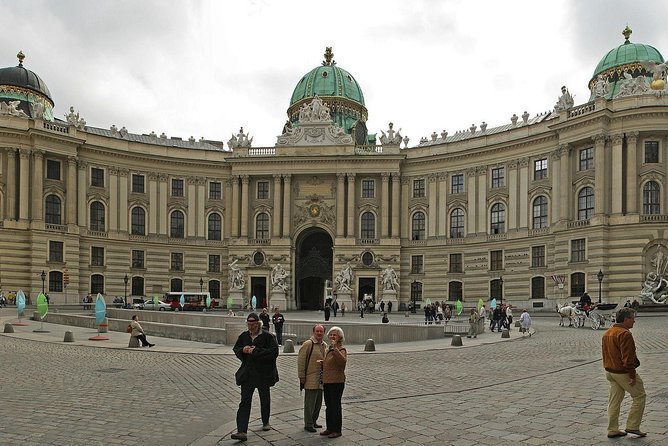
Michaelerplatz is a strong place to begin because several layers of Vienna meet in one view. The Hofburg dominates the square. It served as the Habsburg imperial palace and seat of power from the thirteenth century onward.
Your guide can use the palace to explain how Vienna grew from a medieval center into the capital of a large European empire. The value here is not just the facade. You start to understand why so much of central Vienna feels ceremonial, oversized, and carefully arranged.
Look clockwise from the Hofburg and you find a sharp contrast: the green and gray Loos House, designed by Austrian architect Adolf Loos from 1870 to 1933. Its plain appearance caused a stir beside the ornate imperial buildings. That contrast gives the tour an early lesson in Vienna’s architecture. The city is not one neat style. It is a conversation between periods.
This first stop is also useful for orientation. After the tour, you will recognize the Hofburg as more than a palace. It becomes a fixed point for finding your way around the Inner City.
Kohlmarkt and the Graben: shopping streets with older stories
From Michaelerplatz, the walk continues along Kohlmarkt and the Graben. Today, these are among Vienna’s most fashionable shopping streets, but the guide shifts your attention from window displays to the buildings and monuments around them.
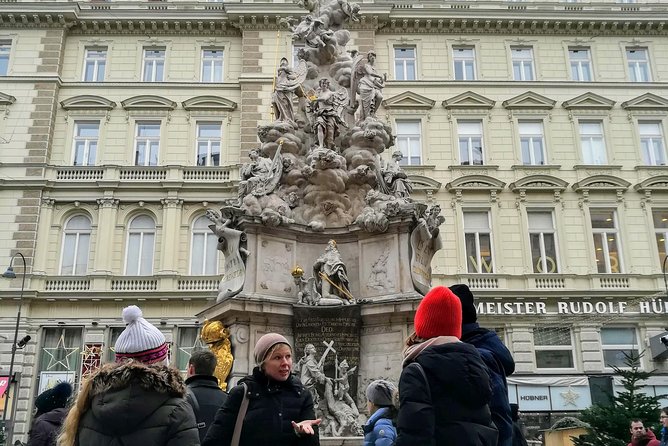
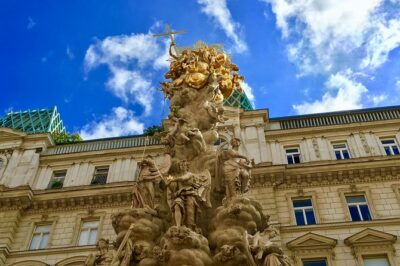
The Graben is especially good for a guided explanation. You see grand buildings in several architectural styles, a baroque church, and the Pestsäule, or plague column. The column recalls the plague that struck Vienna and reflects the religious mood of the period. It is easy to hurry past it while shopping. With a guide, the monument becomes part of the city’s social and political story.
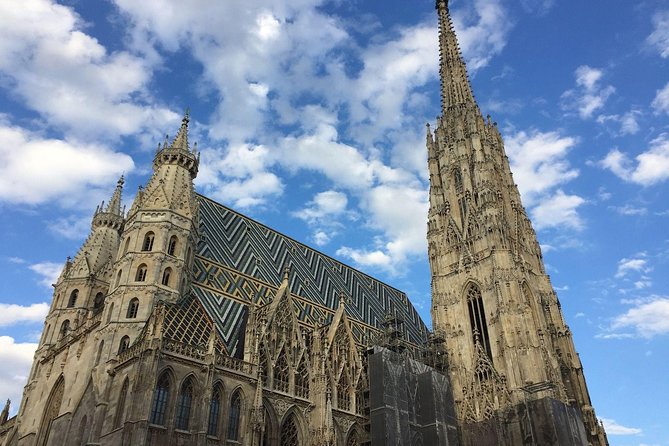
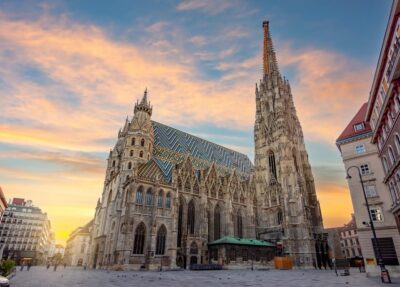
This section also leads toward St. Stephen’s Cathedral, Vienna’s national architectural icon. Its scale and importance make it one of the tour’s central reference points. The walk does not simply treat it as a postcard subject. It places the cathedral within the Habsburg system and the religious life of the city.
One practical point: the itinerary includes many major landmarks, but the supplied details do not promise interior admission to every building. If entering a particular church or museum is essential to you, ask the provider before booking.
Three churches and the Habsburgs’ unusual burial tradition

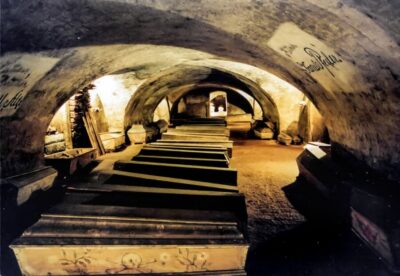
One of the most memorable parts of the route is the explanation of the Habsburgs’ tripartite burials. The imperial family did not always rest in one place with every part of the body together.
St. Stephen’s Cathedral holds the imperial entrails. The nearby Capuchin Church contains centuries of sarcophagi belonging to Vienna’s rulers. St. Augustine’s Church has silver urns holding the hearts of the Habsburgs.
It is an odd detail, but it brings the dynasty’s ceremonies down to a human scale. You are no longer hearing only about emperors, marriages, wars, and titles. You are seeing how power was expressed even in death.
For families, this can be one of the easier historical ideas to remember. The three churches provide a clear story with a strange twist, and a private guide can explain it at the level that suits your group. The subject is solemn, but it is also the kind of memorable detail that helps Vienna’s past stick.
A completely different kind of day:
- Vienna: Vivaldi’s Four Seasons Concert in Karlskirche
★ 4.7 · 14,951 reviews - Vienna: Spanish Riding School Training
★ 3.9 · 9,281 reviews - Vienna: Schönbrunn Palace & Gardens Skip-the-Line Tour
★ 4.7 · 7,739 reviews - Vienna: Light of Creation Votive Church Immersive Light Show
★ 4.8 · 6,779 reviews
Old city walls and the story of two Ottoman sieges
Along the edge of the Inner City, you examine remnants of Vienna’s old city walls. These fortifications date from the twelfth century and protected the city during Ottoman sieges in 1529 and 1683.
The two sieges matter because they shaped Vienna’s sense of danger and identity. The walls were not permanent, though. They were eventually demolished to make room for the Ringstrasse, the grand circular boulevard that became Vienna’s answer to the wide boulevards of Paris.
This is a fine example of how the tour connects events to the city you see today. A wall is not just an old piece of masonry. Its removal changed traffic, public space, architecture, and the way Vienna presented itself as a modern capital.
You also get a break from the palace-heavy center. The old walls remind you that Vienna was once a defended medieval town, not simply an imperial showpiece.
Schwarzenbergplatz and the complicated memory of war
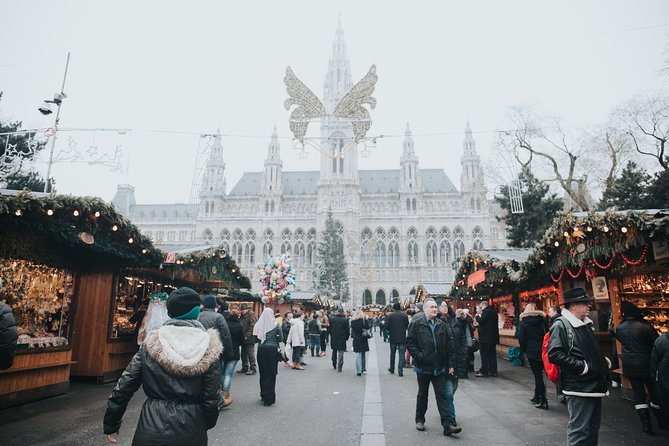
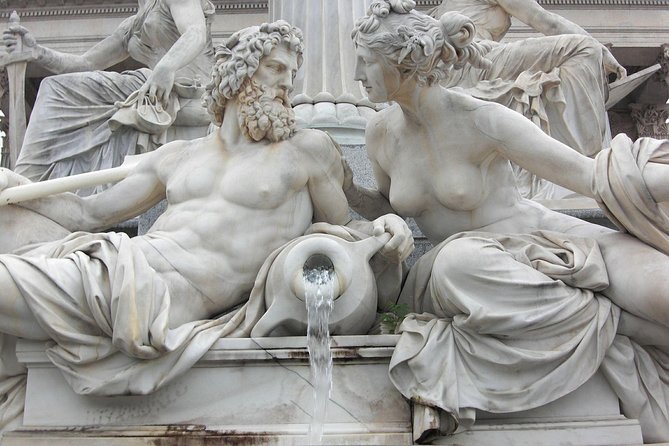
The walk continues to Schwarzenbergplatz, where a large fountain and memorial to the Russian soldiers who died liberating Vienna from the Nazis dominate the area. This is an important stop because it introduces twentieth-century history and the way Vienna remembers the end of the Second World War.
The memorial sits in an area associated with many embassies. That setting gives the stop a diplomatic and political angle, too. Your guide can help connect the monument to Austria’s changing relationship with Europe and the wider world.
This part may appeal most to adults and older children who want more than decorative architecture. It also gives the route emotional range. Vienna’s story includes imperial ceremony, religious devotion, architectural change, occupation, liberation, and modern politics.
A private format helps here because war memory can lead to questions. You can ask for context rather than receiving a quick date and moving on.
The Belvedere detour and the approach to Karlsplatz
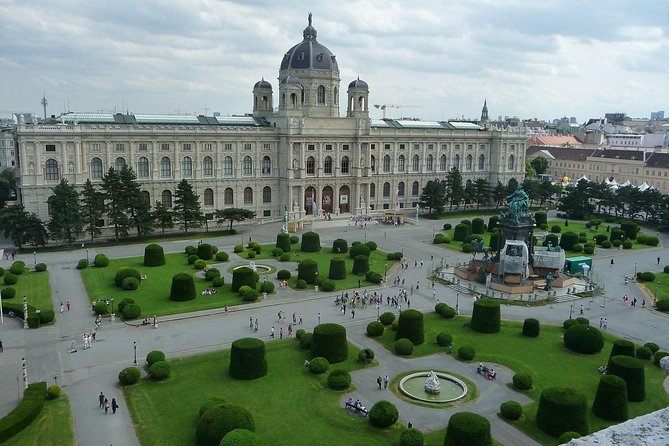
The itinerary makes a quick detour to Belvedere Palace before heading back toward Karlsplatz. The Belvedere adds another palace setting to the walk, but the broader value is comparison.
The Hofburg represents the center of Habsburg government. Belvedere helps you see the dynasty’s taste for grand residences and formal settings outside the immediate palace core. The tour does not present Vienna as one palace with a few side streets. It shows how power shaped several parts of the city.
Because this is a walking tour rather than a palace admission tour, do not expect a long visit inside the Belvedere unless that has been arranged separately. The detour is best understood as a way to place the palace in Vienna’s larger layout and architectural story.
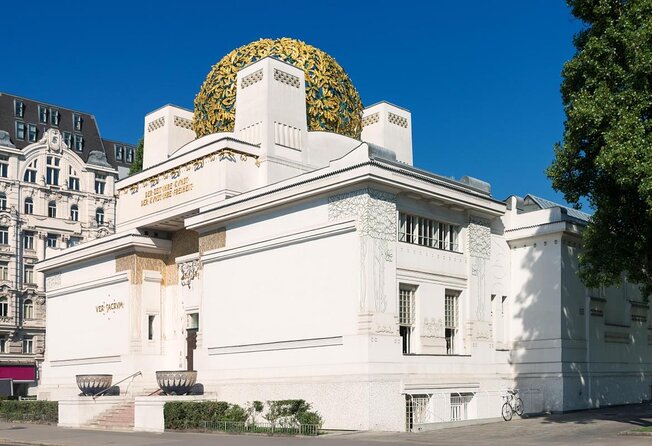
The route then moves toward Karlsplatz. This part of Vienna brings together major buildings, open views, and access to the Naschmarkt. The tour includes a view of one of the gold-domed Secession buildings and the market area, adding modern art and everyday city life to the imperial narrative.
Karlsplatz, the Secession, and Naschmarkt
The Secession building is one of Vienna’s clearest breaks from the old imperial style. Its gold dome gives it an immediate visual identity, while its role in the city’s art story helps explain Vienna’s turn toward modernism.
This is where the tour’s architecture theme becomes especially useful. Earlier, the Loos House showed a challenge to ornament near the Hofburg. At Karlsplatz, the Secession offers another example of artists and architects pushing against established taste.
Naschmarkt brings a more ordinary side of Vienna into the route. The tour does not include food and drinks, but the market’s presence helps you think about the city as a place where residents shop, eat, and move through daily routines. If you want to linger over food, save that for after the three-hour walk.
I like this balance. You get grand buildings, but you are not trapped in a royal bubble. Vienna’s public life comes back into view.
Museums Quartier and Maria Theresien Platz
The final section passes through the Museums Quartier and Maria Theresien Platz, an area with Vienna’s largest concentration of museums. Here, the guide turns toward the capital’s current cultural, political, and economic direction.
That closing discussion matters. A city tour can easily stop in the past, especially in Vienna. This one tries to explain how the city functions now, after centuries of imperial rule and the upheavals of the twentieth century.
Maria Theresien Platz also provides a satisfying visual end to the route. After seeing the Hofburg, churches, fortifications, palaces, and memorials, you finish among major cultural institutions. The city’s identity comes into focus as something still developing, not a museum display frozen in the Habsburg era.
The endpoint is listed simply as Vienna rather than one precise final address. Confirm the exact ending point with your guide if you have a reservation, onward transport, or a timed booking.
What the private format is worth at $566.25
The listed cost is $566.25 per group of up to 10 people. That works out to about $56.63 per person if you fill all 10 places, or about $141.56 each for a group of four. For two people, the same tour costs about $283.13 per person.
That price makes the most sense for a family or group of friends. You are paying for a dedicated historian guide, not only for a standard route. The guide can focus on your interests, answer questions, and keep the pace comfortable for your party.
For a couple, the price is much harder to justify unless personal attention is a top priority. You could also find value in the tour if this is your first time in Vienna and you want a strong mental map before exploring on your own.
The 70-day advance booking average suggests that planning early is wise, especially for a specific date or a popular guide. The tour has a five-star rating from 25 ratings, with 100 percent recommending it. That is encouraging, though the sample is not large enough to remove every uncertainty.
Food and drinks are not included. The price also should not be treated as a package covering every interior visit, since only the three-hour private guided walk is specifically included.
Who will enjoy this walk most
I would choose this tour for a family arriving in Vienna, a small group sharing the cost, or anyone who wants context before visiting museums independently. It also suits people who prefer conversation and questions over a large group with a fixed script.
The route works well for mixed ages. Biljana was praised for engaging young adults, while Selin was credited with building a customized experience for a family. Katarina helped one family begin its first morning in Vienna, and Else was praised for combining history, religious sites, and culture without rushing.
You should be comfortable walking for about three hours. The itinerary covers a wide area, and the historic center includes busy shopping streets, large squares, and several changes in subject. If you want a slow look inside one palace or cathedral, book a dedicated interior visit instead.
Pickup is offered, but it must be arranged. Without hotel pickup, meet at Cafe Hawelka 15 minutes before the start time. Confirmation arrives when you book, and most people can participate.
Free cancellation is available if you cancel at least 24 hours before the local start time. Cancellations or changes made less than 24 hours ahead are not refunded or accepted.
Should you book the Private Introduction to Vienna Walking Tour?
Book it if you want a personal city orientation, especially on your first full day, and if your group can share the cost. The route gives you a useful sweep of Vienna, from Habsburg power and unusual royal burials to Ottoman sieges, modern architecture, museums, and present-day Austria.
Skip it if you mainly want long visits inside the Hofburg, Belvedere, or churches. This experience is about connections and conversation across the city, not an admission-heavy schedule.
For a group of six to 10, the price becomes easier to defend. For two people, compare the cost with your interest in having a dedicated guide. If that personal attention matters, the tour offers a smart, efficient introduction to Vienna. If not, use the route as a map for your own walking day and spend the money on individual entries or meals.
FAQ
How long is the Private Introduction to Vienna Walking Tour?
The walk lasts approximately three hours.
Where does the tour begin?
Unless hotel pickup has been arranged, meet your guide 15 minutes before the start at Cafe Hawelka, Dorotheergasse 6, 1010 Vienna, Austria.
Is hotel pickup available?
Yes. Pickup is offered, but it must be arranged. The default meeting point is Cafe Hawelka.
How many people can join the private tour?
The price covers one private group of up to 10 people. Only your group participates.
Is the tour offered in English?
Yes. The experience is offered in English.
Are food and drinks included?
No. Food and drinks are not included unless specifically stated.
Just added in Vienna
- Vienna: Austrian Wine Tasting Experience★ 4.2 · 2 reviews
- World War II History Vienna Old Town Private Walking Tour★ 4.8 · 9 reviews
- Vienna_ Meet Beethoven Life Private Guided Walking Tour★ 5.0 · 1 review
- Vienna: Wine Tasting Tour★ 4.8 · 61 reviews
- Vienna: Wine Tasting E-Bike Tour★ 4.9 · 46 reviews
- Vienna: Wine Tasting at Schönbrunn Palace★ 4.3 · 71 reviews
- Vienna: Winery and Wine Tasting Tour with a Wine Expert★ 5.0 · 5 reviews
- Vienna: Concert by the Vienna Baroque Orchestra★ 4.6 · 56 reviews
Walking Tours, compared.
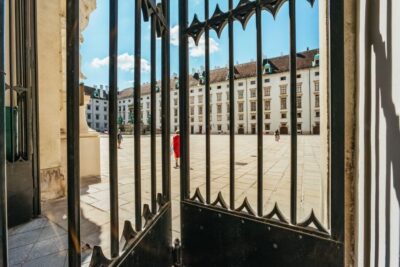
Guided Walking Tour of City Center Highlights
Read our review →
Guided Walking Tour of City Highlights & Hidden Gems
Read our review →
Vienna Historic Center Small Group Walking Tour
Read our review →
Browse the lists this tour appears in