
Reviewed · HISTORICAL TOURS
Historical Hitler Walking Tour of Vienna
History can feel uncomfortably close in Vienna. This 2.5-hour walk connects Hitler’s early years, Austria’s Nazi past, wartime destruction, and the city’s Jewish heritage through places you could otherwise pass without a second thought. I like the route’s focus on real streets and memorials, and I like that guides such as Dieter, Wolfgang, Stephan, Charles, and Siggy add context rather than simply reciting dates. The main drawback is the title: this is not a tour devoted only to Hitler, and some people may find the broad political and social history less focused than expected.
At $32.65 per person, the experience offers solid value if you want a serious historical introduction with a local guide. You will walk at a moderate pace through central Vienna, so comfortable shoes matter. Winter can be especially tough, although guides have sometimes added indoor pauses to help the group warm up.
In This Review
- Key points to know before booking
- Starting at the Albertina and Vienna State Opera
- Facing the Memorial Against War and Fascism
- Hitler’s rejected application to Vienna’s art school
- Heldenplatz and the March 15, 1938 speech
- Judenplatz and the Austrian Jewish victims of the Shoah
- Morzinplatz and the former Gestapo headquarters
- The hidden Stadttempel synagogue
- What the walking pace and group size feel like
- The guides are the main value
- Is $32.65 good value?
- Who should book this Vienna history walk?
- Practical details before you go
- Should you book it?
- FAQ
- Where does the Historical Hitler Walking Tour of Vienna start?
- What time does the tour begin?
- How long does the tour last?
- Where does the tour finish?
- What language is the tour offered in?
- Is admission to the listed attractions included?
- What should I bring?
Key points to know before booking
- Hitler’s Vienna is only part of the story: The tour places his early life within Vienna’s political, artistic, religious, and social setting.
- The route covers six major stops: You visit the State Opera, the Memorial Against War and Fascism, the rejected art school, Heldenplatz, Judenplatz, Morzinplatz, and the Stadttempel area.
- Expect serious historical storytelling: The most praised guides, including Dieter, Wolfgang, and Stephan, explain causes and consequences instead of offering a quick sightseeing loop.
- The walk ends near dinner and public transport: Schwedenplatz has U1 and U4 access, along with many restaurants.
- The weather affects comfort: Bring water, sun protection, and rain gear. The tour requires suitable weather and can be canceled if conditions are poor.
- Groups can reach 25 people: The size is manageable, but you should stay close to the guide, especially at the busy meeting point near the Albertina.
Starting at the Albertina and Vienna State Opera
The tour begins at Albertinaplatz, outside the Albertina Museum, at 2:30 pm. This is a busy central location, so allow time to identify the meeting point and your guide. A practical tip comes directly from an unfortunate experience on this route: stay close when the group begins walking, and make sure you can see the guide before moving away from the starting area.
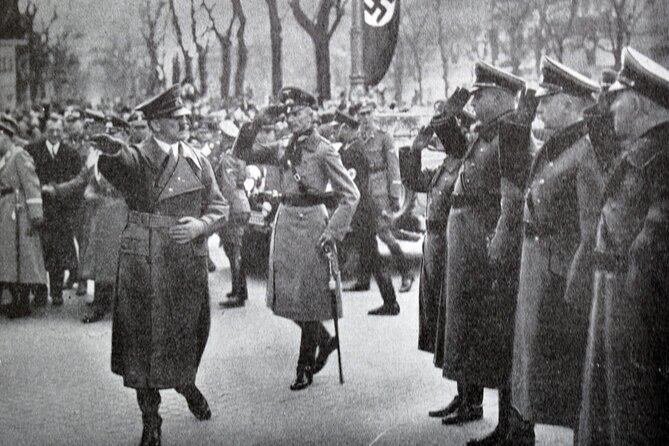
The first major stop is the Vienna State Opera. Opened in 1869 with Mozart’s Don Juan in the presence of Emperor Franz Joseph and Empress Elisabeth, the opera house represents Vienna’s high cultural life. The Nazi period brought a brutal change. After the 1938 annexation of Austria, Hitler visited the opera house, while artists and staff were dismissed, persecuted, or murdered. Some works were banned from performance.
I like beginning here because it shows that Nazi rule was not only a military or political matter. It reached into music, theater, employment, public taste, and the identity Vienna built around the arts. The stop lasts about 10 minutes and admission is not required. You view the site from outside, then continue on foot.
More Walking Tours in Vienna
- Vienna: Guided Walking Tour of City Center Highlights
★ 4.7 · 4,989 reviews - Vienna: Vienna Central Cemetery Guided Walking Tour
★ 4.8 · 3,307 reviews - Vienna: Guided Walking Tour of City Highlights & Hidden Gems
★ 4.9 · 2,180 reviews
Facing the Memorial Against War and Fascism
At Albertinaplatz, the Memorial Against War and Fascism offers one of the tour’s most direct encounters with Austria’s difficult past. Created by sculptor Alfred Hrdlicka, the memorial has been here since 1988 and is dedicated to victims of war and fascism.
This is not a polished imperial monument. Its force comes from its harsh, unsettling forms. Your guide explains how the memorial confronts both the violence of war and the political system that enabled persecution. The timing matters: Austria spent years presenting itself mainly as a victim of Nazi Germany, while the country also had many enthusiastic supporters of National Socialism. The tour helps you understand that tension.
The stop takes around 10 minutes. It is outdoors, with no admission charge, so your comfort depends on the weather. On cold days, gloves and a warm coat are not optional luxuries.
Hitler’s rejected application to Vienna’s art school
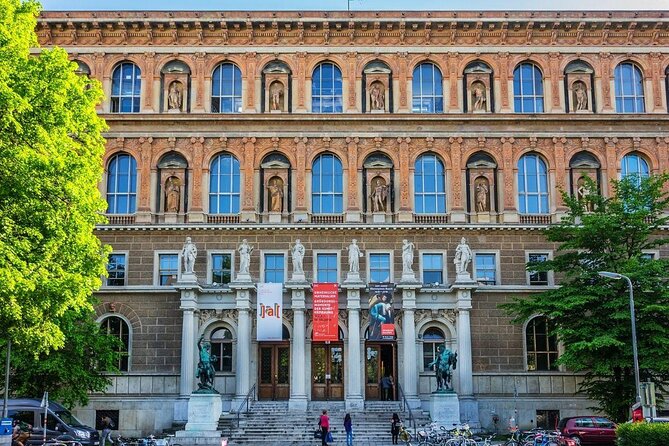
The Akademie der bildenden Künste is one of the most recognizable Hitler-related sites on the route. Hitler applied to the Vienna Academy of Fine Arts and was not accepted. That fact is often treated as a neat explanation for his later path, but a good guide will help you avoid turning it into a simple, convenient legend.
The stop is useful because it introduces Hitler before his political career. You hear about his early years in Vienna and the setting in which his ideas developed. The tour draws on the historical connection between Hitler and Vienna, while also showing why one rejection from an art school cannot explain the rise of a dictator by itself.
The discussion is brief, about 10 minutes, and the building is viewed as part of the walking route. This is one place where expectations matter. If you want a tour devoted to every detail of Hitler’s biography, you may find the stop too short. If you want a responsible introduction to his Vienna years, it fits the larger route well.
Heldenplatz and the March 15, 1938 speech
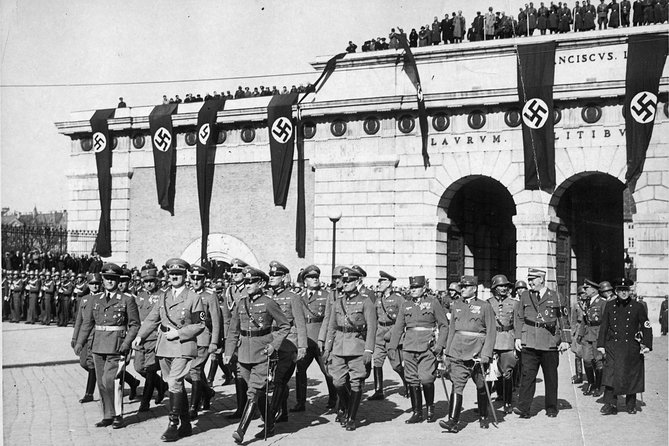
At Heldenplatz, the scale of Nazi spectacle becomes easier to grasp. On March 15, 1938, Hitler addressed a huge crowd from the balcony of the Neue Hofburg after Germany annexed Austria. The speech became a symbol of the Nazi seizure of power and the public approval that accompanied it.
Your guide places the event within Vienna’s physical setting. This is important because Heldenplatz is also one of the city’s grandest ceremonial spaces. Imperial architecture, national pride, and mass political theater meet here. You can look across the square and understand why the location carried such emotional weight.
I find this stop especially valuable for readers who know the broad outline of the Anschluss but want a better sense of how it appeared in Vienna itself. The guide may also discuss the later Austrian discomfort surrounding Heldenplatz and the way the event remained a national trauma.
Again, plan on about 10 minutes. The tour does not enter the palace as part of this stop, and the historical value comes from the explanation and the setting.
More History Tours in Vienna:
- Vienna: Time Travel and Magic Vienna History Tour
★ 4.6 · 3,879 reviews - Vienna: World War II Historical Walking Tour
★ 4.8 · 1,772 reviews - Vienna Historic Center Small Group Walking Tour
★ 5.0 · 1,746 reviews - Time Travel-Magic Vienna History Tour Ticket
★ 4.5 · 1,099 reviews
Judenplatz and the Austrian Jewish victims of the Shoah
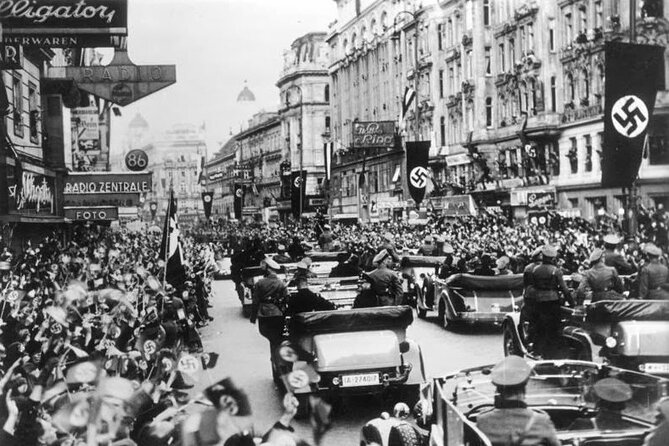
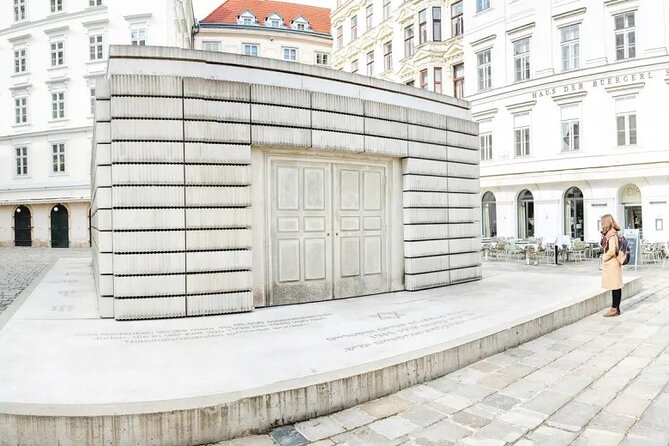
Judenplatz changes the mood of the walk. The Holocaust Memorial for Austria’s Jewish victims remembers more than 65,000 Austrian Jews murdered by the National Socialists between 1938 and 1945.
The memorial’s design resembles a sealed library, with rows of books facing outward. The titles cannot be read, and the doors cannot be opened. That image gives the site a quiet, heavy quality. It is not simply a marker with names and dates. It asks you to think about lives, families, and knowledge that were cut off.
The guide also explains Vienna’s Jewish population and the growth of antisemitism. This broader context is one of the strongest parts of the walk. You are not shown persecution as a sudden event that began with deportations. You learn how prejudice developed, how it became accepted in public life, and how ordinary institutions helped create the conditions for mass murder.
The stop lasts around 10 minutes and is free to visit. Please treat it as a place for reflection rather than a photo opportunity. The subject is painful, and the guide’s tone matters. The strongest sessions have been praised for being balanced, careful, and direct.
Morzinplatz and the former Gestapo headquarters
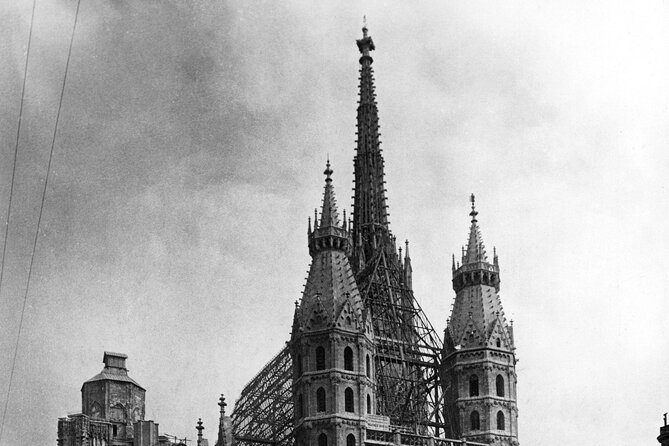
At Morzinplatz, the tour reaches the site of the former Hotel Metropole. Once a luxury hotel, it became one of the Third Reich’s most brutal Gestapo headquarters in Vienna.
The memorial here helps you grasp the machinery of repression. The story shifts from public speeches and political symbolism to interrogation, imprisonment, and terror. This contrast gives the tour its shape. You move from places associated with culture and mass approval to sites connected with victims and state violence.
The exact building no longer functions as the wartime Gestapo headquarters, so the historical explanation is essential. Without a guide, you could easily cross the square without realizing what happened there. The 10-minute stop is short, but it connects the city’s attractive center with the fear that operated behind its grand facades.
The hidden Stadttempel synagogue
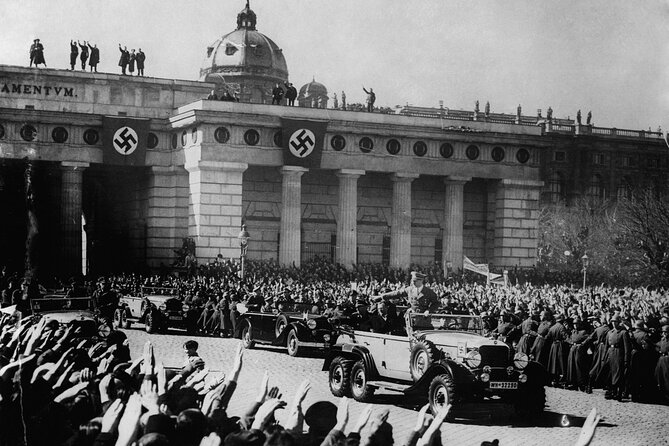
Near the end of the walk, the route explores Jewish Vienna and the Stadttempel, Vienna’s main synagogue on Seitenstettengasse. The synagogue is hidden behind a five-story apartment building rather than facing the street openly.
The reason is rooted in historic regulations. Non-Catholic houses of worship had to be concealed and could not be visible from the street. The building at the entrance carries the inscription, Come to his gates with thanksgiving, to his courts with praise.
This detail is easy to miss, yet it says a great deal about the legal and religious limits Jewish residents faced long before the Nazi era. The guide explains how the synagogue’s design reflects those restrictions. You do not simply look at a handsome building. You see how architecture recorded discrimination.
The tour does not promise entry into the synagogue. It ends nearby at Schwedenplatz, a practical finish after an intense walk. You are only a few minutes from U1 and U4 stations, and the area has many restaurants for dinner.
What the walking pace and group size feel like
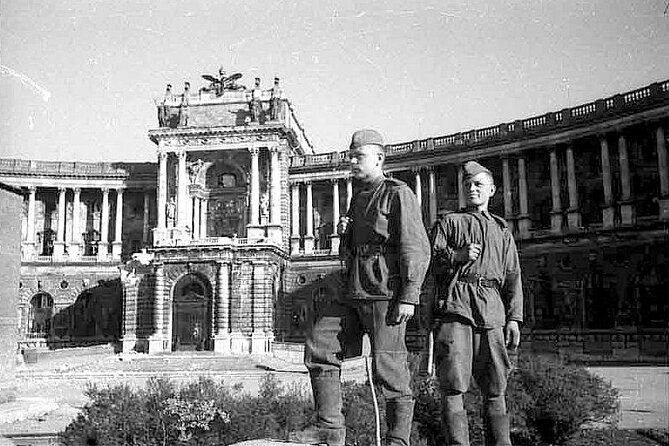
The tour lasts approximately two and a half hours and includes several stops of about 10 minutes each. Much of the value comes between the official stops, when the guide links one location to the next. You should expect continuous walking through central Vienna rather than a series of long indoor presentations.
The activity calls for moderate physical fitness. The route is not described as strenuous, but standing and walking for 150 minutes can be tiring, especially in poor weather. Wear comfortable shoes and bring water. In summer, use sun protection. In winter, pack a raincoat or umbrella and dress warmly.
The group may include up to 25 people. That is not a tiny private walk, but it is still small enough for a guide to manage a discussion. Use care at the start. One person reported being left behind when the group moved too quickly from the meeting point. The operator apologized and noted that guides are instructed to keep everyone together, but I would still take responsibility for staying visible and confirming the guide’s identity before setting off.
Some guides use visual aids. Stephan has used an iPad with maps and photographs, which can help you compare past and present views. That kind of material is useful here because so much of the tour concerns buildings, crowds, and events that no longer look the same.
The guides are the main value
The route is worthwhile, but the guide determines how much you take away. Dieter is repeatedly praised for clear English, careful organization, a relaxed pace, and personal attention to the group. Wolfgang is described as warm, thoughtful, and especially strong at connecting Vienna’s past with its present. Stephan has been praised for detailed explanations and visual material.
Other named guides include Charles, Siggy, and a female guide whose name is not provided. The strongest descriptions share a pattern: the guides answer questions, keep the group together, explain difficult subjects honestly, and add political and social context.
That matters because Hitler tours can easily become sensational. This one works best when it treats Hitler as part of a wider story about antisemitism, nationalism, art, public institutions, and Austrian responsibility. The tour is also not a standard World War II walk. It covers the connection between Hitler and Vienna, but its reach includes the period before the war and the city’s reaction to Nazi rule.
One criticism is fair: the title may suggest a closer, more exclusive focus on Hitler than the experience delivers. The operator explains that the route is inspired by Brigitte Hamann’s book Hitler’s Vienna and examines the social setting of Vienna at the turn of the 20th century. Read the stops carefully before booking, and you will have a more accurate idea of the content.
Is $32.65 good value?
At $32.65, you are paying mainly for the guide’s preparation and interpretation. The sites themselves are public memorials and exterior locations, so the price does not cover major entrance tickets, food, or transport. That is not a weakness for this kind of experience. The point is to connect places that would otherwise feel scattered.
I consider the price fair for a 2.5-hour English-language walk, especially if you are interested in modern European history. The value rises when the guide uses images, answers questions, and gives the city’s Jewish history the attention it deserves. It falls if you want interior access, a small private group, or a fast overview with many sightseeing stops.
The tour has a 4.8 rating from 887 ratings, and 96 percent of people recommend it. Those numbers suggest a dependable experience, but the content still requires the right expectations. This is a serious, outdoor history walk, not light entertainment.
Who should book this Vienna history walk?
I would choose this tour if you enjoy history, museums, memorials, and difficult questions about how societies change. It suits visitors who want to understand Austria’s role in the Nazi period rather than hear only a simplified story about Hitler.
You should also consider it if you have already seen Vienna’s imperial highlights and want another way to read the city. The route passes through beautiful central areas, but the focus remains on memory and politics.
I would think twice if you dislike long walks, cold weather, or emotionally heavy subjects. Families with older teenagers may find it worthwhile, but the mature themes require attention. It is also not the best choice if you expect a full biography of Hitler or a dedicated World War II battlefield-style tour.
Practical details before you go
The tour is offered in English and includes a mobile ticket plus a licensed guide. Hotel pickup and drop-off are not included, and food and drinks are your responsibility. Service animals are allowed, and the starting and ending points are close to public transportation.
Free cancellation is available if you cancel at least 24 hours before the 2:30 pm start time. Changes made within 24 hours are not accepted for a refund. Since the walk requires suitable weather and a minimum number of people, the operator may cancel and offer another date, another experience, or a full refund.
Should you book it?
Book this walk if you want a thoughtful explanation of Hitler’s connection to Vienna, the rise of antisemitism, Austria’s Nazi past, and the destruction suffered by the city’s Jewish population. The best guides, especially Dieter, Wolfgang, and Stephan, turn a difficult subject into a clear and memorable lesson.
Skip it if the title alone attracts you and you want nonstop Hitler biography. For the right audience, $32.65 buys more than a stroll past monuments. It gives you a framework for seeing Vienna’s opera houses, squares, memorials, and synagogue with sharper eyes.
FAQ
Where does the Historical Hitler Walking Tour of Vienna start?
The tour starts outside the Albertina Museum at Albertinaplatz, 1010 Vienna.
What time does the tour begin?
The scheduled start time is 2:30 pm.
How long does the tour last?
The walk lasts approximately 2 hours and 30 minutes.
Where does the tour finish?
The tour ends at Schwedenplatz, a short walk from U1 and U4 stations and several restaurants.
What language is the tour offered in?
The tour is offered in English.
Is admission to the listed attractions included?
The listed stops are visited without admission tickets. Hotel pickup, food, drinks, and guide gratuities are not included.
What should I bring?
Wear comfortable shoes and clothes. Bring water, sunblock, and a raincoat or umbrella because Vienna’s weather can change. Dress warmly in cold weather, since much of the experience takes place outdoors.
Just added in Vienna
- Vienna: Austrian Wine Tasting Experience★ 4.2 · 2 reviews
- World War II History Vienna Old Town Private Walking Tour★ 4.8 · 9 reviews
- Vienna_ Meet Beethoven Life Private Guided Walking Tour★ 5.0 · 1 review
- Vienna: Wine Tasting Tour★ 4.8 · 61 reviews
- Vienna: Wine Tasting E-Bike Tour★ 4.9 · 46 reviews
- Vienna: Wine Tasting at Schönbrunn Palace★ 4.3 · 71 reviews
- Vienna: Winery and Wine Tasting Tour with a Wine Expert★ 5.0 · 5 reviews
- Vienna: Concert by the Vienna Baroque Orchestra★ 4.6 · 56 reviews
Historical Tours, compared.
Vienna Historic Center Small Group Walking Tour
Read our review →
Skip-the-Line Schonbrunn Palace Guided Tour and Vienna Historical City Tour
Read our review →
Vienna Mozart Concert in Historical Costumes at the Musikverein
Read our review →
Browse the lists this tour appears in