Reviewed · TOURS
Vienna: ‘Armenia In The Heart Of Austria’ Tour
Vienna keeps an Armenian secret in plain sight. This two-hour visit to the Mekhitarist Monastery brings together a beautiful church, rare books, Armenian art, and a liqueur tasting in one compact experience. I like the unusual focus on Armenia’s place in Vienna, and I like that a learned monk leads you through spaces you would not understand as well on your own.
The small group, limited to 10 people, should make it easier to ask questions and follow the story. The main consideration is the narrow subject: if you want Vienna’s grand palaces and famous museums, this is not that tour. It is a focused visit for curious people who enjoy art, religion, books, and the less obvious chapters of a city.
In This Review
- Key points at a glance
- Why this small Armenian corner matters
- Beginning at the Mekhitarist Monastery
- Maria Schutz Church and its 1874 interior
- The Loretto-Chapel and Mary with the Rose
- The refectory and a dramatic biblical painting
- Inside a library of 2,800 Armenian manuscripts
- Museum objects, coins, carpets, and Armenian paintings
- Finishing with Mechitharine liqueur
- Is $84 a fair price for two hours?
- Who should book this Vienna experience?
- Should you book the Armenia in the Heart of Austria tour?
- FAQ
- Where does the tour meet?
- How long does the tour last?
- What languages are available?
- How large is the group?
- What is included in the price?
- Can I cancel the booking?
Key points at a glance

- Small Armenia in Vienna: Learn how the Mekhitarist Congregation preserved Armenian culture, faith, language, and scholarship in Austria.
- Maria Schutz Church: See a church built in 1874, with major works connected to Camillo Sitte and Theophil von Hansen.
- Rare Armenian collections: View part of a library holding more than 2,800 Armenian manuscripts and over 170,000 Armenian publications.
- Art and objects: Look for paintings by Armenian artists, including three works by Ivan Aivazovsky, along with coins, ceramics, and carpets.
- A story of survival: Visit the Loretto-Chapel and its baroque image, Mary with the Rose, saved during the 1683 siege of Vienna.
- Mechitharine tasting: Finish with the monastery’s distinctive liqueur and an explanation of its history and production.
Why this small Armenian corner matters
Vienna is often presented through imperial palaces, grand concert halls, and coffeehouses. Those places deserve their fame, but the city also rewards you for following smaller cultural threads. The Mekhitarist community offers one of those threads, linking Armenia with Austria through religion, education, art, and publishing.
The tour opens with the story of the Mekhitarist Congregation in Vienna. That introduction gives the rest of the visit a clear purpose. You are not simply moving from one attractive room to another. You are learning how a religious community helped preserve Armenian identity far from Armenia.
I especially like the way this setting connects faith and scholarship. The monastery is not only a place of worship. Its library, museum, artworks, manuscripts, and historical objects show how cultural memory can be protected through books and careful collecting.
The visit is also personal in tone. The guide is a learned monk, and the available languages are Armenian, English, and German. Father Vahan is specifically praised for his warm welcome and generous explanations. One touching moment shared about his approach is his comment to a German-Armenian couple that the Armenian people had gained another Armenian. That gives you a sense of the open, welcoming spirit behind the tour.
A few more options to weigh up in Vienna
- Vienna: Vivaldi’s Four Seasons Concert in Karlskirche
★ 4.7 · 14,951 reviews - Vienna: Spanish Riding School Training
★ 3.9 · 9,281 reviews - Vienna: Schönbrunn Palace & Gardens Skip-the-Line Tour
★ 4.7 · 7,739 reviews
Beginning at the Mekhitarist Monastery
You meet in front of the main entrance of the Mekhitarist Monastery. Since the experience lasts only two hours, arrive ready to begin on time. The meeting point is simple, but you should confirm the exact starting hour when booking because several departure times may be available.
The group size is a real advantage here. With no more than 10 participants, the visit should feel far more personal than a large sightseeing tour. You can ask about Armenian customs, Vienna’s Armenian community, the objects in the museum, or the religious artwork without trying to catch a guide’s attention from the back of a crowd.
The opening explanation about the Mekhitarists is important, so do not treat it as a quick preamble. It supplies the names, dates, and religious background needed to understand the church and collections that follow. Without that context, the monastery might seem like a pleasant but obscure building. With it, the rooms become part of a larger story about preservation and identity.
Maria Schutz Church and its 1874 interior
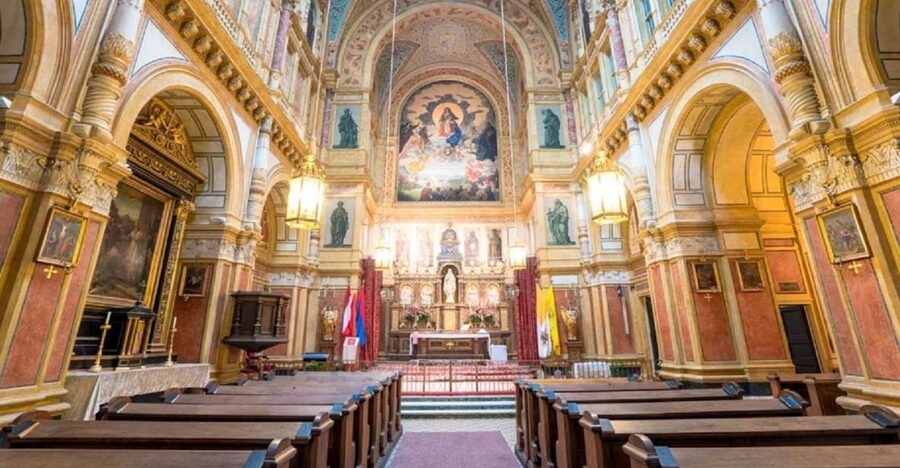
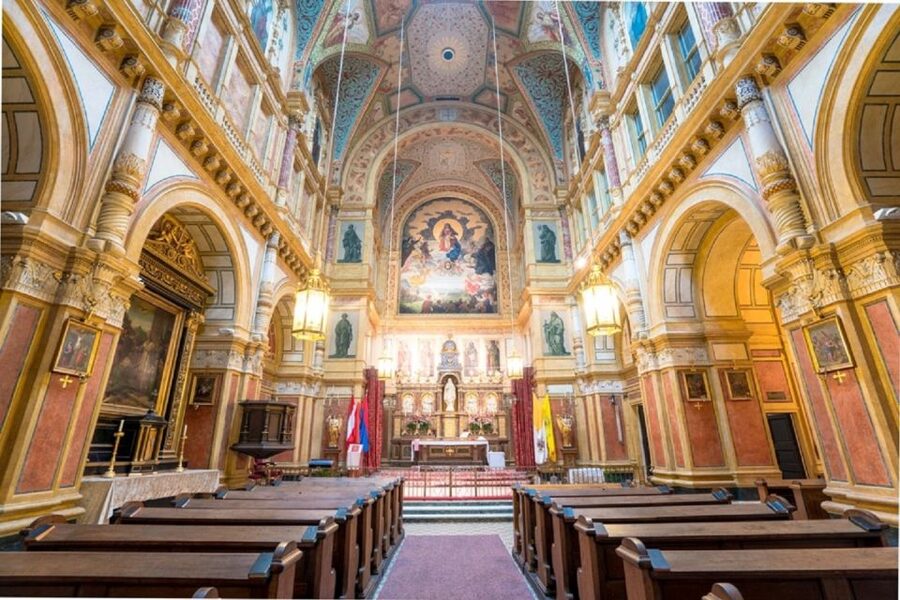
The first major stop is Maria Schutz Church. The present church was built in 1874, replacing an older Capuchin church. That change gives the building a useful place in Vienna’s religious history, while its Armenian connection gives the interior a character different from the city’s better-known churches.
Take time to look upward and around rather than rushing toward the altar. The tour is designed to point out details that can easily slip past you during an independent visit. The guide explains the church’s artworks and their connection to Armenian devotion.
One key work is the altar painting showing the protection of Armenia by the Virgin Mary. It was painted by Camillo Sitte, a name especially familiar to people interested in Vienna’s architecture and urban design. Here, his work appears in a religious and Armenian setting rather than in the civic context you might expect.
Another important feature is the altar dedicated to St Gregory the Illuminator. The design is connected with Theophil von Hansen, the architect of Vienna’s Austrian Houses of Parliament. That link gives you a striking reminder that the monastery is tied to the wider artistic and architectural world of nineteenth-century Vienna.
I like this part of the visit because it rewards close looking. You are not merely told that the church is beautiful. You are given particular people, subjects, and connections to notice. If religious art is not usually your main interest, the architectural names and Vienna connections still give you a way into the story.
The Loretto-Chapel and Mary with the Rose
The tour continues into the Loretto-Chapel, which holds the baroque miraculous image Mary with the Rose. Its importance is not only artistic. The image was rescued intact during the Turkish siege of Vienna in 1683.
That detail gives the chapel emotional weight. The object survived a dangerous moment in Vienna’s past and remains part of the monastery’s living religious setting. You can appreciate the image as art, but the guide’s explanation also shows why it matters to the community.
This is one of the places where a guided visit is more useful than a quick look around. A small chapel can be easy to pass through without understanding its significance. The story of the image’s survival makes the stop memorable and connects the monastery to one of Vienna’s defining historical events.
The subject is religious, so the tone may feel more reflective than a standard city attraction. That will suit you if you enjoy places with an active spiritual purpose. If you prefer only secular museums, this section may feel less immediately engaging, though the 1683 story gives it wider historical interest.
A completely different kind of day:
- Vienna: Light of Creation Votive Church Immersive Light Show
★ 4.8 · 6,779 reviews - Vienna Spanish Riding School Guided Tour
★ 4.7 · 6,765 reviews - Vienna: Classical Concert in the World-Famous Musikverein
★ 4.6 · 6,673 reviews - Vienna: Skip-the-Line Sisi Museum, Hofburg and Gardens Tour
★ 4.8 · 5,918 reviews
The refectory and a dramatic biblical painting
Next comes the refectory, the monastery’s dining room. Its most impressive feature is a monumental painting by Ludwig Ferdinand Schnorr von Carolsfeld depicting The Feeding of the Five Thousand.
The setting matters here. You are seeing a work intended for a communal religious space, not simply a picture placed in a gallery. The large scale and biblical subject would have shaped the atmosphere of the room for generations of monks.
The guide can help you read the painting as part of the building’s daily life. Look at how the artwork relates to the room itself, rather than treating it as an isolated canvas. This is a short stop, but it adds another layer to the visit: the monastery was a working community with spaces for worship, study, and meals.
The refectory also breaks up the visit to the church and collections. After several religious artworks, the change of room helps you picture how the monastery functioned. You are moving through a real community space, not just a sequence of display rooms.
Inside a library of 2,800 Armenian manuscripts
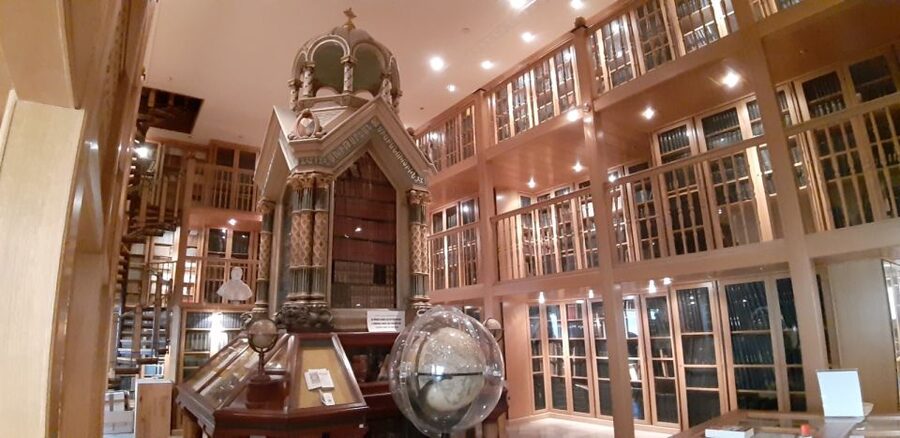
The Mekhitarist Library is likely the strongest reason to choose this experience. The collection includes more than 2,800 Armenian manuscripts and over 170,000 volumes of ancient and modern Armenian publications. It also holds the largest collection of Armenian newspapers and magazines in the Western world.
Those numbers are impressive, but the value is not only in the scale. The collection shows how language and memory survive through careful work. Armenian publications can be difficult to encounter outside Armenian cultural institutions, so this library gives you a rare view into a long tradition of writing, printing, scholarship, and communication.
The guide explains the special features of the library and museum rather than leaving you to guess at the meaning of what you see. You should expect the emphasis to be on cultural and intellectual importance, not on browsing shelves like a public library. The tour gives you an introduction to the collection, not unrestricted research access.
For anyone interested in manuscripts, minority languages, religious orders, or the history of publishing, this section offers excellent value. It is also a good choice if you want to understand Vienna as a meeting place for communities from beyond Austria’s borders.
The scale of the collection may be hard to absorb in a short visit. Two hours must cover the church, chapel, refectory, museum, library, and tasting. You will receive a guided overview rather than a long, quiet study of individual manuscripts. That is a reasonable tradeoff for a compact tour, but book a longer specialist visit elsewhere if you want detailed examination of rare books.
Museum objects, coins, carpets, and Armenian paintings
The museum adds visual variety after the church and library. The collection includes ceramics, carpets, coins, and other objects, mainly of Armenian production. The numismatic section includes 10,000 Armenian coins and another 20,000 coins from other countries.
Coins can seem like a narrow subject until you see how they trace political changes, trade, rulers, and national identity. Here, the size of the collection gives the guide plenty to explain. The non-Armenian coins also help place Armenia within a wider network of cultures and countries.
The ceramics and carpets bring a more domestic and decorative side to the visit. They show that Armenian culture is not confined to manuscripts and religious buildings. Everyday objects can preserve patterns, techniques, materials, and local traditions just as strongly as written records.
The gallery contains paintings by Armenian artists, including three works by Ivan Aivazovsky. Aivazovsky is especially known for his seascapes, so seeing several of his paintings in this setting adds a strong artistic reason to visit. You do not need to be an Armenian art specialist to appreciate the gallery. The guide’s explanations help place the works within the broader collection.
I would give the museum enough attention rather than treating it as a corridor before the tasting. The combination of paintings, coins, textiles, and ceramics is one of the tour’s best features because it gives you several ways to connect with Armenian culture.
Finishing with Mechitharine liqueur
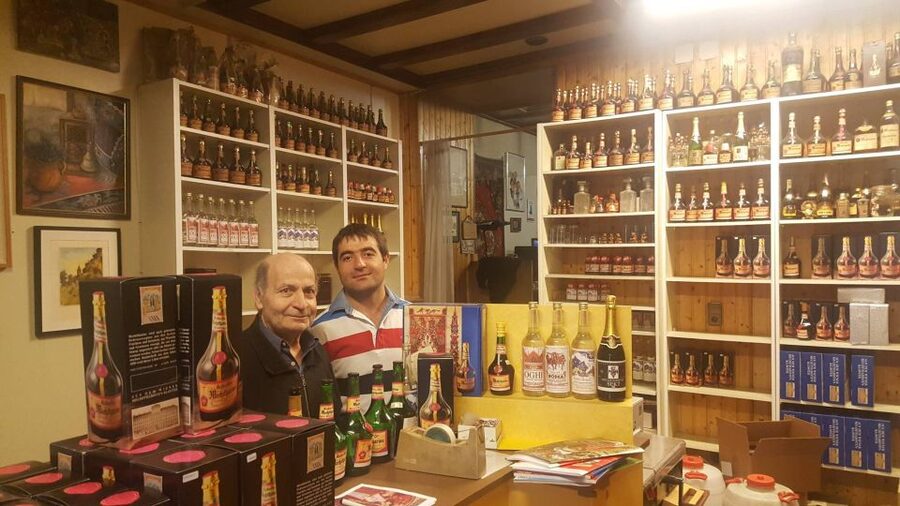
The tour ends with a tasting of high-quality Mechitharine liqueur. This is more than a final drink added for atmosphere. You learn about its taste, history, families, and business, including some of the secrets behind the liqueur tradition.
The tasting gives the visit a relaxed finish after the concentration required by the church and museum. It also connects the monastery to a practical product with an economic and family story. That makes the ending feel tied to the institution rather than tacked on.
If you do not drink alcohol, the tasting may be less important to you, but the explanation remains part of the experience. The supplied details do not specify alternative beverages, so you should check with the provider if that matters.
For many people, this final stop will be the most social part of the tour. It gives you time to ask follow-up questions and reflect on the collection. It also helps the visit feel complete: you have seen the spiritual side of the monastery, its scholarship, its art, and one of its distinctive traditions.
Is $84 a fair price for two hours?
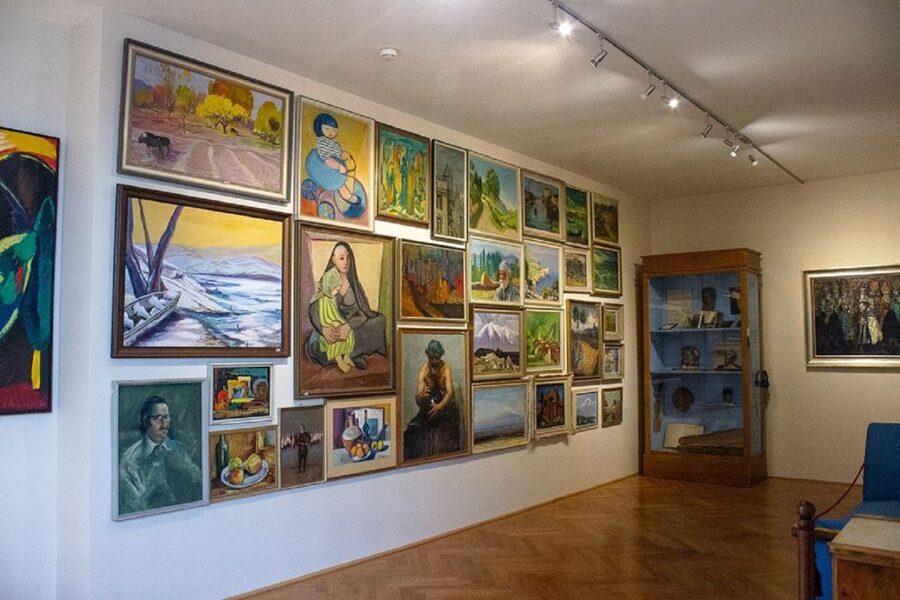
At $84 per person, this is not a cheap way to fill time in Vienna. It is also not simply an entrance ticket. The price includes admission, a live guide, and the liqueur tasting, with a small group limited to 10 people.
I think the value depends on what you want from Vienna. If you only want famous sights and quick photographs, the cost may feel high for two hours. If you care about access, context, and a subject you would be unlikely to understand fully alone, the price is easier to justify.
The guided explanation is the main part of the value. You are paying for the connections between the church, the Mekhitarists, Armenian history, the library, the artwork, and the liqueur. Without a guide, you could see some attractive objects, but you would miss much of the meaning.
A perfect five-star rating across six published bookings supports the idea that the tour delivers a strong experience for its intended audience. The strongest praise centers on the church, the art and literature, Father Vahan’s warmth, and the amount of information provided.
The two-hour length is also useful if your Vienna schedule is full. You can fit the visit into a morning or afternoon without giving up half a day. Just remember that the compact format means the tour moves through many parts of the monastery. You will get breadth, not extended time with every object.
Who should book this Vienna experience?
I would recommend this tour to you if you enjoy:
- Armenian culture, religion, art, or language
- Unusual museums and smaller cultural institutions
- Manuscripts, old publications, coins, and historic objects
- Architecture connected with famous Viennese figures
- Warm, discussion-based guiding
- A short experience that feels different from standard sightseeing
It is also a strong choice for Armenian visitors and families with Armenian connections. The German-Armenian couple’s emotional response shows how meaningful the visit can be for people who see their own heritage reflected in Vienna.
You do not need to be Armenian to enjoy it. The art, library, siege story, architecture, and museum objects give the tour broad appeal. Still, you should be ready for a focused cultural and religious visit rather than an entertaining general tour of central Vienna.
The live guiding is offered in Armenian, English, and German. The small group format should help if you want to ask questions, but the tour’s usefulness will also depend on choosing a language in which you can follow historical and religious explanations comfortably.
Free cancellation up to 24 hours before the experience and the option to reserve now and pay later make planning less risky. Those policies are useful if your Vienna schedule is still changing, though the most important practical step is checking the available start time before you commit.
Should you book the Armenia in the Heart of Austria tour?
Book it if you want to see a side of Vienna that most city tours skip. The combination of Maria Schutz Church, the Loretto-Chapel, the refectory, Armenian manuscripts, Aivazovsky paintings, numismatic collections, and Mechitharine liqueur is unusually varied for a two-hour visit.
I would especially choose it for a second or third day in Vienna, when you have already seen the main imperial sights and want a more personal cultural story. It also makes sense as a first-day stop if Armenian history or religious art is a major interest.
Skip it if your priority is a broad introduction to Vienna or if you dislike guided visits centered on religious institutions. At $84, the subject needs to interest you. For the right person, though, this is a thoughtful, intimate look at how an Armenian community made a lasting place for itself in Austria.
FAQ
Where does the tour meet?
The meeting point is in front of the main entrance of the Mekhitarist Monastery in Vienna.
How long does the tour last?
The tour lasts two hours.
What languages are available?
Live guiding is available in Armenian, English, and German.
How large is the group?
The tour is limited to 10 participants.
What is included in the price?
The price includes entrance fees, guide service, and a Mechitharine liqueur tasting.
Can I cancel the booking?
You can cancel up to 24 hours in advance for a full refund. You can also reserve now and pay later.
Just added in Vienna
- Vienna: Austrian Wine Tasting Experience★ 4.2 · 2 reviews
- World War II History Vienna Old Town Private Walking Tour★ 4.8 · 9 reviews
- Vienna_ Meet Beethoven Life Private Guided Walking Tour★ 5.0 · 1 review
- Vienna: Wine Tasting Tour★ 4.8 · 61 reviews
- Vienna: Wine Tasting E-Bike Tour★ 4.9 · 46 reviews
- Vienna: Wine Tasting at Schönbrunn Palace★ 4.3 · 71 reviews
- Vienna: Winery and Wine Tasting Tour with a Wine Expert★ 5.0 · 5 reviews
- Vienna: Concert by the Vienna Baroque Orchestra★ 4.6 · 56 reviews
Tours, compared.
Schönbrunn Palace & Gardens Skip-the-Line Tour
Read our review →

Skip-the-Line Sisi Museum, Hofburg and Gardens Tour
Read our review →
Skip-the-Line Schönbrunn Palace & Gardens Tour
Read our review →
Guided Walking Tour of City Center Highlights
Read our review →