
Reviewed · CITY TOURS
Terrible crimes in Vienna, hidden secrets of the inner city
Vienna has a dark side. This two-hour walk trades grand palaces and café culture for grim crimes, political scandals, strange punishments, and forgotten corners of the old city. I like the way it uses real locations to explain Vienna’s past, rather than treating history as a list of dates. I also like that guide Ben adds research and stories that help connect each crime to the city’s changing politics and social customs.
The tour costs $46.13 per person, which is fair if you enjoy true crime and unusual history, though it is not the best choice if you want a classic sightseeing walk or dislike gruesome subjects. The stories can be disturbing, and several stops rely on what once stood at a location rather than an interior visit. A complimentary smartphone audio guide is included, but the live storytelling is the main reason to book.
In This Review
- Key points to know before booking
- Why this walking tour feels different from ordinary Vienna sightseeing
- Capuchin monastery and the strange dungeon at Tegetthoffstraße 2
- The Jaroszynski murder case and a ruined acting career
- Palais Bathory and the legend of the Blood Countess
- Demel, Udo Proksch, and the Lucona affair
- Ferstel Palace and the five murders
- Colonel Redl and the spy affair at Hotel Klomser
- Molker Bastei and the Anna Gaugisch murder
- Am Hof and the killing of Theodor Baillet de Latour
- The Hannaken Fountain and a surgeon who created injuries
- Maria am Gestade and the last wheel execution
- Hoher Markt and the torture of Thekla Riener
- St. Stephen’s Cathedral and the punishment of bad bakers
- Steffl and Vienna’s only burned witch
- Himmelpfortgasse and a medieval family feud
- Price, timing, and practical value
- Who will enjoy this tour most
- Should you book Terrible Crimes in Vienna?
- FAQ
- Where does the tour begin?
- Where does the tour end?
- How long is the experience?
- Is the tour offered in English?
- How many people can join the tour?
- Can I cancel for a full refund?
Key points to know before booking
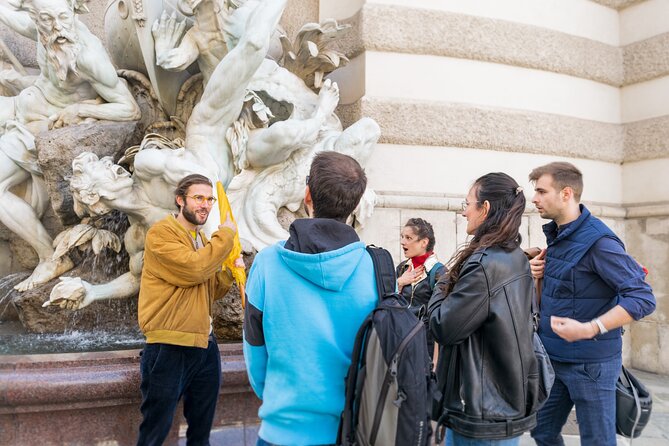
- Fourteen dark-history stops take you through Vienna’s central streets, from the Capuchin monastery to St. Stephen’s Cathedral.
- The stories cover many centuries, including medieval punishments, imperial espionage, political violence, murder, fraud, and witch persecution.
- Ben is a major strength, adding extra stories and creating smooth links between the stops.
- The tour visits places many sightseers pass without noticing, including remnants of the old city wall and sites connected with vanished buildings.
- No attraction admission is required, so the price pays for the guided experience rather than entry tickets.
- The subject matter suits adults and older teenagers, not young children or anyone looking for a gentle introduction to Vienna.
Why this walking tour feels different from ordinary Vienna sightseeing
Most first visits to Vienna focus on emperors, composers, elegant palaces, and polished squares. This walk looks beneath that surface. Its subject is not simply murder. The stories also reveal how Vienna handled crime, mental illness, jealousy, political unrest, religious pressure, espionage, and public punishment.
I appreciate that approach because the city becomes easier to understand through its worst moments. The tour shows how power worked, how rumors damaged lives, and how public opinion could force authorities into actions they normally opposed.
The route remains within Vienna’s central district, beginning at Helmut-Zilk-Platz near the Albertina and ending on Rauhensteingasse. The stops are short, usually five to fifteen minutes, so you are rarely standing in one place for long. The walking links matter as much as the crime stories. You pass grand façades, old street alignments, churches, squares, and the last remnants of the medieval city wall.
The group limit is 20 people. That is small enough to keep the guide’s explanations personal without making the experience feel like a private tour. Several stops are in busy public areas, so staying close to the guide will help.
A few more options to weigh up in Vienna
- Vienna: Vivaldi’s Four Seasons Concert in Karlskirche
★ 4.7 · 14,951 reviews - Vienna: Spanish Riding School Training
★ 3.9 · 9,281 reviews - Vienna: Schönbrunn Palace & Gardens Skip-the-Line Tour
★ 4.7 · 7,739 reviews
Capuchin monastery and the strange dungeon at Tegetthoffstraße 2
The first story begins near the Capuchin monastery on Tegetthoffstraße. Father Innocentius discovered a monastery dungeon where monks could be locked away for years or even decades.
The reasons for imprisonment were sometimes startlingly minor. Unauthorized afternoon walks and a single abuse of a monastery official could lead to confinement. These details make the story more than a tale of cruelty. They show the severe discipline and closed authority structures that could exist inside religious institutions.
Father Innocentius reported the dungeon to Emperor Joseph II. The emperor ordered it closed, but the priest was sent to Lviv for his own safety. His later life took several unexpected turns: he became Protestant, joined the Freemasons, and advised the tsar.
I like this opening because it establishes the tour’s style. The stories are dramatic, but they also lead into broader questions about power and punishment. The drawback is that the dungeon itself is not presented as a standard sightseeing admission. You are hearing about the place from the street, so the value comes from the explanation.
The Jaroszynski murder case and a ruined acting career
At Trattnerhof, the focus shifts to the Jaroszynski murder case and actress Therese Krones. Krones was pulled into a crime with little real connection to her, yet public suspicion helped destroy her career.
Rumors claimed that her expensive tastes pushed Jaroszynski toward desperation and murder. The more ordinary truth was that he was addicted to gambling and deeply in debt. That contrast is one of the tour’s strongest themes: scandal often creates a better story than facts do.
This stop should appeal to you if you enjoy the social side of true crime. It is not only about who committed an offense. It is about how reputations are made and broken, particularly when an attractive public figure becomes part of the story.
Palais Bathory and the legend of the Blood Countess
At Augustinerstraße 12, the former Palais Bathory introduces Elisabeth Bathory. She is remembered either as one of history’s most dangerous serial killers or as the target of a political plot designed to remove a powerful countess.
The familiar legend says she murdered more than 600 young women and bathed in their blood to preserve her youth and beauty. The tour presents the uncertainty rather than treating every part of that tale as settled fact.
That balance is important. The Bathory story is famous because it is horrifying, but the political question gives it more substance. You get a lesson in how sensational accusations could be used against a person of rank.
This is one of the more graphic stories on the route. If you prefer lighter historical anecdotes, this stop may feel too grim. If you enjoy separating documented events from later legend, it is a useful example.
More city tours in Vienna:
- Vienna: Guided Walking Tour of City Center Highlights
★ 4.7 · 4,989 reviews - Vienna: City Cruise with Optional Lunch
★ 3.4 · 3,982 reviews - Vienna: City Cruise
★ 3.3 · 2,978 reviews - Vienna: Guided Walking Tour of City Highlights & Hidden Gems
★ 4.9 · 2,180 reviews
Demel, Udo Proksch, and the Lucona affair
Graben and Kohlmarkt bring the tour into some of Vienna’s most elegant streets. Near Demel, the story turns to Udo Proksch, whose business connections and social position helped hide a major crime for years.
The Lucona affair involved a heavily overinsured freighter chartered for Asia with an explosive charge concealed aboard. The resulting conspiracy caused deaths and massive insurance fraud. Investigators took years to unravel the case because Proksch had connections in many directions.
This is a good reminder that Vienna’s darker stories are not all medieval or imperial. The Lucona affair belongs to modern Austria and involves money, influence, deception, and institutional weakness.
I especially like the setting. You may be looking at a refined shopping street while hearing about a crime built around fraud and mass murder. That sharp contrast gives the stop its force. It also helps the tour avoid becoming a parade of old executions.
Ferstel Palace and the five murders
At Ferstel Palace on Herrengasse, you learn about the former house called Zu den Fünf Morden, or To the Five Murders. It was the site of one of medieval Vienna’s most notorious mass killings.
The crime involved five victims, including a seven-year-old child. The punishment was unusually severe even by the standards of the period. The perpetrator was impaled, and the execution lasted an extremely long time because the executioner had little experience with that method.
This is not a comfortable story, but it explains how medieval authorities used public punishment to send a message. The crime was considered so terrible that the punishment had to be equally memorable.
The guide’s placement of the story near a grand palace makes the point clearly: modern Vienna’s polished appearance often sits on top of older layers of fear, justice, and violence.
Colonel Redl and the spy affair at Hotel Klomser
Across from Palais Ferstel, the former Hotel Klomser marks the end of Colonel Alfred Redl’s suicide and one of the monarchy’s greatest spy scandals.
Redl’s espionage damaged the reputation of the Austro-Hungarian army. It also exposed the weakness of the underfunded Evidenzbureau, the monarchy’s secret service. The affair may have influenced the conditions that led to the First World War, making this one of the route’s most politically important stories.
This stop broadens the tour again. You move from individual crime to state security and military failure. I find that useful because it shows that Vienna’s dangerous secrets did not always involve knives or torture. Sometimes the most serious damage came through betrayal inside powerful institutions.
The story also rewards anyone interested in European history. You do not need specialist knowledge, but the connection to the monarchy and the First World War gives the stop more weight than a simple spy anecdote.
Molker Bastei and the Anna Gaugisch murder
At Molker Bastei, the tour recounts the 1861 murder of Anna Gaugisch by her boyfriend Raimund Lewisch. He dismembered her after she became pregnant and wanted to remove her from his life.
Some body parts were found in the Danube and others in the nearby forge. Before the murder, Lewisch had attracted attention by dissecting a cat. That detail shows how warning signs can be recognized only after a terrible act has taken place.
The location adds another layer because Molker Bastei preserves part of Vienna’s older defensive system. This is one of the places you might pass without knowing what survives there. The stop combines a physical trace of the old city with a nineteenth-century crime.
This is among the shortest stops, at about five minutes. That is probably sensible. The subject is particularly unpleasant, and the route soon moves on to a wider story of political violence.
Am Hof and the killing of Theodor Baillet de Latour
At Am Hof, you hear about the lynching of War Minister Theodor Baillet de Latour during the revolution of 1848. It was one of Vienna’s rare episodes of political mob violence and helped begin the more violent October phase of the revolution.
The civil arsenal stood nearby and was looted during the unrest. The location therefore connects one killing to the larger collapse of order in the city.
I like this stop because it places crime inside a public crisis. Baillet de Latour was not simply the victim of a private dispute. His death reflected anger, revolution, and the struggle over political authority.
The story also helps explain why the tour is not just a murder walk. Across fourteen stops, you see how crime can reveal the pressures of an entire society.
The Hannaken Fountain and a surgeon who created injuries
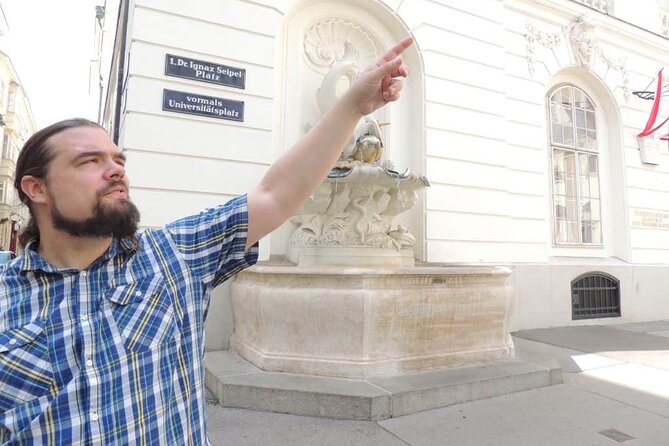
At the Hannaken Fountain, the subject is the Hannakenkönig, a surgeon accused of causing broken bones to improve his business. He supposedly created trip hazards so people would injure themselves and then seek his treatment.
The fountain depicts two men carrying an injured companion to the Hannakenkönig. The Hannaken were a minority from Moravia, and many came to Vienna looking for work. This gives the stop a social dimension that goes beyond the bizarre crime itself.
The story is strange enough to be memorable, but it also raises questions about poverty, prejudice, and the way urban legends form around outsiders. I would not treat every detail as a courtroom-proven fact without further research, but the guide uses it to explain the fountain and the group’s place in Vienna.
Maria am Gestade and the last wheel execution
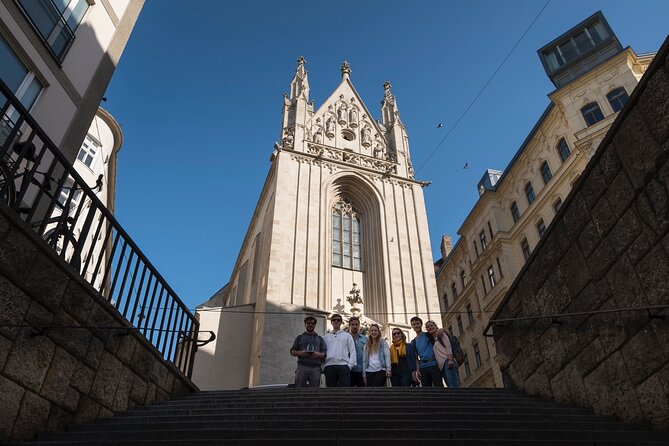
Near Maria am Gestade, a section of the old city wall marks the Zahlheim case, remembered as the last wheel execution in Vienna. This was an exceptionally cruel form of capital punishment, and it was being abandoned in many countries at the time.
The case is especially notable because it happened under Joseph II, who generally opposed the death penalty. The facts forced him to make an exception.
This is one of the tour’s most valuable history lessons. A single criminal case could expose the conflict between a ruler’s principles and public pressure for punishment. The surviving wall also gives you a physical sense of Vienna’s former boundaries while the story describes a justice system that feels remote today.
Hoher Markt and the torture of Thekla Riener
At Hoher Markt, the story becomes a grim account of jealousy. Anton Grünborn tortured his wife, Thekla Riener, using instruments from the courthouse because he believed she had a lover.
There was no lover. His suspicion was based on imagined relationships, yet it drove a series of increasingly irrational acts. He accidentally killed Thekla, and her parents later became mentally ill.
This stop shows how domestic violence and delusion could be treated as a private matter until it became fatal. It is also one of the more emotionally difficult accounts because the victim was targeted by someone close to her.
The short stop works well in the larger route, but you may want a quiet moment afterward. The tour moves steadily, and there is not always time to pause over each story.
St. Stephen’s Cathedral and the punishment of bad bakers
Near St. Stephen’s Cathedral, you hear about the alleged standard bread loaf used by Vienna to check the quality of baked goods. The brutal part of the legend involves the baptism of bakers.
Bakers accused of selling poor bread could be placed in a cage and repeatedly dipped into the Danube. Similar punishments for quarrelsome women existed in English-speaking countries, showing that public humiliation and water punishments were once common in several parts of Europe.
The guide separates the true part of the legend from the questionable details, which is useful. This stop is less about one named criminal and more about the rules of medieval urban life. Food quality mattered, but enforcement could be harsh and theatrical.
St. Stephen’s provides a familiar landmark, yet the story changes how you see the square. The cathedral becomes part of a working city where tradespeople could be publicly punished.
Steffl and Vienna’s only burned witch
At Steffl, the former Malefizspitzbubenhaus once held the executioner’s apartment and a dungeon. It was also where the Plainacher was imprisoned and tortured before becoming the only witch burned in Vienna.
She was accused of bewitching her epileptic granddaughter and summoning demons. Witch persecution was not common in Vienna, but public pressure forced the city judge to proceed.
This is another story where social fear matters as much as the alleged crime. The case reveals how authorities could abandon normal practice when people demanded a visible punishment.
I find the location especially effective because it is now part of one of central Vienna’s busiest sightseeing areas. You are close to one of the city’s best-known landmarks, yet the site once represented imprisonment and execution.
Himmelpfortgasse and a medieval family feud
The final story concerns the former Himmelpfort monastery on Himmelpfortgasse. In 1319, a nun was walled in because she refused to leave the man she loved, a decision shaped by her father’s hatred of the mayor.
The story resembles a Viennese version of Romeo and Juliet. The mayor’s son wanted to marry Anna, but her father condemned her to life as a nun rather than allow the match.
This is a quieter ending than the stories of murder and execution. It shows that the tour also includes coercion, family power, and the punishment of women who resisted decisions made for them.
The route ends on Rauhensteingasse. After fourteen stops, you will have crossed a compact part of the inner city while seeing it through a very different lens.
Price, timing, and practical value
At $46.13, this is not a budget walk, but there are no admission charges at the stops. You are paying for the research, structure, and interpretation. That can be good value if you would otherwise spend hours trying to locate these stories yourself.
The two-hour length is another strength. It fits neatly beside a museum visit or an afternoon in the old town. The walking is spread across many brief stops, though the tour still requires you to remain on your feet and move through central streets.
A mobile ticket is provided, and the experience is offered in English. A complimentary smartphone audio guide is included. The maximum group size is 20, and the tour is near public transportation. Most people can participate, but the provided information does not promise a fully step-free route, so anyone with mobility concerns should confirm details before booking.
Free cancellation is available up to 24 hours before the start time. The experience requires good weather and a minimum number of participants. If poor weather or low enrollment cancels the tour, you can choose another date or receive a full refund.
Who will enjoy this tour most
I would choose this walk if you like:
- True crime with historical context
- Unusual stories that are tied to real streets
- Medieval punishments and old legal customs
- Vienna’s imperial and political scandals
- Seeing older buildings and city-wall remains that are easy to miss
- Tours that mix serious research with entertaining storytelling
It is best for adults and older teenagers. The stories include murder, torture, dismemberment, executions, witch persecution, and political killing. I would not book it for young children or for anyone who wants a cheerful introduction to Vienna.
The experience also suits repeat visitors. One local participant who had lived in Vienna for six years found it a fresh way to act like a tourist in the city again. That is a useful clue: you do not need to be visiting Vienna for the first time to get something from this walk.
Should you book Terrible Crimes in Vienna?
Book it if you want to understand Vienna through its scandals, crimes, and punishments rather than its standard imperial highlights. The strongest parts are the unusual locations, the clear links between crime and politics, and Ben’s personal research and storytelling.
Skip it if you want interiors, grand art, or a conventional overview of the city. Much of the experience happens outside, and some locations now contain modern buildings or busy public spaces rather than visible crime scenes.
For the right audience, this is an entertaining and often revealing way to see the inner city. It gives you stories to remember, places to recognize, and a sharper sense of how Vienna’s polished streets were shaped by fear, power, and human folly.
FAQ
Where does the tour begin?
The tour begins at Helmut-Zilk-Platz, Albertinaplatz 2 to 3, in Vienna’s first district.
Where does the tour end?
The tour ends on Rauhensteingasse in Vienna’s first district.
How long is the experience?
The walking tour lasts approximately two hours.
Is the tour offered in English?
Yes. The tour is offered in English, and a complimentary smartphone audio guide is included.
How many people can join the tour?
The experience has a maximum group size of 20 people.
Can I cancel for a full refund?
Yes, if you cancel at least 24 hours before the experience begins. Changes or cancellations made less than 24 hours before the start time are not accepted for a refund.
Just added in Vienna
- Vienna: Austrian Wine Tasting Experience★ 4.2 · 2 reviews
- World War II History Vienna Old Town Private Walking Tour★ 4.8 · 9 reviews
- Vienna_ Meet Beethoven Life Private Guided Walking Tour★ 5.0 · 1 review
- Vienna: Wine Tasting Tour★ 4.8 · 61 reviews
- Vienna: Wine Tasting E-Bike Tour★ 4.9 · 46 reviews
- Vienna: Wine Tasting at Schönbrunn Palace★ 4.3 · 71 reviews
- Vienna: Winery and Wine Tasting Tour with a Wine Expert★ 5.0 · 5 reviews
- Vienna: Concert by the Vienna Baroque Orchestra★ 4.6 · 56 reviews
City Tours, compared.
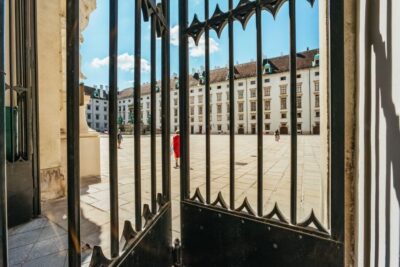
Guided Walking Tour of City Center Highlights
Read our review →
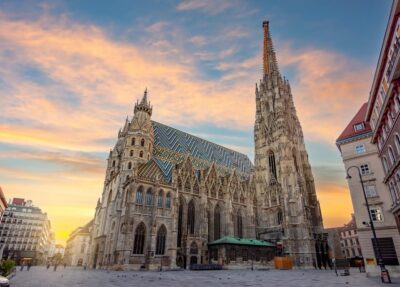
Guided Walking Tour of City Highlights & Hidden Gems
Read our review →
City Sightseeing Tour in an Electro Vintage Car
Read our review →
Skip-the-Line Schonbrunn Palace Guided Tour and Vienna Historical City Tour
Read our review →
Browse the lists this tour appears in