
Reviewed · CITY TOURS
Jewish Vienna Inner City Private Walking Tour
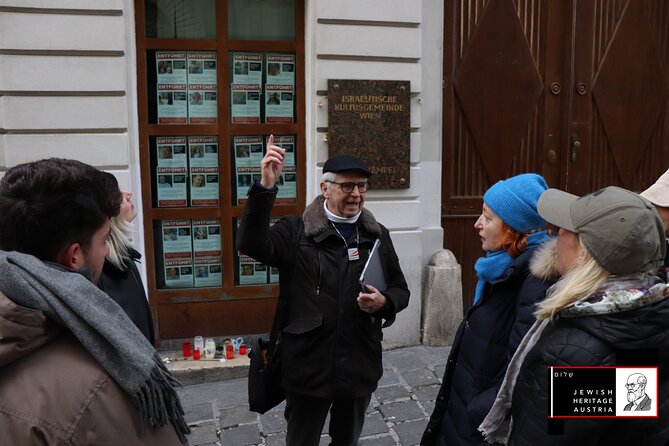
Vienna’s Jewish story is written into its streets. This private walk links medieval Jewish Vienna, court suppliers, the Shoah, and the city’s Jewish life today, all within the central district. I like the route for two clear reasons: Judenplatz gives the tour a powerful starting point, and the private format lets your group ask questions as the story unfolds. I also like that the walk connects monuments, streets, institutions, and people instead of treating Jewish history as one isolated museum visit.
The main drawback is the price: $505.97 per group for up to 15 people is a serious cost for about two hours, especially since museum and synagogue admission are extra. It can make good sense for a larger family or private group, but a couple may find the value harder to justify. The tour also covers painful subjects, including persecution and the Shoah, so it suits visitors ready for a thoughtful, sometimes difficult history lesson.
In This Review
- Key points at a glance
- Why this small area tells such a large story
- Judenplatz and the first encounter with memory
- Hoher Markt and the medieval Jewish quarter
- Judengasse, where a street name carries memory
- Desider-Friedmann-Platz and Jewish figures in Vienna
- Seitenstettengasse and Jewish life today
- The Vienna Wiesenthal Institute and confronting the Shoah
- Graben, Kohlmarkt, and the court suppliers
- Finishing at the Jewish Museum Dorotheergasse
- What the private format means for the price
- Pace, practical details, and who should book
- Should you book the Jewish Vienna Inner City tour?
- FAQ
- How long does the Jewish Vienna Inner City Private Walking Tour last?
- Where does the tour begin?
- Where does the tour end?
- Is this a private tour?
- Are museum and synagogue admissions included?
- How much does the tour cost?
Key points at a glance
- Judenplatz sets the tone: Begin beside Rachel Whiteread’s Holocaust Memorial, the Jewish Museum Judenplatz, and the site of a medieval synagogue.
- The route covers many centuries: You move from the Middle Ages through the Fin de Siècle, the interwar years, the Shoah, and Jewish Vienna today.
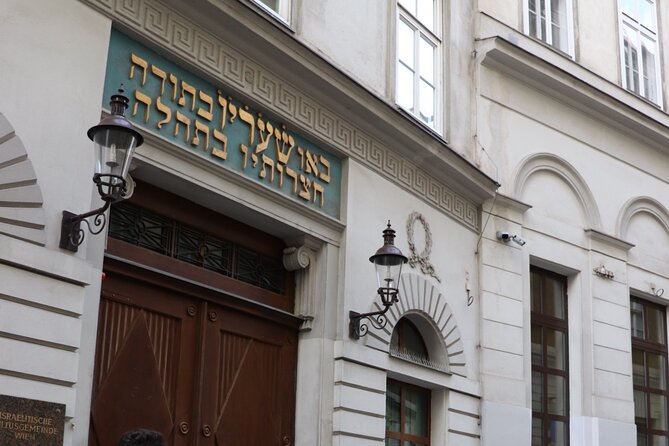
- Seitenstettengasse remains central: See the Stadttempel Synagogue and the area around today’s Jewish community administration.
- A private group keeps the pace flexible: Only your party joins, with space for questions and discussion.
- The Jewish Museum is a strong finish: The walk ends at Dorotheergasse 11, where you can continue with museum exhibits if you buy admission.
- Plan for extra costs: Entry to the Jewish Museum, Stadttempel, and Vienna Wiesenthal Institute is not included.
Why this small area tells such a large story
Vienna’s first district is compact, but its Jewish past is not. This walk uses a small section of the Inner City to show how Jewish life developed, suffered, disappeared in large part, and returned in new forms.
That structure matters. You are not simply moving from one plaque to another. The guide places each stop within a longer timeline. Medieval settlement leads to later cultural and economic influence. The story then turns to exclusion, Nazi persecution, murder, remembrance, and the continuing Jewish community.
I find this approach more useful than a tour focused only on famous buildings. You see the physical city, but you also hear about people, institutions, and choices that shaped Vienna. The walk asks you to look closely at ordinary streets that can otherwise blur into the grand facades of the Inner City.
The tour lasts about two hours. The listed stops account for roughly 95 minutes, leaving time for walking between them and for the guide’s explanations. It is a fairly concentrated experience, so you should expect a steady flow of information rather than long museum visits.
More Walking Tours in Vienna
- Vienna: Guided Walking Tour of City Center Highlights
★ 4.7 · 4,989 reviews - Vienna: Vienna Central Cemetery Guided Walking Tour
★ 4.8 · 3,307 reviews - Vienna: Guided Walking Tour of City Highlights & Hidden Gems
★ 4.9 · 2,180 reviews
Judenplatz and the first encounter with memory
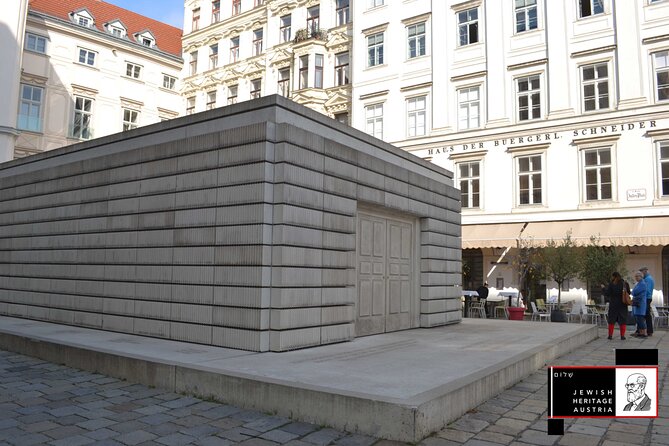
The tour begins at the Judenplatz Holocaust Memorial. This is one of the most important stops because it places memory at the center from the first minute.
Rachel Whiteread’s memorial, often called the Nameless Library, has the form of a sealed library with its books turned outward. The monument is quiet and severe. It does not offer an easy narrative, and that is precisely why it works as a starting point. The guide can explain the memorial’s place in Vienna and connect it to the centuries of Jewish life that existed before the Shoah.
Judenplatz also brings together several layers of the city’s Jewish past. You see Mizrahi House, which represents the Mizrahi Jewish community, and the Jewish Museum Judenplatz. The museum includes the remains of a medieval synagogue, giving you a physical link to the Jewish quarter of the Middle Ages.
The stop is scheduled for about 15 minutes. Admission to the museum is not included, so you should not assume that the walking tour includes an interior visit. If you want more time with the medieval synagogue remains, plan a separate museum visit.
Hoher Markt and the medieval Jewish quarter
From Judenplatz, the walk continues to Hoher Markt, identified as Vienna’s oldest square. Here, the focus shifts from memorial work to the medieval Jewish community.
The value of this stop is partly visual. Hoher Markt is an active city square, not a preserved open-air museum. The guide helps you recognize traces of the medieval Jewish quarter within a modern setting. You hear about the community’s resilience, but also about the pressures and dangers it faced.
The scheduled time is about 10 minutes. That is enough for a clear explanation, but not enough for a full lecture on medieval Vienna. I would pay close attention here because the stop helps explain why Judenplatz matters. The two locations are not separate points on a map. Together, they show the physical center of Jewish life in medieval Vienna and the later work of remembering it.
Admission is not included, though the tour description does not list a required ticket for the square itself.
Judengasse, where a street name carries memory
Judengasse is a short stop, only about five minutes, but it adds a useful piece to the route. You walk through a street whose name points directly to its connection with Vienna’s Jewish past.
This is the kind of stop that can be easy to miss on your own. You might pass through a narrow street without realizing how much historical weight it carries. The guide tells stories of both achievement and suffering across the centuries, keeping the focus on the people who lived here rather than only on architectural remains.
Because the stop is brief, you should treat it as a link in the larger story. It is not a museum visit or a long discussion. It is a moment to notice how memory survives in street patterns and names.
A completely different kind of day:
- Vienna: Vivaldi’s Four Seasons Concert in Karlskirche
★ 4.7 · 14,951 reviews - Vienna: Spanish Riding School Training
★ 3.9 · 9,281 reviews - Vienna: Schönbrunn Palace & Gardens Skip-the-Line Tour
★ 4.7 · 7,739 reviews - Vienna: Light of Creation Votive Church Immersive Light Show
★ 4.8 · 6,779 reviews
Desider-Friedmann-Platz and Jewish figures in Vienna
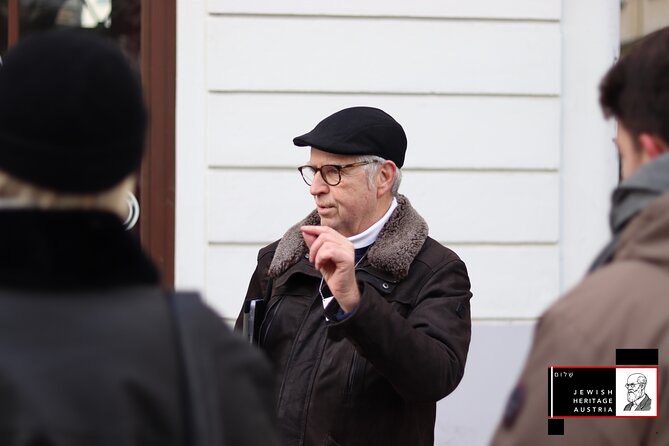
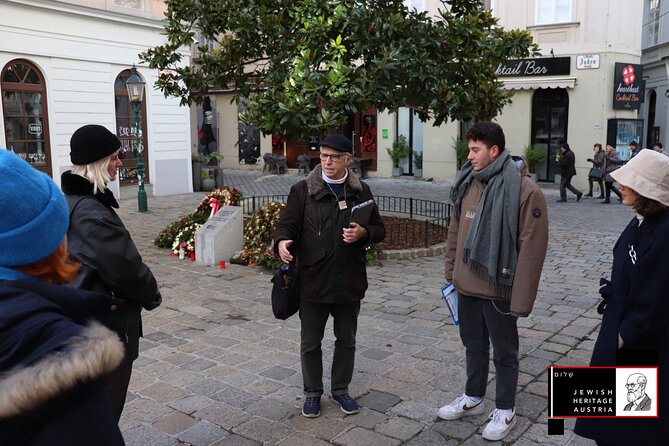
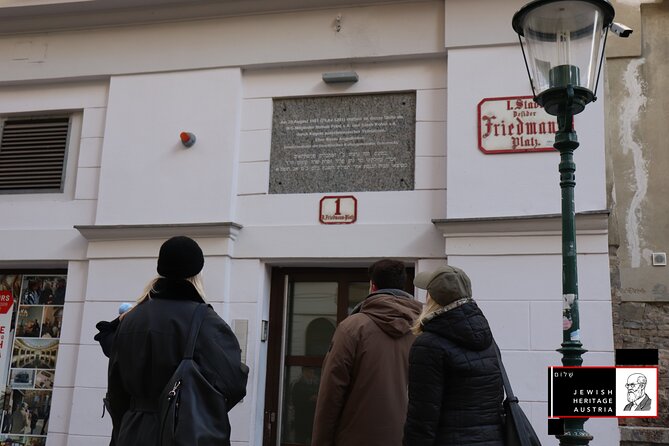
At Desider-Friedmann-Platz, the tour turns toward people who shaped Vienna’s cultural and intellectual life. The stop lasts around 15 minutes, giving the guide more room to discuss famous Jewish personalities.
This portion can balance the darker sections of the tour. Jewish Vienna was not defined only by persecution. Jewish men and women contributed to the city’s culture, ideas, business, and public life, even while facing discrimination and instability.
The exact figures covered can depend on the guide and the interests of your group. The tour description promises stories of renowned Jewish personalities, but it does not name them in advance. If a particular writer, artist, scholar, or public figure matters to you, this is a good place to ask about them.
I like this stop because it restores individual character to a subject that can become overly abstract. Names and careers make the city’s past easier to understand. They also show how Jewish influence reached well beyond the streets traditionally labeled as Jewish.
Seitenstettengasse and Jewish life today
Seitenstettengasse is one of the most important stops on the route. It is tied to Jewish life across several periods and remains a center of the Jewish community today.
Here you learn about the Stadttempel Synagogue, the community administration, and the area’s continuing role. The visit gives the tour a present-day focus rather than ending only with loss and remembrance.
Admission to the Stadttempel is not included. The walking tour does not promise entry, so you should think of this stop as an exterior and neighborhood-based explanation unless separate access has been arranged. The tour description also lists the Stadttempel among the sites requiring an additional ticket.
The scheduled time is about 15 minutes. That makes it possible to understand why Seitenstettengasse matters without turning the tour into a synagogue service or a full building tour. If you want to explore the interior, confirm access details before booking and budget extra time.
For me, this is a key strength of the experience. A tour about Jewish Vienna should not end with the Shoah. By including the synagogue and community offices, the route shows that Jewish life continues in Vienna, even after the enormous destruction of the twentieth century.
The Vienna Wiesenthal Institute and confronting the Shoah
The Vienna Wiesenthal Institute for Holocaust Studies adds a research and education perspective. The institute is connected with the memory of Simon Wiesenthal and focuses on Holocaust research.
The stop lasts about 10 minutes. Admission is not included, so the walking portion offers an introduction rather than a full examination of the institute’s work. You learn how Vienna studies its past and how that research supports education for future generations.
This stop may feel more formal than the street locations. That is useful. Memorials help you remember, while a research institute shows how evidence is gathered, preserved, and interpreted. Together, the two approaches give you a fuller understanding of how a city addresses its past.
The subject is difficult, and the tour does not pretend otherwise. If you are traveling with children or teenagers, consider their age and interest before booking. The private format may help because you can ask the guide to explain complex points at a suitable pace.
Graben, Kohlmarkt, and the court suppliers
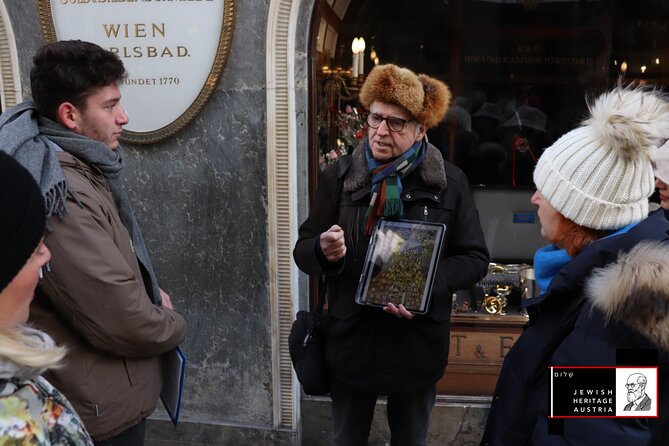
The route then reaches Graben and Kohlmarkt, two of central Vienna’s most famous streets. Here the topic changes to Jewish court suppliers and their role in the city’s cultural and economic life.
This is an especially useful part of the tour because it connects Jewish history with Vienna’s imperial world. Court suppliers were linked to the needs of the royal court, and their work shows how Jewish businesspeople could become important figures in the city’s economy and public life.
At the same time, the subject needs careful handling. Economic success did not erase discrimination or protect Jewish people from later persecution. The guide’s job is to hold both facts together: Jewish citizens contributed to Vienna’s prosperity, yet their place in society remained vulnerable.
The stop takes about 15 minutes. Admission is not included, but these streets are public city spaces. You can expect an outdoor explanation while surrounded by Vienna’s grand shopping and ceremonial center.
This part also makes the route feel less confined to a single quarter. Jewish history appears in the city’s major avenues, commercial life, and imperial institutions, not only in streets marked with Jewish names.
Finishing at the Jewish Museum Dorotheergasse
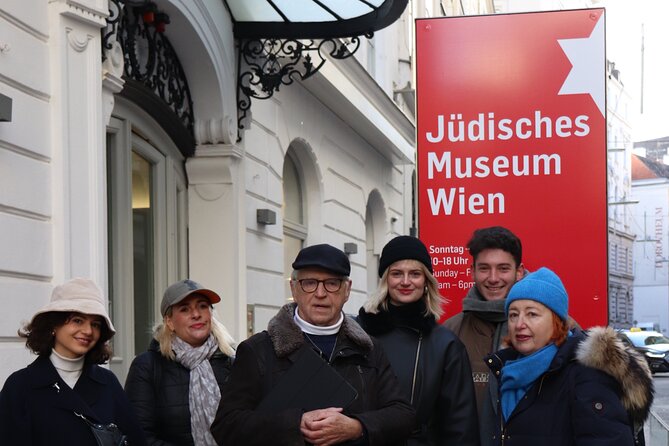
The tour ends at the Jewish Museum of Vienna on Dorotheergasse 11. This is a practical ending because you can continue the subject indoors after the guide says goodbye.
The museum’s exhibits cover Jewish life in Vienna from the Middle Ages to the present. That broad time span matches the main arc of the walk. You can use the museum to revisit the places you have seen and add objects, documents, and displays to the street-level story.
Museum admission is not included. I would consider adding a visit if you want a fuller experience, since the walking tour provides context but only brief time at each location. The listed stop is about 10 minutes, which is enough to identify the museum and explain its place in the route, not enough to see the galleries properly.
Ending here also gives you flexibility. You can enter the museum immediately, return later, or simply continue exploring the Inner City. The end point is near public transportation, and the start and finish are both in Vienna’s first district.
What the private format means for the price
The cost is $505.97 per group, with up to 15 people included. That price is not cheap, but group size changes the calculation.
For a large family, school group, reunion, or group of friends, the cost can be divided among many people. A full group of 15 pays roughly $34 per person before any additional admission fees. For two people, the price becomes much harder to defend.
The private setup gives you the whole guide’s attention. You do not share the walk with strangers, and your group can ask questions about the subjects that matter most to you. The available praise focuses strongly on the guide’s quality and on excellent office support, which are important advantages when the subject requires care and clear explanation.
Still, the tour is only about two hours, and several stops are short. You are paying for a focused private guide, not a full-day program or a package with museum entry. I would book it when personal attention and group privacy matter more than keeping the per-person cost low.
Pace, practical details, and who should book
The walk starts at the Judenplatz Holocaust Memorial and ends at the Jewish Museum on Dorotheergasse. Both points are in the 1010 Vienna district, and the route is near public transportation.
A mobile ticket is provided. Booking confirmation is expected within 48 hours, subject to availability. Service animals are allowed, and the activity states that most people can participate.
Wear comfortable shoes. The distance is not given, but the tour moves between several central locations on foot. You should also allow extra time if you want to enter the Jewish Museum, Stadttempel, or Vienna Wiesenthal Institute, since those admissions are separate.
The tour is best for:
- First-time Vienna visitors who want history beyond palaces and classical music.
- People with a strong interest in Jewish culture, Central European history, or Holocaust remembrance.
- Families and friends who value a private guide and can share the group price.
- Visitors who want both historical context and an explanation of Jewish life in Vienna today.
It may be less suitable if you want a light sightseeing walk, a full museum tour, or a low-cost activity for one or two people. The material is serious, and the short format requires attention.
Should you book the Jewish Vienna Inner City tour?
Book this walk if you want a focused introduction to Jewish Vienna and prefer a private guide who can connect many periods in a small area. The route is strongest at Judenplatz, Seitenstettengasse, and the transition from Holocaust memory to Jewish life today.
I would be more cautious if you are traveling as a small party on a tight budget. The fee is fixed for the group, and museum and synagogue entry cost extra. In that case, compare the price with a public walking tour or visit the Jewish Museum independently.
For a larger group, the value improves sharply. You get a private two-hour route, a guide praised for strong delivery, and a clear way to understand Vienna’s Jewish past without treating it as a footnote. Add museum time afterward if you want the story to continue indoors.
FAQ
How long does the Jewish Vienna Inner City Private Walking Tour last?
The tour lasts approximately two hours.
Where does the tour begin?
It begins at the Judenplatz Holocaust Memorial, Judenplatz, 1010 Vienna, Austria.
Where does the tour end?
The tour ends at the Jewish Museum of the City of Vienna at Dorotheergasse 11, 1010 Vienna, Austria.
Is this a private tour?
Yes. Only your group participates, with a maximum group size of 15 people.
Are museum and synagogue admissions included?
No. Admission to the Jewish Museum, Stadttempel, and Simon Wiesenthal Institute is not included in the tour price.
How much does the tour cost?
The listed price is $505.97 per group, for up to 15 people.
Just added in Vienna
- Vienna: Austrian Wine Tasting Experience★ 4.2 · 2 reviews
- World War II History Vienna Old Town Private Walking Tour★ 4.8 · 9 reviews
- Vienna_ Meet Beethoven Life Private Guided Walking Tour★ 5.0 · 1 review
- Vienna: Wine Tasting Tour★ 4.8 · 61 reviews
- Vienna: Wine Tasting E-Bike Tour★ 4.9 · 46 reviews
- Vienna: Wine Tasting at Schönbrunn Palace★ 4.3 · 71 reviews
- Vienna: Winery and Wine Tasting Tour with a Wine Expert★ 5.0 · 5 reviews
- Vienna: Concert by the Vienna Baroque Orchestra★ 4.6 · 56 reviews
City Tours, compared.
Guided Walking Tour of City Center Highlights
Read our review →
Guided Walking Tour of City Highlights & Hidden Gems
Read our review →
City Sightseeing Tour in an Electro Vintage Car
Read our review →
Skip-the-Line Schonbrunn Palace Guided Tour and Vienna Historical City Tour
Read our review →
Browse the lists this tour appears in