
Reviewed · CITY TOURS
Guided Walking Tour of Vienna City Center Highlights
Vienna reveals itself one grand façade at a time. This two-hour walking tour links the city center’s biggest sights, beginning at Minoriten Church and ending at St. Stephen’s Cathedral, with a guide adding the political, artistic, and royal backstory along the way. I like the clear route and the easy pace, especially if you are new to Vienna. I also like that it includes the unusual Last Supper mosaic, not just the usual palace-and-cathedral circuit.
The main tradeoff is simple: you see the interiors of none of the major museums, palaces, or churches. The tour is an outdoor introduction, not a museum visit. On a hot day, book a morning departure if you can. Rain is manageable with a good coat, but the weather can shape your enjoyment.
In This Review
- Key points to know before you go
- Why this Vienna walking tour works as a first look
- Starting at Minoriten Church and its mosaic
- Heldenplatz: monuments, power, and public memory
- Seeing the Hofburg from the outside
- Passing the Spanish Riding School on the way to the Albertina
- The Albertina: art and architecture without an interior visit
- Vienna State Opera and the city’s musical identity
- Ending at St. Stephen’s Cathedral
- What the guides add to the walk
- Price, pace, weather, and practical value
- Who should book this Vienna city-center walk?
- Should you book it?
- FAQ
- How long is the Vienna city-center walking tour?
- Where does the tour begin?
- Where does the tour end?
- Is entry to the Hofburg Palace included?
- Does the tour include museum interiors?
- Is entry to St. Stephen’s Cathedral included?
- What is included in the tour price?
- What is the cancellation policy?
Key points to know before you go
- The Last Supper mosaic at Minoriten Church gives the tour an unusual starting point and a memorable first story.
- Heldenplatz and Hofburg Palace bring together imperial power, Austrian politics, statues, and grand architecture.
- The Spanish Riding School, Albertina, and Vienna State Opera appear along a compact central route.
- St. Stephen’s Cathedral is the final stop, but the tour ends outside and does not include entry.
- The pace is relaxed and suitable for families, with several reviews praising how easy the walk is to follow.
- Guides such as Nora, Alex, Michael, Lisa, Stefan, Trim, and Achim have been praised for humor, local tips, clear narration, and strong historical storytelling.
Why this Vienna walking tour works as a first look
Vienna can feel like a city built from one enormous ceremonial set. Palaces, monuments, opera houses, museums, and churches crowd the central district. That is wonderful, but it can also make a first visit hard to organize. This tour gives you a clean line through the center, so you can see where the main sights sit in relation to one another.
I see the tour as a get your bearings fast experience. You are not spending two hours inside one attraction. Instead, you move between landmarks while a certified local guide explains what you are seeing. That format is especially useful on a short visit, or on your first morning before choosing which interiors deserve your own time.
The route takes about two hours and is described as an easy stroll. One family review found it simple to manage with children, while another praised the comfortable pace. That does not mean you should ignore sensible footwear. You will still be walking through the city center, usually on paved streets and public squares, with stops for explanations.
The group may include up to 28 people. That is not an intimate private tour, but it is still small enough to keep the route moving. Some departures may be smaller. One group was reported as numbering 12, and headphones were used on at least one tour, which helped everyone hear the guide.
More Walking Tours in Vienna
- Vienna: Guided Walking Tour of City Center Highlights
★ 4.7 · 4,989 reviews - Vienna: Vienna Central Cemetery Guided Walking Tour
★ 4.8 · 3,307 reviews - Vienna: Guided Walking Tour of City Highlights & Hidden Gems
★ 4.9 · 2,180 reviews
Starting at Minoriten Church and its mosaic
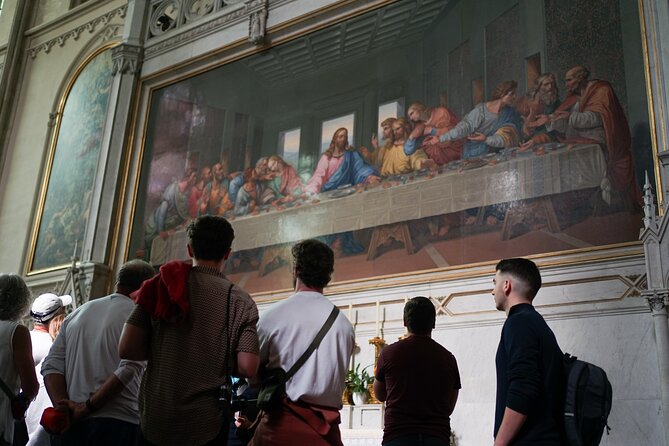
The meeting point is the Leopold-Figl-Denkmal at Minoritenplatz 8, beside Minoriten Church. This is a useful central location, and the tour begins with about 20 minutes devoted to the church and its story.
The highlight is the Last Supper mosaic. It is an unusual detail to lead with because many first-time visitors expect Vienna’s grand imperial sights to come first. Instead, you get a piece of religious art and a reminder that the city center is full of smaller surprises hiding beside the major landmarks.
Your guide explains the background of Minoriten Church before the group heads onward. Since the included visit is specifically the Last Supper mosaic, you should not assume that this is a full guided church interior tour. The broader experience focuses on selected sights and exterior architecture.
This first stop also sets the tone for the rest of the walk. You get context before the famous buildings arrive. I find that useful because a palace façade means more when you understand the institutions and people connected to it.
Heldenplatz: monuments, power, and public memory
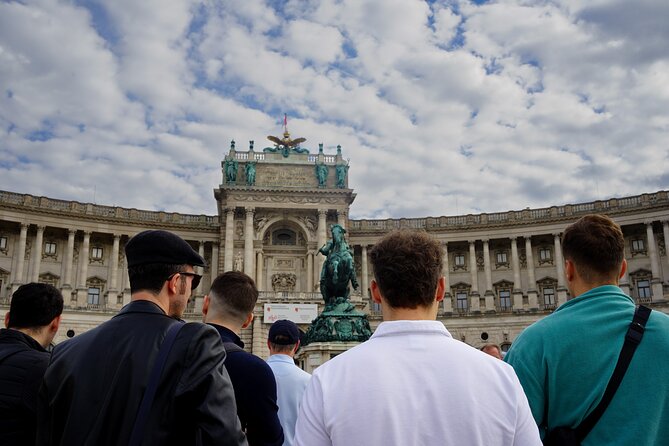
From Minoritenplatz, the route continues to Heldenplatz, one of Vienna’s most imposing open spaces. The stop lasts about 20 minutes, giving the guide time to explain its past and point out several important features.
Here you can look toward the Hofburg complex, the Austrian National Library, and the equestrian statue of Prince Eugene of Savoy. The square brings architecture and politics together in a very visible way. You are not just looking at another grand plaza. You are seeing the public face of imperial Austria and the symbols used to project power.
The guide’s explanation matters here. Without context, Heldenplatz can feel like a broad space surrounded by grand buildings. With a good storyteller, it becomes a place where royal ceremony, national identity, and Austrian politics connect. Several guides have been praised for making those subjects accessible, often adding humor rather than delivering a dry list of dates.
The National Library is mentioned as part of the area, but entry is not included. Keep that in mind if its interior is high on your Vienna wish list. You can return later with a separate admission ticket and more time.
Seeing the Hofburg from the outside
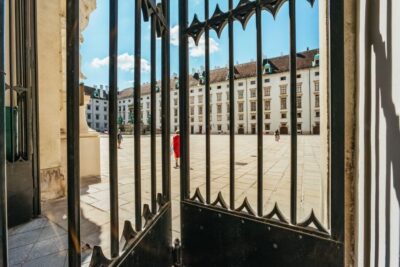
The Hofburg receives its own stop after Heldenplatz, again for roughly 20 minutes. This part of the tour focuses on the palace exterior. You will hear about the complex and admire its façade, but you will not go inside.
That limitation is important because the Hofburg is not one single, simple palace. It is a large complex tied to Vienna’s imperial past and several museums and collections. An outdoor explanation gives you a useful overview, but it cannot replace visiting the rooms, exhibits, or palace museums on your own.
I like the way the tour separates Heldenplatz from the Hofburg. The square gives you the wider political setting, while the palace stop lets you focus on the building itself. You have time to look up at the architecture, take photographs, and ask a question without trying to rush through an interior display.
If you have only one day in Vienna, this orientation can help you decide if the Hofburg deserves a return visit. If you already know you want to see the palace interiors, plan that separately. The tour will not provide admission or an inside line.
A completely different kind of day:
- Vienna: Vivaldi’s Four Seasons Concert in Karlskirche
★ 4.7 · 14,951 reviews - Vienna: Spanish Riding School Training
★ 3.9 · 9,281 reviews - Vienna: Schönbrunn Palace & Gardens Skip-the-Line Tour
★ 4.7 · 7,739 reviews - Vienna: Light of Creation Votive Church Immersive Light Show
★ 4.8 · 6,779 reviews
Passing the Spanish Riding School on the way to the Albertina
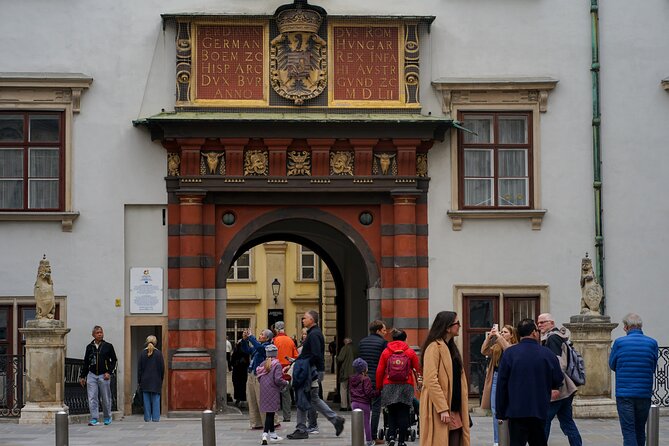
As the group leaves the Hofburg area, the route passes the Spanish Riding School. This is not listed as a dedicated stop, so expect a brief look and explanation while walking rather than a performance, stable visit, or indoor tour.
That passing moment is still useful. The Spanish Riding School is one of the names many people associate with Vienna before arrival, and seeing where it fits into the central district helps you plan later. If you want to attend a performance or visit inside, you will need to arrange that independently.
This section also shows the strength of a walking route. Vienna’s famous sights are close enough that you can connect several of them without boarding a bus or spending time underground. The route keeps your attention on the buildings and squares around you.
A guide such as Michael can make this stretch especially enjoyable. He was praised for animated storytelling, humor, and the ability to keep a rain-soaked walk interesting. That sort of energy matters outdoors, where the setting and the speaker must work together.
The Albertina: art and architecture without an interior visit
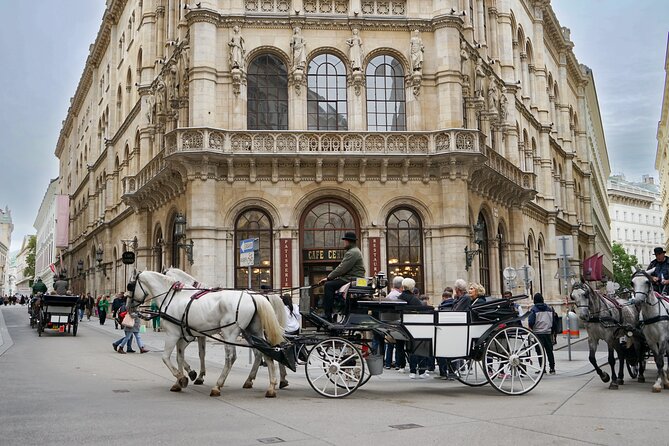
The Albertina stop lasts about 20 minutes and concentrates on the museum’s exterior. You can admire its prominent architecture and learn why the building matters, but admission is not part of the experience.
This is a good example of what the tour does best and what it leaves for later. You get the museum’s place in Vienna’s cultural center, a look at its façade, and a guide’s explanation. You do not get time with the collection itself.
If you enjoy art museums, treat this stop as a preview. You can note the location and return when you have enough time for the galleries. If you are traveling with children or prefer city walks to long museum visits, the exterior stop may be all you need on this particular day.
The 20-minute format keeps the overall route moving. You will not linger long enough to explore every architectural detail, but you also will not lose half the afternoon at one building. That balance is part of the value for first-time visitors.
Vienna State Opera and the city’s musical identity
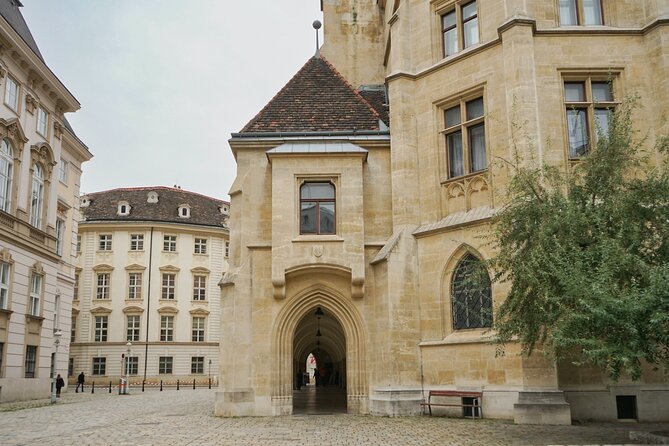
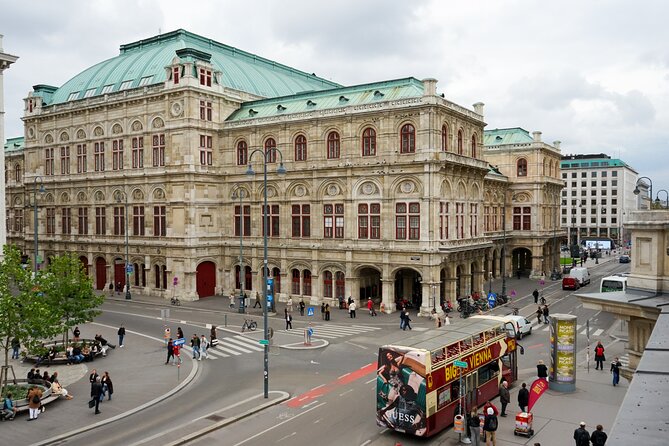
The next major sight is the Wiener Staatsoper, or Vienna State Opera. The guide pauses to discuss the exterior, its history, and its place in Vienna’s cultural life.
The opera house is a natural stop on a city-center highlights walk. Even if you do not plan to attend a performance, the building helps explain why music is so closely tied to Vienna’s public image. The tour lets you see it in context, rather than treating it as an isolated photo stop.
Again, this is an exterior visit only. You will not tour the auditorium or attend a show through this booking. That is not a flaw if you want a broad overview, but it is a limitation if the opera house is your main reason for booking.
The guide’s role is especially valuable here because architecture alone does not explain the building’s cultural weight. The best departures have included guides praised for clear narration, humor, and useful suggestions for what to do afterward. Alex, Nora, Lisa, Stefan, and others have received strong praise for keeping their explanations easy to follow.
Ending at St. Stephen’s Cathedral
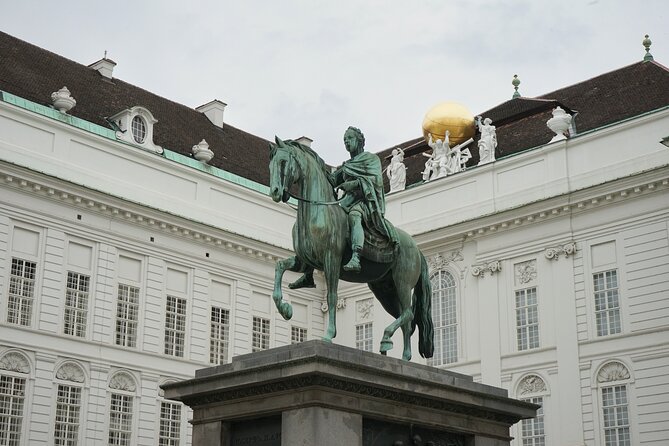
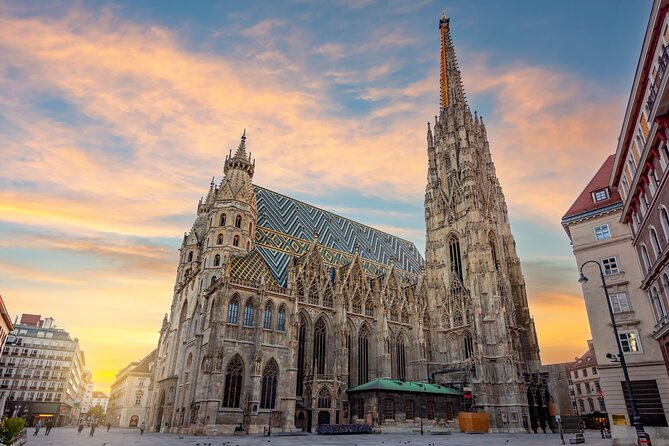
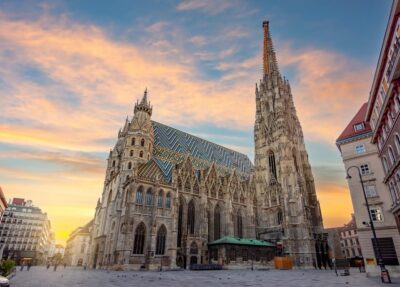
The walk concludes in front of St. Stephen’s Cathedral at Stephansplatz 3. The cathedral receives about 20 minutes of explanation from the outside, and the tour ends there.
St. Stephen’s is a fitting finish because it places you in one of central Vienna’s best-known public spaces. By this point, you have seen religious architecture, imperial buildings, museums, the opera house, and major monuments. The cathedral ties the route together with a final look at Vienna’s older spiritual and civic center.
Entry is not included. You can return later if you want to see the interior, and the tour’s end point makes that easy to consider as part of your own plans. The important practical point is that the guide does not lead you inside as part of the two-hour experience.
Ending here is also handy for continuing your day. The tour does not include food or drinks, but guides have sometimes offered local restaurant suggestions. One review specifically praised a dinner recommendation at Reinthaler’s Beisl. Treat that as a helpful tip rather than a guaranteed part of every departure.
What the guides add to the walk
The strongest part of this experience is the guiding. The tour is built around places you could technically see on your own, so the guide must provide the added value.
Nora has been praised for polished narration and for holding attention throughout the full two hours. Alex received credit for historical references, local food advice, and a voice that was easy to hear and follow. Michael was singled out for humor and vivid storytelling, even in poor weather.
Lisa, Stefan, Trim, and Achim have also been praised for friendly presentation and strong explanations. Achim used headphones on one departure, which made it easier for the group to hear. The exact guide will vary, so you should not book expecting one named person, but the pattern is encouraging: clear speaking, humor, and useful local suggestions are recurring strengths.
The subject range is broader than dates and royal names. You may hear about art, Austrian politics, local life, and the personalities connected to Vienna. That mix gives the walk more shape than a simple monument checklist.
Price, pace, weather, and practical value
At $30.19 per person, the tour is priced as an affordable introduction rather than a full attraction package. You are paying for two hours with a certified local guide and a planned route through several of Vienna’s main sights. Admission to museums, the Hofburg, the cathedral, and other interiors is not included.
I think the price makes sense if you want orientation and storytelling. You can see the key buildings without spending extra on multiple tickets, then choose which places deserve a return visit. The value is weaker if you want long stops, detailed interior tours, or a specialist art and architecture lecture.
The tour is booked an average of 32 days in advance, so early planning is sensible if your Vienna dates are fixed. Confirmation arrives at booking, and the mobile ticket is convenient for a central walking experience.
Near-public-transport access makes the meeting point practical. Service animals are allowed, and most people can take part. Free cancellation is available up to 24 hours before the start time for a full refund. Changes or cancellations inside that window are not accepted for a refund.
Weather deserves attention. A warm-day review specifically recommended a morning departure, and another departure remained enjoyable despite heavy rain because the guide kept the group engaged. Bring clothing suited to the forecast. The tour is outdoors from beginning to end.
Who should book this Vienna city-center walk?
I would choose this tour for a first visit, a short stay, or the first day of a longer Vienna trip. It gives you a useful map in your head and helps you decide what to explore in depth later.
Families may appreciate the easy pace and the fact that the route keeps changing scenery. It also suits people who want history in plain language rather than a long academic lecture. The mix of humor, politics, art, food tips, and architecture gives different ages and interests something to hold onto.
You may want another experience instead if you have limited mobility that makes a two-hour city walk difficult, or if you are mainly seeking interiors. The tour does not include seats, meals, museum admissions, or a palace visit inside. It is also not the best choice for someone who wants a private guide and a highly customized route.
Should you book it?
Book it if you want a relaxed, well-organized introduction to Vienna’s central sights for about $30.19. The Last Supper mosaic, Heldenplatz, Hofburg, Spanish Riding School, Albertina, opera house, and St. Stephen’s Cathedral make a strong route, and the guides add the context that turns façades into stories.
Skip it if you already know the center well or want to spend your time inside museums and palaces. For most first-time visitors, though, this is a sensible way to start: take the walk, note what catches your eye, and return afterward to explore Vienna at your own pace.
FAQ
How long is the Vienna city-center walking tour?
The tour lasts approximately two hours.
Where does the tour begin?
It begins at the Leopold-Figl-Denkmal at Minoritenplatz 8, 1010 Vienna, Austria, near Minoriten Church.
Where does the tour end?
The tour concludes in front of St. Stephen’s Cathedral at Stephansplatz 3, 1010 Vienna.
Is entry to the Hofburg Palace included?
No. The Hofburg portion focuses on the exterior, and palace admission is not included.
Does the tour include museum interiors?
No. The tour does not include interior visits to museums.
Is entry to St. Stephen’s Cathedral included?
No. The cathedral is visited from the outside, and admission is not included.
What is included in the tour price?
The price includes a certified local guide, the two-hour walking tour, and the Last Supper Mosaic visit.
What is the cancellation policy?
You can cancel at least 24 hours before the experience start time for a full refund. Cancellations or changes made less than 24 hours before the start time are not accepted for a refund.
Just added in Vienna
- Vienna: Austrian Wine Tasting Experience★ 4.2 · 2 reviews
- World War II History Vienna Old Town Private Walking Tour★ 4.8 · 9 reviews
- Vienna_ Meet Beethoven Life Private Guided Walking Tour★ 5.0 · 1 review
- Vienna: Wine Tasting Tour★ 4.8 · 61 reviews
- Vienna: Wine Tasting E-Bike Tour★ 4.9 · 46 reviews
- Vienna: Wine Tasting at Schönbrunn Palace★ 4.3 · 71 reviews
- Vienna: Winery and Wine Tasting Tour with a Wine Expert★ 5.0 · 5 reviews
- Vienna: Concert by the Vienna Baroque Orchestra★ 4.6 · 56 reviews
City Tours, compared.
Guided Walking Tour of City Center Highlights
Read our review →
Guided Walking Tour of City Highlights & Hidden Gems
Read our review →
City Sightseeing Tour in an Electro Vintage Car
Read our review →
Skip-the-Line Schonbrunn Palace Guided Tour and Vienna Historical City Tour
Read our review →
Browse the lists this tour appears in