
Reviewed · CITY TOURS
Guided city tour in Vienna: the emergence of a cosmopolitan city
Two millennia fit into two hours. This Vienna walking tour links Roman beginnings, Habsburg power, Mozart, Beethoven, art, and modern memory in one compact route through the old center. I like the clear sense of story, and I like that Christian Grausam explains Vienna through religion, social customs, music, and daily life, not dates alone. The main consideration is pace: two hours gives you a useful framework, but not much time inside major sights.
The tour starts at 3 p.m. on Michaelerplatz and ends at St. Stephen’s Cathedral. You walk rather than ride, with a group capped at 20 people, so comfortable shoes and attention to the guide matter more than admission tickets or transport planning.
In This Review
- Key points about this Vienna walking tour
- Why this short walk helps you understand Vienna
- Michaelerplatz: Roman beginnings and a modern building dispute
- The Hofburg: where imperial power shaped the city
- Heldenplatz: heroic monuments and the memory of 1938
- Josefsplatz: books, Habsburg marriage, and white horses
- Albertinaplatz: art, opera, cake, and wartime memory
- Neuer Markt: imperial burial traditions and Haydn’s Vienna
- Rauhensteingasse: Mozart’s final days
- Stephansplatz: ending at Vienna’s emotional center
- What the $34.73 price gives you
- Timing, meeting point, and practical details
- Who should book this experience
- Should you book the Vienna city tour?
- FAQ
- How long does the Vienna city tour last?
- What time does the tour begin?
- Where does the tour begin?
- Where does the tour end?
- Who provides the tour?
- How many people can join the tour?
- Is the tour delivered with a mobile ticket?
- Are admission tickets included?
- Is the tour near public transportation?
- Can I cancel for a full refund?
Key points about this Vienna walking tour
- A two-hour route through two thousand years: Begin with a Roman fort and finish at the city’s spiritual and geographic center.
- Christian Grausam leads the walk: His style is described as charming, entertaining, clear, and full of detail.
- Eight central Vienna stops: Michaelerplatz, the Hofburg, Heldenplatz, Josefsplatz, Albertinaplatz, Neuer Markt, Rauhensteingasse, and Stephansplatz.
- Music and monarchy share the spotlight: Mozart, Beethoven, Haydn, Maria Theresa, Franz Joseph, and Elisabeth all enter the story.
- Admission costs are limited but not absent: Most stops are viewed from public spaces, while the Hofburg and Capuchin Crypt do not include entry.
- A small-group format: The maximum group size is 20, which should make a live explanation easier to follow than a large coach walk.
Why this short walk helps you understand Vienna
Vienna can feel polished and orderly at first glance. Grand buildings line broad streets, horse-drawn carriages pass through the center, and famous names appear on nearly every block. The challenge is knowing how those pieces fit together.
This walk offers a basic answer. You follow Vienna from a small Roman military settlement to a Habsburg capital and then to a modern European metropolis shaped by art, music, empire, war, and political memory.
I especially like the way the route moves through different layers rather than treating Vienna as one long imperial postcard. You hear about medieval traces, court life, religious ceremony, musical culture, architectural change, and the difficult memories attached to some of the city’s most impressive spaces.
The guide’s role matters here. Christian Grausam is praised for making complex history understandable and entertaining. That is useful in Vienna, where a short walk can easily turn into a string of names and dates. A good explanation gives each building a place in the larger story.
The tour does not promise long visits inside museums or palaces. Think of it as a city orientation with substance. Afterward, you should have a better idea of which sights deserve a separate visit.
A few more options to weigh up in Vienna
- Vienna: Vivaldi’s Four Seasons Concert in Karlskirche
★ 4.7 · 14,951 reviews - Vienna: Spanish Riding School Training
★ 3.9 · 9,281 reviews - Vienna: Schönbrunn Palace & Gardens Skip-the-Line Tour
★ 4.7 · 7,739 reviews
Michaelerplatz: Roman beginnings and a modern building dispute
The walk begins at Michaelerplatz, a strong choice because the square puts several eras close together. You start with traces of Vienna’s Roman past and then look toward the center of historic Vienna.
The focus here is not only ancient remains. A building became a public scandal, giving the guide a way to show how Vienna’s architecture changed and how new designs could unsettle people accustomed to imperial grandeur.
You spend about 10 minutes here. That is enough for an introduction and a quick look at the surrounding structures, but it is not a detailed archaeological visit. If you want to study the Roman remains closely, plan extra time before or after the tour.
This opening also sets up the central idea of the walk: Vienna is not just a collection of beautiful facades. It is a city where new layers were built over old ones, sometimes politely and sometimes not.
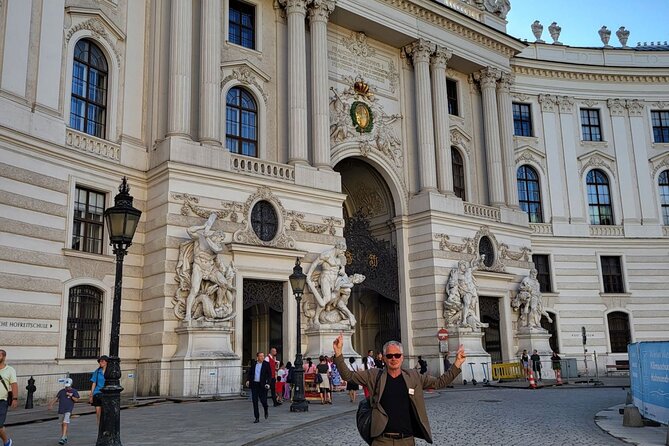
The Hofburg: where imperial power shaped the city
The Hofburg receives the longest stop, about 40 minutes. That tells you where the tour places its main historical weight.
You walk through the former Habsburg power center, the seat of rulers who governed a large and varied empire. The discussion includes the Habsburgs, Charles V, Franz Joseph, and Elisabeth, better known as Sisi. Her presence adds a familiar human figure to an otherwise vast political story.
The Hofburg works well as a teaching ground because power here was not abstract. Palaces, courtyards, chapels, stables, offices, and ceremonial spaces all supported the imperial court. Even from public areas, you can sense how the center of Vienna was organized around monarchy.
The entry ticket is not included. The walk is therefore best for learning the setting and deciding if you want to return for an indoor visit. You should not expect the two-hour tour to replace the palace museums or state rooms.
I would pay close attention during this part if you are new to Austrian history. The guide connects rulers, family relationships, religion, and court life, helping you avoid the usual confusion over titles and repeated royal names.
Heldenplatz: heroic monuments and the memory of 1938
From the Hofburg, the route reaches Heldenplatz, a grand open space surrounded by buildings associated with Vienna’s Ringstrasse and imperial identity.
The square contains monuments to two figures from Austrian military history. Those statues offer a direct look at how a nation presents its past, but Heldenplatz also carries a darker memory connected with 1938.
That contrast is important. The setting can look ceremonial and triumphant, yet it also recalls one of the most painful moments in modern Austrian history. A short explanation here gives the square more weight than a simple photo stop.
The visit lasts about 15 minutes and requires no admission ticket. Since the tour stays outdoors, the quality of the experience depends on the guide’s explanation and your ability to connect the monuments with the wider political story.
I like this stop because it keeps the walk from becoming a parade of palaces. Vienna’s public spaces can celebrate power, question power, and remember the consequences of power, sometimes within a few steps.
More city tours in Vienna:
- Vienna: Guided Walking Tour of City Center Highlights
★ 4.7 · 4,989 reviews - Vienna: City Cruise with Optional Lunch
★ 3.4 · 3,982 reviews - Vienna: City Cruise
★ 3.3 · 2,978 reviews - Vienna: Guided Walking Tour of City Highlights & Hidden Gems
★ 4.9 · 2,180 reviews
Josefsplatz: books, Habsburg marriage, and white horses
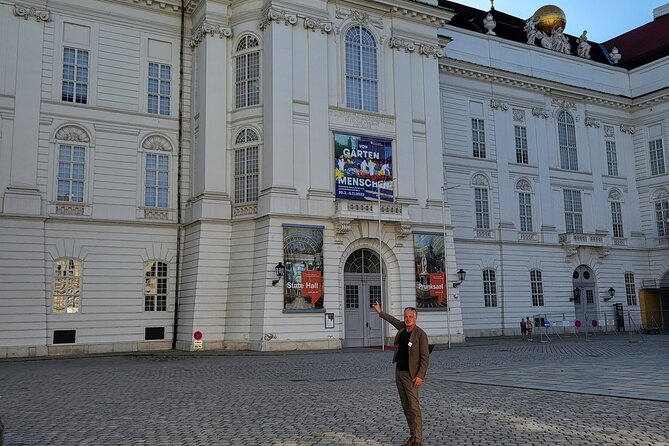
Josefsplatz brings together several subjects that might seem unrelated at first: the Austrian National Library, Maria Theresa’s eldest son, Mozart, the Vienna Central Cemetery, the Habsburg marriage church, and the famous white horses in the castle stables.
That mix is part of the appeal. Vienna’s court culture touched education, religion, music, family ceremony, and public display. The square gives the guide room to show how those areas worked together.
The Austrian National Library’s State Hall is a major visual landmark, though the tour does not include admission. You view it from outside and hear the story rather than spending time among the books and interiors.
The reference to the white horses points toward the Spanish Riding School and the long ceremonial traditions of the imperial court. The horses are not presented as an isolated attraction. They fit into the larger story of Habsburg display and ritual.
This stop lasts about 15 minutes. It is a colorful section of the walk, but the number of topics means you may want to note down the places that interest you most for later visits.
Albertinaplatz: art, opera, cake, and wartime memory
Albertinaplatz shifts the focus from court power to Vienna’s cultural life. The Albertina represents art, while the Vienna State Opera points to the city’s musical identity.
Mozart and Beethoven lived and worked in Vienna, and music remains one of the clearest ways to understand the city’s place in European culture. The tour also brings in Josef Haydn, whose work connects Vienna to a melody still important in Germany today.
Then comes Sachertorte, the famous Viennese chocolate cake, and a sweet dispute over its original version. This lighter subject gives the route a welcome change of tone. Vienna’s culture is not only found in museums and concert halls. It is also argued over in pastry shops.
Albertinaplatz has a serious side, too. It is linked to the Second World War and contains a memorial against war and fascism. That combination of art, music, food, and political memory makes this one of the most varied stops.
You spend about 10 minutes here, with no admission ticket required. The short timing means you will not tour the Albertina or opera house, but you will understand why both matter before deciding to visit them separately.
Neuer Markt: imperial burial traditions and Haydn’s Vienna
At Neuer Markt, the tour turns toward the Capuchin Crypt, the burial place of many Habsburg rulers. The guide explains the tradition and also answers an intriguing question: why is Austria’s last emperor not buried there?
This is the kind of detail that can make a dynastic story easier to remember. Burial customs reveal how the Habsburgs viewed family, faith, rank, and imperial identity.
The stop also returns to music. Haydn composed an important melody in a place opposite the square, linking an ordinary urban setting to a piece of music with lasting national meaning.
The Capuchin Crypt requires an admission ticket that is not included. You should treat the stop as an introduction, not as a crypt visit. If royal burial sites interest you, allow separate time and budget for entry.
The tour gives this section about 10 minutes. That is enough for the key story, though the many connections may leave you wanting more detail.
Rauhensteingasse: Mozart’s final days
Rauhensteingasse marks the place where Mozart died. The stop offers a glimpse of Vienna during Mozart’s time, rather than presenting the composer only as a name attached to concert halls.
This part of the route can feel more personal than the imperial sites. Mozart’s Vienna was a working city of composers, patrons, churches, apartments, performances, and social networks. Understanding that setting makes his career easier to place.
The stop lasts about 10 minutes and does not require admission. The site is best approached as a historical location connected to Mozart’s final days, not as a large memorial complex.
I like the progression here. After hearing about rulers and court ceremony, you return to the life of an artist whose work still defines Vienna’s public image. It gives the music story a human center.
Stephansplatz: ending at Vienna’s emotional center
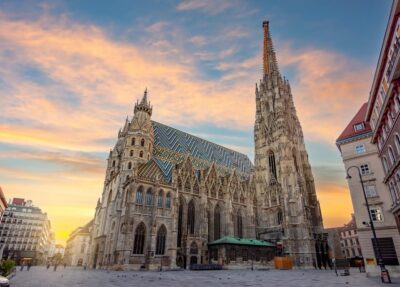
The tour finishes at Stephansplatz, outside St. Stephen’s Cathedral. This is both a practical and meaningful ending. You finish in the city center, close to major streets, public transport, and more places to explore on foot.
The cathedral represents Vienna’s geographic and emotional center. The guide explains its place in the city and recalls Mozart’s farewell there, bringing the music and religious strands of the tour together.
Stephansplatz is also a good point for continuing your day. You can use the cathedral as a landmark, explore nearby lanes, or return to one of the earlier sights with a clearer sense of its importance.
No admission ticket is listed for this outdoor stop. The tour ends outside, so do not assume the guided walk includes an interior cathedral visit.
What the $34.73 price gives you
At $34.73 per person, this is not the cheapest way to see Vienna’s center, since much of the route uses public streets and squares. You are paying for the guide’s structure, interpretation, and ability to connect sites that you might otherwise see as unrelated buildings.
The value is strongest if you are visiting Vienna for the first time, enjoy history, or want help sorting out Habsburg names and cultural references. A self-guided walk can show you the same facades, but it may not explain why a square recalls both imperial ceremony and 1938, or why a burial place matters to Austrian identity.
The price does not cover entry to the Hofburg or Capuchin Crypt. That keeps the base cost clear, but you should set aside extra money if you plan to enter either site.
For a small group of no more than 20 people, the price is reasonable if Christian Grausam’s personal storytelling is your main reason for booking. The strongest praise centers on his charming manner, detailed knowledge, and clear delivery. Those qualities matter more here than luxury extras.
Timing, meeting point, and practical details
The tour begins at 3 p.m. at Michaelerplatz 3 in Vienna’s 1010 district. It ends at Stephansplatz after about two hours.
The route stays in the central city and is near public transportation. You receive a mobile ticket, and confirmation arrives when you book.
Most people can participate, according to the supplied details, but you should remember that this is a walking tour with several stops. Wear shoes suited to city streets, and arrive ready to listen outdoors.
A maximum of 20 people keeps the group smaller than a typical mass-market city tour. It does not guarantee a private feel, but it should make it easier to hear the guide and ask a question.
Free cancellation is available if you cancel at least 24 hours before the 3 p.m. start time. Changes or cancellations made within 24 hours are not refunded, and the cut-off follows Vienna local time.
Who should book this experience
I would choose this tour if you want a strong first look at central Vienna without spending half a day inside museums. It suits people who like politics, architecture, music, religion, royal families, and the way those subjects overlap.
It is also useful early in a Vienna visit. The ending at Stephansplatz leaves you well placed to continue exploring, while the route helps you decide which sights deserve more of your time.
Families and mixed-age groups may appreciate the varied subjects. The story moves from Roman soldiers to imperial rulers, famous composers, horses, cake, and modern memory. That gives the guide several ways to hold your attention.
You may want another option if you need extensive interior access, a very slow pace, or a specialist tour focused only on art, Mozart, the Habsburgs, or wartime history. This experience covers a lot, and its breadth comes at the cost of detail.
Should you book the Vienna city tour?
Book it if you want Vienna to make sense quickly. The route is compact, the subject matter is broad, and Christian Grausam’s reported style combines serious detail with an approachable delivery.
The best reason to go is not the number of stops. It is the way the walk joins them: Roman fort, Habsburg court, military monuments, library, opera, cake, burial crypt, Mozart’s final days, and St. Stephen’s Cathedral.
Just keep your expectations in check. This is an outdoor introduction, not a museum tour. You will pay extra for the Hofburg or Capuchin Crypt, and two hours cannot answer every question about Vienna.
For a first afternoon in the city, $34.73 is a fair price for a guided framework, especially if you prefer stories and context to simply checking off famous buildings.
FAQ
How long does the Vienna city tour last?
The tour lasts approximately two hours.
What time does the tour begin?
The tour starts at 3 p.m.
Where does the tour begin?
It begins at Michaelerplatz 3, 1010 Vienna, Austria.
Where does the tour end?
It ends at Stephansplatz, near St. Stephen’s Cathedral.
Who provides the tour?
The experience provider is Christian Grausam.
How many people can join the tour?
The group has a maximum of 20 travelers.
Is the tour delivered with a mobile ticket?
Yes. A mobile ticket is provided, and confirmation is received at the time of booking.
Are admission tickets included?
Admission is not included for the Hofburg or the Capuchin Crypt. The itinerary lists free admission for the other stops.
Is the tour near public transportation?
Yes. The tour is near public transportation.
Can I cancel for a full refund?
Yes, if you cancel at least 24 hours before the experience start time. Cancellations made less than 24 hours before the start are not refunded.
Just added in Vienna
- Vienna: Austrian Wine Tasting Experience★ 4.2 · 2 reviews
- World War II History Vienna Old Town Private Walking Tour★ 4.8 · 9 reviews
- Vienna_ Meet Beethoven Life Private Guided Walking Tour★ 5.0 · 1 review
- Vienna: Wine Tasting Tour★ 4.8 · 61 reviews
- Vienna: Wine Tasting E-Bike Tour★ 4.9 · 46 reviews
- Vienna: Wine Tasting at Schönbrunn Palace★ 4.3 · 71 reviews
- Vienna: Winery and Wine Tasting Tour with a Wine Expert★ 5.0 · 5 reviews
- Vienna: Concert by the Vienna Baroque Orchestra★ 4.6 · 56 reviews
City Tours, compared.
Guided Walking Tour of City Center Highlights
Read our review →
Guided Walking Tour of City Highlights & Hidden Gems
Read our review →
City Sightseeing Tour in an Electro Vintage Car
Read our review →
Skip-the-Line Schonbrunn Palace Guided Tour and Vienna Historical City Tour
Read our review →
Browse the lists this tour appears in