Reviewed · TOURS
Alternative Tour in Vienna Off the tourist track
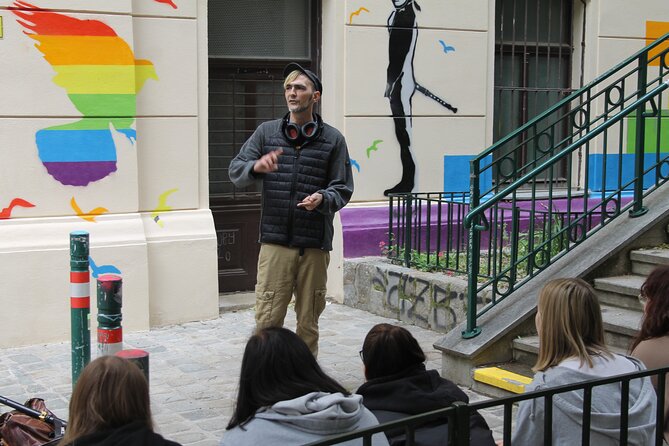
Vienna has another story to tell. This two-hour tour leaves the grand boulevards behind and follows Martin, who once lived on the streets of Vienna, through places tied to his past. I like the firsthand storytelling and the chance to hear about homelessness, addiction, squatting, and punk life without the polished city-tour filter. I also like the small-group limit of 20, which gives you room to ask questions. The main consideration is the subject matter: Martin’s stories can be painful, direct, and emotionally heavy.
This is not a sightseeing circuit built around palaces and picture stops. It is a walking conversation about how people survive outside ordinary society, told with humor as well as sadness. The $46 price is fair if you value personal insight more than a long list of landmarks, though you should choose a classic Vienna tour instead if you want architecture, music, or imperial history.
In This Review
- Key points to know before booking
- Why this Vienna tour feels different
- Starting underground at Karlsplatz
- Alfred-Grünwald-Park and the reality of sleeping outside
- From Karlsplatz toward a less polished Vienna
- Ilse-Pisk-Stiege and Vienna’s squat history
- The stories, the humor, and the emotional weight
- Is $46 good value for two hours?
- Who should book this experience?
- Ending beside Haus des Meeres
- Should you book Vienna Neverland’s tour?
- FAQ
- How long does the tour last?
- Where does the tour begin?
- Where does the tour end?
- Who leads the tour?
- What places are included?
- How large is the group?
- Can I cancel for a refund?
Key points to know before booking
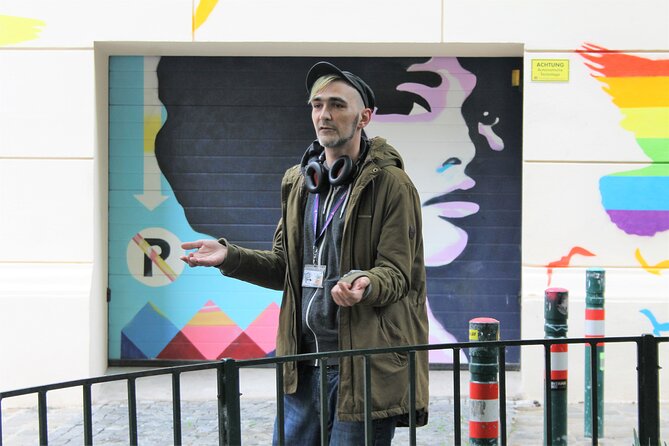
- Martin’s personal story: The guide once experienced homelessness and speaks openly about addiction, street life, and recovery.
- A different Vienna route: The tour begins at Karlsplatz, passes the Secession, and finishes beside Haus des Meeres in Esterhazypark.
- Two especially meaningful stops: Alfred-Grünwald-Park and Ilse-Pisk-Stiege connect directly to Martin’s memories and local social history.
- A serious topic with humor: The tone can move from shocking and sad to funny, especially when Martin explains Vienna’s anarchist and punk past.
- Short, manageable format: The experience lasts about two hours, making it easier to fit into a city break or school program.
- Practical setup: Mobile tickets, group discounts, dogs and service animals are allowed, and groups are limited to 20 people.
Why this Vienna tour feels different
Vienna is easy to admire from the outside. You can spend days looking at imperial façades, grand cafés, churches, and museums. Yet the city also has people who sleep in parks, occupy empty buildings, struggle with addiction, and build their own communities beyond the usual social rules.
This experience asks you to look at that side of Vienna directly. Martin does not present a distant lecture about social problems. He explains parts of his own life, including where he slept, how he got into difficult situations, and what everyday life on the streets could involve.
That personal angle is the reason to book. You are not simply collecting facts. You are listening to someone explain how a familiar city can look completely different when you have no secure place to live.
The tone is not relentlessly bleak. Martin is described as warm, open, and able to make a group laugh without making light of the subject. That balance matters. A tour about homelessness can easily become either sentimental or voyeuristic. Here, the stated aim is personal understanding, not a spectacle.
Still, you should be comfortable with frank discussion of drug use, homelessness, police action, squatting, and social exclusion. This is better suited to adults and mature teenagers than to very young children.
A few more options to weigh up in Vienna
- Vienna: Vivaldi’s Four Seasons Concert in Karlskirche
★ 4.7 · 14,951 reviews - Vienna: Spanish Riding School Training
★ 3.9 · 9,281 reviews - Vienna: Schönbrunn Palace & Gardens Skip-the-Line Tour
★ 4.7 · 7,739 reviews
Starting underground at Karlsplatz
The meeting point is the Police Inspectorate Vienna at the Kärntnertorpassage in Karlsplatz, in central Vienna. The start is convenient for anyone already visiting the city center, since Karlsplatz is served by public transportation.
The opening route goes through the subway passage at Karlsplatz. You then leave via the exit beside the Secession, one of Vienna’s best-known Art Nouveau buildings. The Secession itself is not presented as the main attraction, but passing it helps mark the shift from the formal center to a less familiar side of the city.
This beginning sets the tone well. You start in a place that many visitors use simply to change trains, then move into streets and public spaces that carry a different meaning for Martin. The transition is part of the point. You are still in central Vienna, but the tour encourages you to notice the city from ground level rather than from a museum entrance or palace courtyard.
Be ready for a walking experience rather than a seated talk. Comfortable shoes make sense, and you should expect the group to move between locations. The details provided do not give a total walking distance, so anyone who needs precise route information should ask the provider before booking.
Alfred-Grünwald-Park and the reality of sleeping outside
One of the main stops is Alfred-Grünwald-Park. It offers comfortable seating for the whole group, which is useful because Martin spends about 20 minutes here telling a personal story connected to the park.
This is where the tour becomes especially concrete. Martin explains why the park became a sleeping place for him and why sleeping on the meadow is not necessarily a good idea. That detail says a great deal about homelessness. To someone passing through, a patch of grass may look like a simple place to rest. Someone who has had to sleep outdoors knows that visibility, weather, police attention, other people, and the condition of the ground can all change the calculation.
I find this kind of detail more useful than a general statement about poverty. It shows how ordinary urban spaces take on a second meaning when you are trying to find safety for the night.
The park also gives the group a natural pause. The seating should make this part less tiring than a continuous roadside talk, and it creates room for questions. The experience is strongest when you listen carefully and allow Martin’s memories to lead the conversation rather than treating the stop as a quick photo opportunity.
Do not expect a conventional attraction here. Alfred-Grünwald-Park is important because of the story attached to it, not because it is a major landmark. If your idea of a tour requires famous buildings at every stop, this may feel too ordinary. If you want to understand how public spaces are used by people with very different circumstances, it is one of the most valuable parts.
From Karlsplatz toward a less polished Vienna
Between the stops, the route continues through central Vienna and toward the final location. The walk includes the passage at Karlsplatz and the area around the Secession, linking recognizable city scenery with Martin’s less familiar memories.
The route is not designed to show you the greatest hits of Vienna. Instead, the city becomes a setting for stories about survival, addiction, and marginal communities. That makes the experience feel more like a moving conversation than a standard guided walk.
Martin’s ability to answer questions is a major benefit. Past participants describe being able to ask about his experiences and receive additional explanations along the way. That matters because homelessness is often surrounded by quick judgments. Direct questions, handled respectfully, can replace assumptions with a more complicated picture.
The provider also appears to be connected with Nadine, who is mentioned in a response as contributing quieter administrative work to the project. The tour itself centers on Martin, but that small detail suggests the experience is supported by more than the person holding the conversation in the street.
A completely different kind of day:
- Vienna: Light of Creation Votive Church Immersive Light Show
★ 4.8 · 6,779 reviews - Vienna Spanish Riding School Guided Tour
★ 4.7 · 6,765 reviews - Vienna: Classical Concert in the World-Famous Musikverein
★ 4.6 · 6,673 reviews - Vienna: Skip-the-Line Sisi Museum, Hofburg and Gardens Tour
★ 4.8 · 5,918 reviews
Ilse-Pisk-Stiege and Vienna’s squat history
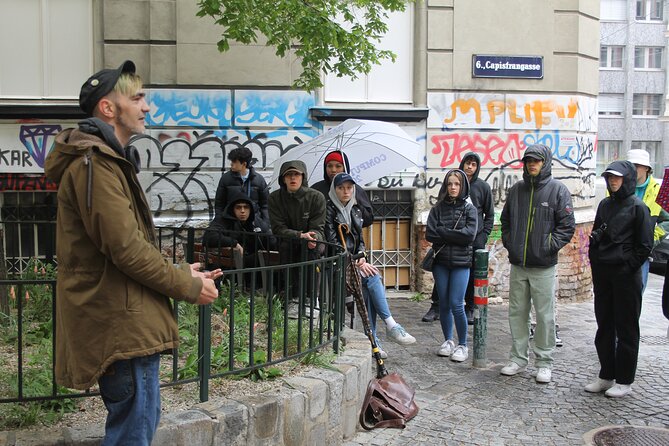
The penultimate station is Ilse-Pisk-Stiege, the stairs of the Capistr Ascent. This is another place to pause, although the seating is different from the park. You can catch your breath on the stairs while Martin explains the world of squats and punks.
For many people, this will be the most surprising historical section. Vienna’s alternative communities are not usually part of the standard introduction to the city. Martin connects the subject to the famous evacuation of Pizzeria Anarchia, a house occupied by 19 people that was cleared by 1,700 police officers.
That contrast is striking. Nineteen occupants and a police operation involving 1,700 officers sounds almost absurd, and Martin reportedly brings out the strange, sometimes comic side of the story. Yet the humor sits beside serious questions about housing, protest, policing, and who gets to claim a place in the city.
This stop gives the tour a wider frame. You are no longer hearing only about one person’s life. You are also hearing about a local subculture and a particular episode in Vienna’s recent social history. If you are interested in anarchist politics, punk communities, squatting, or conflicts over property, this part adds real value.
The stairs are also the one named stop where mobility deserves attention. The route includes a stairway, and the information provided does not specify step-free access. If stairs are a concern, contact Wiener Nimmerland before reserving.
The stories, the humor, and the emotional weight
The strongest praise for this experience centers on Martin himself. He is repeatedly described as sympathetic, warm, open, and easy to listen to. His story includes homelessness and drug addiction, but he does not present it as a simple morality tale.
That distinction is important. A weak tour about social hardship can turn its guide into a symbol rather than a person. Martin’s approach appears more personal and preventative. He explains what happened to him, what street life involved, and how quickly outsiders can judge people whose circumstances they do not understand.
The tone can change quickly. One moment may be shocking or sad. The next may include a funny story about anarchist history or a wry observation about city life. I see that mix as a strength, provided you are prepared for the subject. Humor can make difficult material easier to hear, but it does not remove the seriousness underneath.
This also makes the tour useful for school groups and teenagers. Several comments describe it as educational, exciting, and suitable for classes. Adults can benefit just as much, especially if they want a conversation that challenges quick opinions about addiction and homelessness.
Do not book this for entertainment alone. You may enjoy Martin’s humor, but the point is not to consume someone else’s hardship as a dramatic performance. Go with respect, listen carefully, and ask questions in the same spirit.
Is $46 good value for two hours?
At $46, this is not the cheapest way to spend two hours in Vienna. You can walk through central districts for free, and many classic city tours offer more landmarks for a similar amount.
The value here comes from access to a personal perspective that you cannot get from a guidebook. Martin’s connection to the places on the route gives the stops meaning. Alfred-Grünwald-Park is not valuable because it is famous. Ilse-Pisk-Stiege is not a standard must-see. Their value comes from the stories told there.
I would consider the price reasonable for visitors who prefer small, focused experiences over broad sightseeing. A maximum of 20 people is not private-tour size, but it is still limited enough to make questions possible. Group discounts may improve the value for schools, youth groups, workplace groups, or cultural organizations.
The short length is also useful. Two hours leaves most of the day open for museums, meals, or traditional sights. The tradeoff is that you are paying for a concentrated social-history experience rather than a full tour of Vienna.
Who should book this experience?
I would recommend it to you if you want:
- A personal account of life on the streets of Vienna
- A serious look at homelessness and addiction
- Local stories about squatting, punk communities, and anarchist history
- A tour that encourages tolerance instead of quick judgment
- A short activity for mature teenagers or school groups
- A central route that ends near Haus des Meeres
It may not suit you if you want palace interiors, famous artworks, classical music, or a broad introduction to Vienna’s main sights. The tour is also not ideal if you prefer light subject matter or feel uncomfortable hearing direct accounts of drug use and street survival.
Dogs are allowed, and service animals are allowed. The experience is near public transportation, and most people can participate, though the stairs at Ilse-Pisk-Stiege are worth considering. The group limit is 20, and you receive a mobile ticket after booking.
The cancellation terms are straightforward: cancel at least 24 hours before the start time for a full refund. Cancellations or changes inside that window are not refunded or accepted. If the minimum group size is not reached and the tour is canceled, you are offered another date or experience, or a full refund.
Ending beside Haus des Meeres
The tour finishes at Esterhazypark, beside Haus des Meeres. That makes the end practical. You can continue to the aquarium and zoo-style attraction, explore the surrounding district, or use public transportation to return to central Vienna.
The ending also leaves you in an ordinary city neighborhood rather than bringing you back to a major monument. That fits the experience. You finish not with a grand view or a ceremonial farewell, but with a changed sense of the streets around you.
For me, that is the lasting value of this tour. It does not replace a classic Vienna sightseeing walk. It adds a human layer that most visitors never encounter. You may leave thinking less about what makes a city beautiful and more about who gets to feel safe and welcome there.
Should you book Vienna Neverland’s tour?
Book it if you want a candid, personal, and sometimes uncomfortable look at Vienna’s social underside. Martin’s firsthand experience, his openness, and his ability to mix serious stories with humor are the main reasons this tour earns its strong reputation.
I would especially choose it for mature teenagers, school groups, and adults who want to question their assumptions. I would skip it only if your Vienna plans are focused entirely on art, architecture, and classic sightseeing, or if the topics of addiction and homelessness are not right for you.
At $46 for about two hours, it is a focused purchase rather than a bargain tour. But for a direct human story, a small group, and a side of Vienna rarely included in guidebooks, it offers something genuinely different.
FAQ
How long does the tour last?
The tour lasts approximately two hours.
Where does the tour begin?
It begins at the Police Inspectorate Vienna in the Kärntnertorpassage at Karlsplatz, 1010 Vienna.
Where does the tour end?
It ends at Esterhazypark, beside Haus des Meeres.
Who leads the tour?
The tour is led by Martin, who previously lived on the streets of Vienna and shares personal experiences of homelessness, addiction, and street life.
What places are included?
The route goes through the subway passage at Karlsplatz, passes the Secession, and includes Alfred-Grünwald-Park and Ilse-Pisk-Stiege. The final stop is near Esterhazypark.
How large is the group?
The tour allows a maximum of 20 participants. Group discounts are available.
Can I cancel for a refund?
Yes. You can cancel at least 24 hours before the start time for a full refund. Cancellations or changes made less than 24 hours before the start time are not refunded or accepted.
Just added in Vienna
- Vienna: Austrian Wine Tasting Experience★ 4.2 · 2 reviews
- World War II History Vienna Old Town Private Walking Tour★ 4.8 · 9 reviews
- Vienna_ Meet Beethoven Life Private Guided Walking Tour★ 5.0 · 1 review
- Vienna: Wine Tasting Tour★ 4.8 · 61 reviews
- Vienna: Wine Tasting E-Bike Tour★ 4.9 · 46 reviews
- Vienna: Wine Tasting at Schönbrunn Palace★ 4.3 · 71 reviews
- Vienna: Winery and Wine Tasting Tour with a Wine Expert★ 5.0 · 5 reviews
- Vienna: Concert by the Vienna Baroque Orchestra★ 4.6 · 56 reviews
Tours, compared.
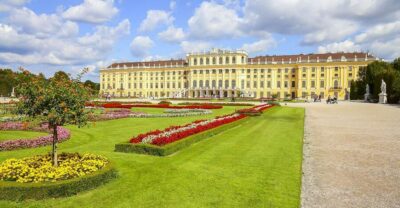
Schönbrunn Palace & Gardens Skip-the-Line Tour
Read our review →

Skip-the-Line Sisi Museum, Hofburg and Gardens Tour
Read our review →
Skip-the-Line Schönbrunn Palace & Gardens Tour
Read our review →
Guided Walking Tour of City Center Highlights
Read our review →