
Reviewed · MOZART CONCERTS
Vienna: Mythos Mozart Experience
Mozart’s last Vienna address becomes a stage. Mythos Mozart turns the composer’s final year into a one-hour show of music, projection, light, and interactive displays. You move through the building where Mozart lived and died in 1791, and where he composed parts of The Magic Flute and The Requiem.
I like the 1500-candle Requiem room, which gives the visit a solemn start, and the playful Little Night Music room, where you can try instruments from around the world. My main caution is that this is more of an audiovisual art experience than a traditional museum. If you want a detailed biography, original manuscripts, or long wall texts, you may find it a little light on facts.
In This Review
- Key things to know before you go
- What Mythos Mozart is trying to do
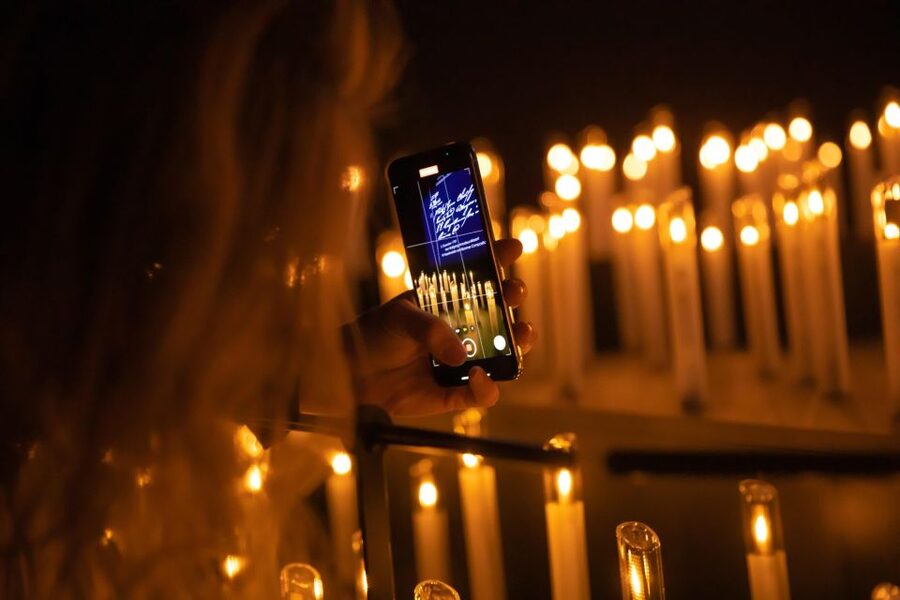
- Starting with the 1,500 candles in the Requiem room
- Walking through Vienna in 1791
- Making music in the Little Night Music room
- Light, sound, and the final modern section
- The rooftop view after the exhibition
- How much does the one-hour visit offer for $27?
- Timing, access, and practical details
- Who will enjoy Mythos Mozart most?
- Should you book Mythos Mozart?
- FAQ
- Where is the Mythos Mozart Experience located?
- How long does the experience last?
- How much does admission cost?
- What does the ticket include?
- Is food included with admission?
- Can I visit without booking in advance?
- How early should I arrive?
- Is the experience wheelchair accessible?
- What language is available?
- Can I bring a pet?
Key things to know before you go
- Mozart’s final home: The exhibition occupies the building where Mozart spent the last year of his life and died in 1791.
- A powerful candle room: The REQUIEM, MOZART’S DEATH room uses 1,500 candles to create a serious, theatrical opening.
- Vienna from above: The VIENNA, 1791 room gives you 360-degree views of the city as it looked in Mozart’s time.
- Hands-on music: Little Night Music lets you play different instruments rather than simply look at them.
- Good rainy-day choice: The entire visit lasts about one hour, making it easy to fit into a busy Vienna schedule.
- A rooftop finish: The Sky and Roofgarden has views toward Karlskirche, the Ferris wheel, and St. Stephen’s Cathedral.
What Mythos Mozart is trying to do
Traditional Mozart museums often ask you to stand quietly beside portraits, documents, and display cases. Mythos Mozart takes another path. It uses music, projections, lighting, animation, and interactive technology to create a feeling for Mozart’s world.
That makes it especially useful if you know Mozart mainly as a name on a concert program. You do not need formal music training to follow the visit. The program uses familiar human themes: work, fame, imagination, illness, and death.
The setting matters. This is not an exhibition placed in an unrelated modern hall. You are in the building where Mozart spent his final year. He composed The Magic Flute and The Requiem during this period, and he died here in 1791.
Still, keep your expectations in the right place. The exhibition gives you impressions more than a full scholarly account. One room may teach you a few facts, while another simply surrounds you with sound and images. Some people will find that refreshing. Others will wish for more commentary or subtitles.
More Mozart Concerts in Vienna
- Vienna: Mozart Concert at the Golden Hall
★ 4.6 · 3,986 reviews - Vienna: Classical Concert at Mozart’s First House
2,423 reviews - Vienna: Mozart and Strauss Concert at Schönbrunn
★ 4.5 · 2,364 reviews
Starting with the 1,500 candles in the Requiem room
The visit begins in the REQUIEM, MOZART’S DEATH room. It contains 1,500 candles and was designed with lighting by British-German designer Moritz Waldemeyer.
This opening is deliberately dramatic. Candlelight, Mozart’s music, and the subject of his final days create a serious mood from the first few minutes. Several people describe this room as the emotional high point, and I can understand why. It is not a room you simply pass through on the way to something else.
The design also gives the exhibition a strong sense of place. Mozart’s death is not treated as a dry date in a timeline. Instead, the room asks you to pause and feel the weight of the music.
That intensity may not suit everyone at the start. If you are visiting with young children, the candle room could feel a little eerie. It is not a frightening attraction, but the atmosphere is clearly meant to suggest mortality and farewell.
The room works best if you allow yourself a few quiet moments instead of rushing to photograph everything. The candle display is the kind of feature that can lose some force when viewed only through a phone screen.
Walking through Vienna in 1791
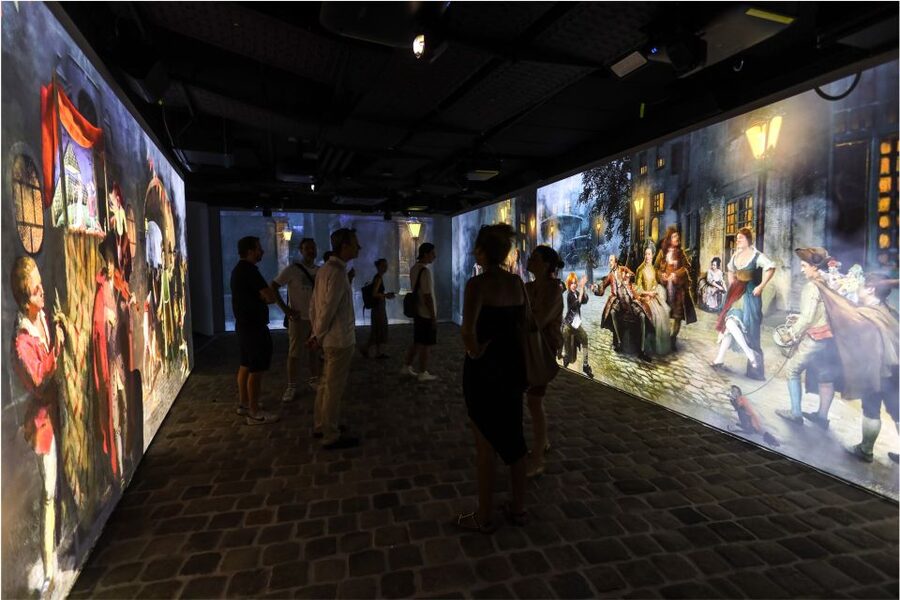
Next comes VIENNA, 1791, MOZART’S CITY. Here, the exhibition opens out from Mozart’s private life and shows the city around him.
You can stroll through animated streets, climb over rooftops in a balloon, and find yourself facing the house where Mozart died. The room also offers 360-degree panoramic views of 18th-century Vienna.
This is one of the most useful sections for visitors who have not spent much time studying Mozart. It gives a basic sense of his surroundings. You are not only hearing compositions in isolation. You are placing the composer in a city of streets, buildings, and daily movement.
The rooftop balloon idea adds a playful touch. It keeps the presentation from becoming too solemn and gives younger visitors something active to follow. The animated city also helps explain why the exhibition is better described as a multimedia show than a conventional museum.
Do not expect a precise architectural reconstruction in the style of a historical model. The aim is atmosphere and movement. Some scenes may feel more like a visual theater piece than a lesson about urban planning.
That is fine if you want a quick introduction to Vienna in Mozart’s time. If you are already an expert on 18th-century Vienna, you may want more detail than this room provides.
Making music in the Little Night Music room
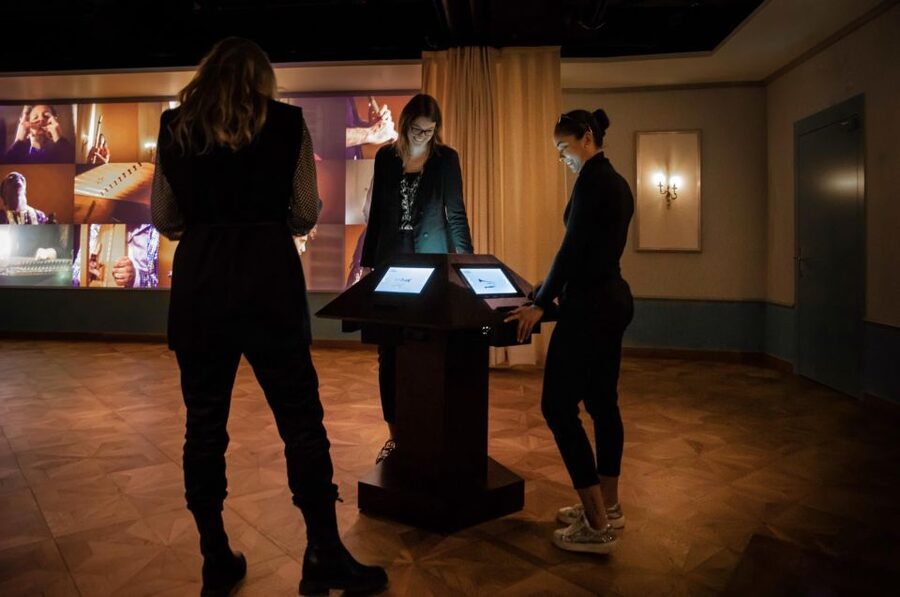
The Little Night Music room changes the pace. Instead of simply watching projections, you can play different instruments from around the world.
This is a smart choice in the middle of the exhibition. After the darker opening and the city scenes, the hands-on section lets you take part. You do not need to know how to read music, and you do not need to be a Mozart specialist.
I especially like this part for families and mixed-age groups. Adults who have come for the cultural content can listen to Mozart, while children have a clear reason to interact with the displays. It also gives you a simple reminder that music is physical. It comes from breath, strings, rhythm, touch, and movement, not just from a name printed on a concert ticket.
The room is not a full music lesson, and you should not expect private instruction or a carefully structured workshop. Its value is in the invitation to experiment.
If you are visiting at a busy time, the interactive elements may be more enjoyable when you can take your turn without feeling hurried. Booking a time slot helps the visit follow a planned flow, though the pace inside is not described as a guided tour.
A completely different kind of day:
- Vienna: Vivaldi’s Four Seasons Concert in Karlskirche
★ 4.7 · 14,951 reviews - Vienna: Spanish Riding School Training
★ 3.9 · 9,281 reviews - Vienna: Schönbrunn Palace & Gardens Skip-the-Line Tour
★ 4.7 · 7,739 reviews - Vienna: Light of Creation Votive Church Immersive Light Show
★ 4.8 · 6,779 reviews
Light, sound, and the final modern section
The rooms use large visual effects, animation, and music to carry the story. Several parts are designed to give you an emotional response rather than a list of dates and facts.
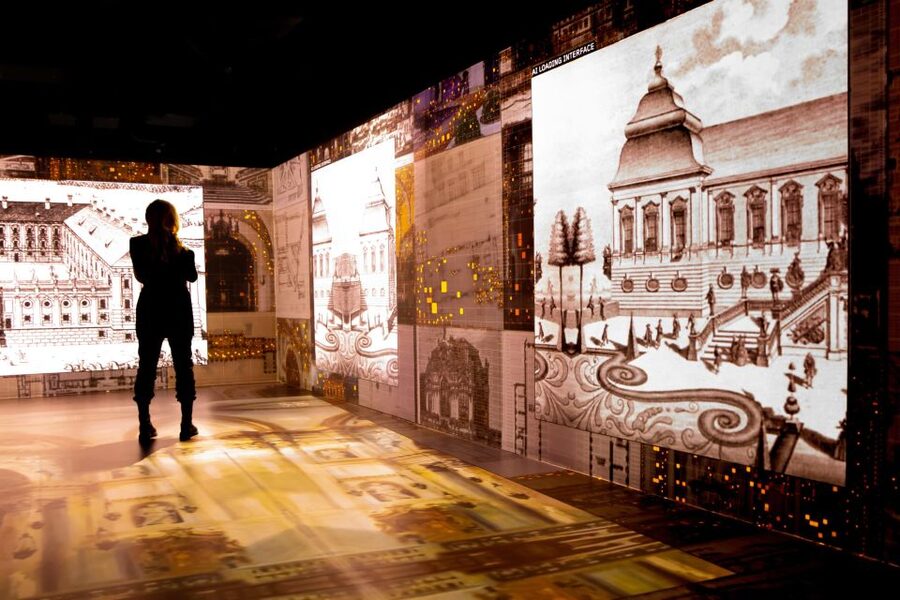
The final section brings Mozart into conversation with modern technology. The use of artificial intelligence and digital composition has impressed many people, especially those interested in the meeting point between music and art. It asks a playful question: what might Mozart have done with 21st-century tools?
This ending gives the exhibition a sense of motion. Mozart is not presented only as a composer locked in the 18th century. His work becomes the raw material for a modern audiovisual piece.
There is a fair point to consider here. Some people love the technology, while others may feel it moves too far from Mozart’s actual life and music. If you want period objects and original artifacts, this final section may seem less relevant. If you enjoy digital art, it could be the most memorable part of the visit.
One visitor praised the final display as the best part, while another felt the exhibition needed more explanation. That difference tells you a lot about Mythos Mozart. It succeeds through mood, sound, and visual ideas. It is less strong as a detailed, traditional account of the composer’s life.
The rooftop view after the exhibition
The Sky and Roofgarden gives you a chance to change gears after the indoor rooms. From the rooftop, you can look across Vienna’s First District toward Karlskirche, the Ferris wheel, and St. Stephen’s Cathedral.
This is a practical bonus, particularly if you visit near the end of a long sightseeing day. You can sit down, have food or a drink, and look over the city you have just seen recreated in 18th-century form.
The Sky Café and Restaurant sells food and drinks, and the roof terrace has panoramic views. These purchases are not part of the admission price, so plan on paying separately.
I would not book Mythos Mozart only for the rooftop. The view is an extra, not the main reason to come. But it gives the one-hour visit a pleasant finish and makes the attraction easier to combine with nearby central Vienna sightseeing.
How much does the one-hour visit offer for $27?
At about $27 per person, Mythos Mozart is not the cheapest short stop in Vienna. The visit lasts roughly one hour, so the price can look high if you measure value only by time.
I think the price makes more sense if you enjoy music, digital art, or well-designed cultural attractions. You are paying for a staged presentation with several specially built rooms, lighting effects, historical city views, and interactive elements. It is also a useful indoor option when rain spoils a walking plan.
The strongest value comes when you visit with someone who has different interests from you. A Mozart fan gets the music and setting. A child gets the interactive instruments. Someone who is not keen on classical music still gets projections, movement, and visual drama.
The value is weaker if you are looking for a deep factual study of Mozart. You might learn some useful things, but the exhibition will not replace a full museum visit, biography, or guided historical tour.
At four days in Vienna, I would see this as a compact cultural stop rather than an all-day centerpiece. It fits neatly before dinner, during a wet afternoon, or between major sights in the First District.
Timing, access, and practical details
The full visit takes about one hour. You should book a time slot in advance and report to the Mythos Mozart Welcome Desk up to 15 minutes before your start time.
Spontaneous entry may be possible when occupancy allows, but I would not rely on it during a busy weekend or holiday period. A timed reservation is the safer choice, especially when you are building the visit around a concert, restaurant booking, or train departure.
The ticket covers entry to the Mythos Mozart Immersive Experience. Hotel pickup, transport, food, and drinks are not included.
The host or greeter speaks English, and the listed activity language is English. Some people would prefer more spoken commentary or subtitles, so keep that in mind if you want detailed explanations throughout the rooms.
The building is wheelchair accessible. Free lockers and toilets are available, which is handy if you are carrying coats or small bags. Pets are not allowed.
Bring a passport or ID card, and bring a student card if you are using student identification. The activity allows free cancellation up to 24 hours before the scheduled time, and you can reserve now and pay later if that option is offered with your booking.
Who will enjoy Mythos Mozart most?
I would recommend it first to people who want a modern introduction to Mozart. You can arrive with little musical background and still follow the broad story through sound and images.
It also works well for:
- Families looking for a cultural activity with hands-on elements
- Classical music fans who want to hear Mozart in the place where he spent his final year
- Couples seeking a short evening activity
- Visitors needing a weather-proof plan
- People who enjoy light shows, projection art, and artificial intelligence
- First-time Vienna visitors with only an hour to spare
You may want to skip it if your main goal is original documents, historic furniture, detailed timelines, or a traditional guided lecture. It is also not a concert. Mozart’s music is central, but you are listening as part of a visual program rather than sitting through a live performance.
Should you book Mythos Mozart?
Book it if you want Mozart presented through music, light, movement, and technology. The candle room, the 1791 city scenes, the playable instruments, and the rooftop views give the visit a varied rhythm. I also like that you do not need to be a classical music expert to enjoy it.
Think twice if $27 feels high for a one-hour attraction or if you want a more detailed account of Mozart’s life. The exhibition gives you a strong emotional and visual impression, but it does not aim to answer every historical question.
For most visitors, I would place it in the good one-hour Vienna stop category. It is particularly worthwhile on a rainy day, with children, or as an introduction before attending classical music elsewhere in the city.
FAQ
Where is the Mythos Mozart Experience located?
It is in Vienna, Austria, in the building where Mozart spent the final year of his life and died in 1791.
How long does the experience last?
The visit lasts about one hour.
How much does admission cost?
The listed price is $27 per person.
What does the ticket include?
The ticket includes entry to the Mythos Mozart multimedia experience.
Is food included with admission?
No. Food and drinks are not included, but they can be purchased at the Sky Café and Restaurant.
Can I visit without booking in advance?
Spontaneous visits may be possible depending on occupancy. Advance booking of a time slot is recommended.
How early should I arrive?
You should report to the Mythos Mozart Welcome Desk up to 15 minutes before your scheduled start time.
Is the experience wheelchair accessible?
Yes, the activity is listed as wheelchair accessible.
What language is available?
The host or greeter speaks English, and English is the listed activity language.
Can I bring a pet?
No. Pets are not allowed.
Just added in Vienna
- Vienna: Austrian Wine Tasting Experience★ 4.2 · 2 reviews
- World War II History Vienna Old Town Private Walking Tour★ 4.8 · 9 reviews
- Vienna_ Meet Beethoven Life Private Guided Walking Tour★ 5.0 · 1 review
- Vienna: Wine Tasting Tour★ 4.8 · 61 reviews
- Vienna: Wine Tasting E-Bike Tour★ 4.9 · 46 reviews
- Vienna: Wine Tasting at Schönbrunn Palace★ 4.3 · 71 reviews
- Vienna: Winery and Wine Tasting Tour with a Wine Expert★ 5.0 · 5 reviews
- Vienna: Concert by the Vienna Baroque Orchestra★ 4.6 · 56 reviews
Mozart Concerts, compared.
Salzburg 2.5-Hour Walking Tour: Mozart, Old Town & More
Read our review →
Vienna Mozart Concert in Historical Costumes at the Musikverein
Read our review →
Browse the lists this tour appears in