
Reviewed · TICKETS
Forchtenstein Castle Admission Ticket & Optional Guided Tour
History wears armor here. Forchtenstein Castle gives you a compact, treasure-filled visit in Burgenland, with original collections, painted courtyards, weapons, royal portraits, and unusual objects gathered by the Esterházy family. I especially like the inner courtyard murals, said to be the largest display of secco wall paintings north of the Alps, and the chance to see Europe’s largest and earliest collection of silver furniture. The main drawback is that the visit lasts about one hour, so you need to keep moving if you want to see every major room.
I also like the castle’s odd, human side. Alongside coronation flags and ceremonial armor, you find fictional ancestors such as Attila the Hun and a full-length portrait of Vlad the Impaler. That mix of power, family storytelling, and collecting makes the visit more memorable than a standard military fortress tour. Access is not suitable for people with mobility impairments, and some rooms or levels may not always be open.
In This Review
- Key things to know before visiting
- Entering Forchtenstein Castle and its painted courtyard
- The chapel, oratory, and Esterházy armory
- Second-floor treasures, from silver furniture to an Ottoman tent
- The Gallery of Ancestors and a surprising Vlad portrait
- The Kunstkammer and Prince Paul Esterházy’s collecting habit
- Is one hour enough for Forchtenstein Castle?
- What the $22 admission offers
- Who will enjoy this castle most?
- Practical advice for a smoother visit
- Should you book Forchtenstein Castle?
- FAQ
- Where is Forchtenstein Castle?
- How long does the castle visit take?
- What is included with the ticket?
- Is an audio guide available?
- What language is available?
- What are the main highlights inside the castle?
- Is the visit suitable for people with mobility impairments?
- Can I cancel the booking?
Key things to know before visiting
- The inner courtyard holds major secco murals: Look up before rushing indoors. The painted walls are one of the castle’s most striking features.
- The armory is a major highlight: You can see weapons from one of Europe’s largest private armories, displayed inside the historic castle.
- The collection goes well beyond military objects: Silver furniture, an Ottoman tent, coronation flags, portraits, and cabinet-of-curiosity objects fill the upper floors.
- Vlad the Impaler appears in the Gallery of Ancestors: The portrait is described as the only known full-length image of Vlad.
- The standard visit takes about one hour: That is enough for a focused look, but not for a slow, detailed study of every display.
- A German audio guide costs €2: An optional guided tour is also available, but its price and language are not specified in the supplied details.
Entering Forchtenstein Castle and its painted courtyard
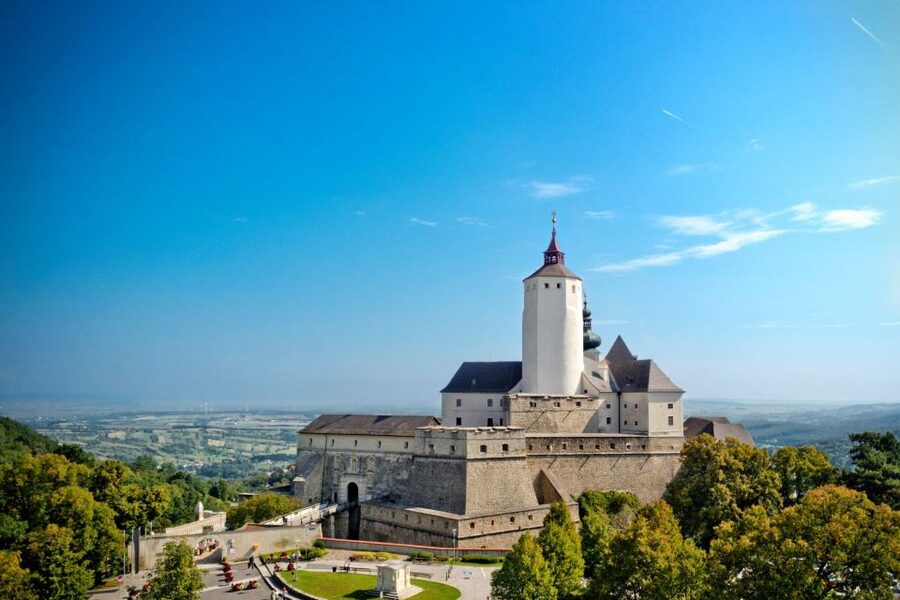
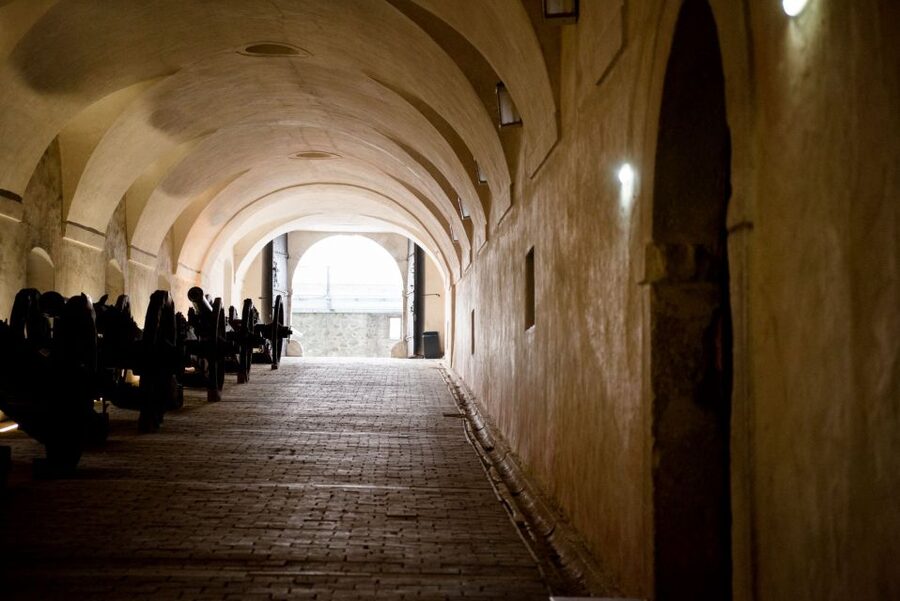
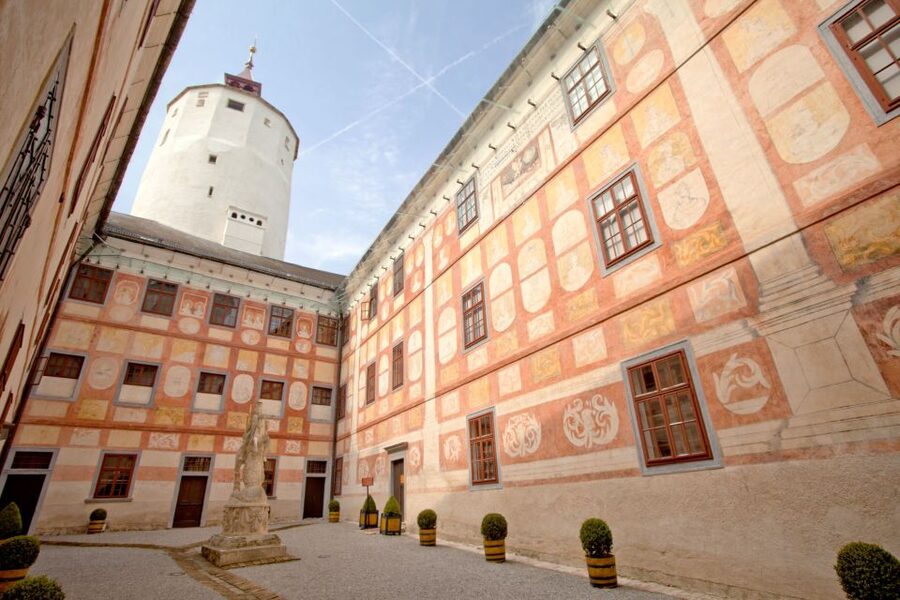
Forchtenstein Castle is in Burgenland, Austria, and the visit begins with the building itself. Before you concentrate on objects in glass cases, take time in the inner courtyard. Its secco wall paintings are a central reason to come, not a minor decoration on the way to the exhibits.
Secco painting is made on dry plaster rather than wet plaster. That technique gives the murals a different character from classic fresco work, and here the scale matters. The courtyard is described as having the largest display of secco wall paintings north of the Alps, so you should pause, look upward, and take in the full walls before heading inside.
I find courtyards like this useful because they give you a sense of the castle as a lived and defended place. A case of armor tells you what people owned. A painted courtyard tells you how they wanted the building to feel. At Forchtenstein, the setting and the collection work together.
The courtyard is also a good place to get your bearings. The visit is short, and the castle contains several different kinds of displays. If you spend the first few minutes simply noticing the architecture and murals, you will understand the setting better when you reach the Esterházy family objects upstairs.
More castles and fortresses in Austria:
- Salzburg: Hohensalzburg Fortress Admission Ticket
★ 4.6 · 2,236 reviews - Salzburg: Best of Mozart Fortress Concert and Dinner
★ 4.5 · 1,424 reviews - Salzburg: Best of Mozart Fortress Concert
★ 4.6 · 762 reviews
The chapel, oratory, and Esterházy armory
The first-floor route continues into the oratory and chapel. These spaces add a religious and ceremonial layer to the castle. They are not just passageways between larger displays, so take a moment to notice how the military and spiritual sides of the building meet.
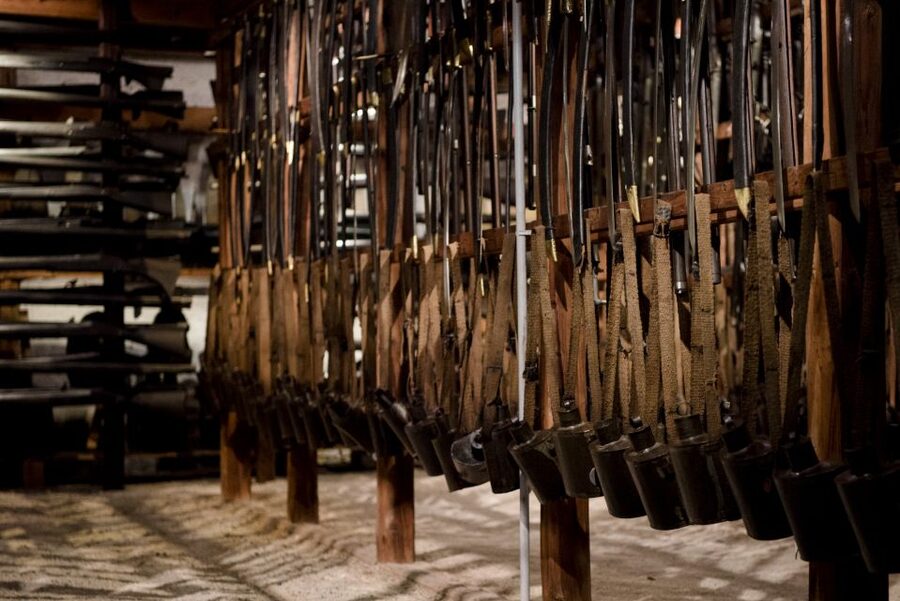
The armory is one of the strongest stops. It is described as one of Europe’s largest private armories, which gives the weapon collection real weight. You can expect a display built around the tools of warfare and status, rather than a small group of decorative swords added to a general castle exhibition.
I like this part of the visit because it makes the Esterházy family’s position easier to understand. Weapons were practical, but they also signaled rank, wealth, and authority. A private armory on this scale tells you that the castle was tied to a powerful family with the means to preserve an impressive collection.
One practical warning matters here. Access can vary, and a recent visit found the first level unavailable. If the chapel, oratory, or part of the armory is closed during your visit, the experience will feel different from the full advertised route. It is worth asking at the entrance which floors and rooms are open before you pay or begin.
Second-floor treasures, from silver furniture to an Ottoman tent
The second floor shifts from fortress life to collecting, ceremony, and family display. This is where Forchtenstein becomes especially unusual. You are not simply walking through rooms furnished in one period. You are seeing a collection assembled over generations, with objects chosen for their status, rarity, historical meaning, or sheer curiosity.
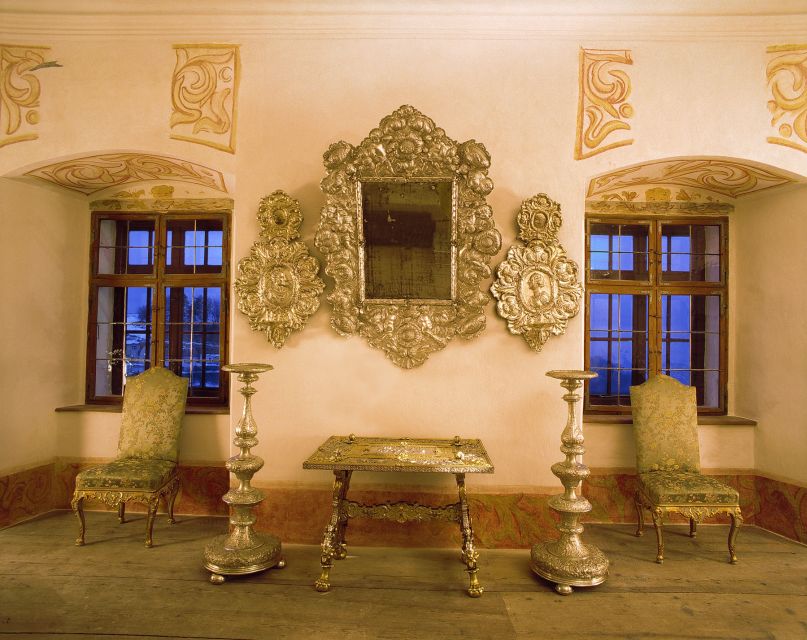
The silver furniture deserves special attention. The collection is described as Europe’s largest and earliest collection of silver furniture. That is a striking claim, and it also explains why the castle offers more than the usual weapons-and-portraits route.
Silver furniture was not made for ordinary use. It represented wealth that could be displayed in a very direct way. Look at it as evidence of court culture and family ambition. The value is not only in the metal. The furniture shows how power could be turned into household objects.
The 400-year-old Ottoman tent is another memorable piece. Its age and size make it easy to picture as a ceremonial or military object, but the supplied information does not assign it a specific event or owner. I would resist inventing a story for it. Instead, pay attention to the material, scale, and visual contrast between an Ottoman tent and the stone rooms of an Austrian castle.
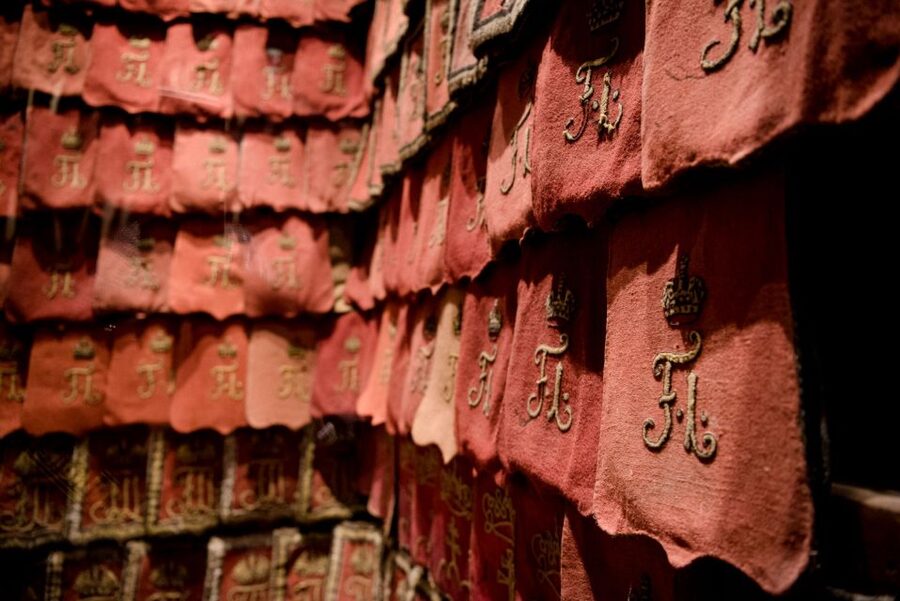
The three coronation flags may be the most politically charged objects on this floor. They date from the 17th century and are associated with Hungary, Croatia, and Serbia. The flags are also described as the oldest known coronation flags from those countries. You are looking at symbols made for public ceremony, not private decoration, and they help show how the Esterházy collections reach beyond the castle’s immediate walls.
The Gallery of Ancestors and a surprising Vlad portrait
The Gallery of Ancestors is one of the most entertaining parts of the visit because it blends genealogy with imagination. You will see portraits of Esterházy family members, but also figures presented as ancestors who belong more to legend and political storytelling than to verified family history.
Attila the Hun appears among these fictional ancestors. Vlad the Impaler appears as well, and his portrait has an especially strong claim: it is described as the only known full-length portrait of Vlad. That makes the painting a serious historical curiosity, even if the gallery’s larger story is partly about how noble families wanted to present themselves.
This is a useful reminder that old portraits do not always offer simple facts. A gallery of ancestors can show who a family was, but it can also show who the family wanted to be connected with. By including figures as famous and fearsome as Attila and Vlad, the collection presents a long, powerful lineage.
I would spend more time here than you might expect. The portraits are not merely wall decoration. They reveal how status was built through images, names, and claimed connections. If you enjoy the way history mixes with family legend, this may be the castle’s most rewarding room.
A few more options to weigh up in Austria
- Vienna Spanish Riding School Guided Tour
★ 4.7 · 6,765 reviews - Vienna: Guided Walking Tour of City Center Highlights
★ 4.7 · 4,989 reviews - Vienna: Vienna Central Cemetery Guided Walking Tour
★ 4.8 · 3,307 reviews - Vienna: Bus & Schönbrunn Palace Skip-the-Line Guided Tour
★ 4.3 · 2,802 reviews
The Kunstkammer and Prince Paul Esterházy’s collecting habit
The art collection includes a Kunstkammer, or cabinet of curiosities, dating from the late 16th to the early 18th century. These collections were built to gather unusual, precious, scientific, artistic, and rare objects in one place. The point was not always a neat category system. It was the pleasure of owning things that sparked wonder or showed the reach of a collector’s interests.
At Forchtenstein, the Kunstkammer gives you insight into Prince Paul Esterházy’s passion for collecting. That personal angle matters. Instead of seeing anonymous objects in a museum display, you can think about the habits and ambitions of the person who gathered them.
I find this kind of room helpful when you are tired of formal galleries. The objects may not tell one single story, but together they reveal a way of seeing the world. Prince Paul’s collection suggests curiosity, prestige, and a desire to bring distant or unusual things into the family sphere.
The cabinet of curiosities also connects the castle to wider European collecting culture. From the late 16th through the early 18th century, wealthy rulers and nobles assembled collections to display learning and influence. Forchtenstein lets you see that tradition in a family setting, alongside weapons, portraits, flags, and furniture.
Is one hour enough for Forchtenstein Castle?
The listed duration is one hour. I would treat that as a brisk but workable visit, especially if you want a clear overview rather than a slow study of every item.
You can see the courtyard, chapel and oratory, armory, second-floor collections, Gallery of Ancestors, and Kunstkammer within that time if the route is open and you keep moving. The short format is useful if you are building a Burgenland day around several stops. It is less suitable if you like to read every label or sketch, photograph, and discuss each object.
The one-hour timing also affects the choice between an audio guide and a guided tour. A German audio guide is listed at €2, which is a modest extra cost if you want more context while moving through the displays. The activity information also refers to an optional guided tour, but it does not provide the guide’s price, schedule, or language beyond the general German language information.
A guided explanation can add real value here because the collection jumps between military objects, family portraits, political symbols, and curiosities. Without context, the displays may feel like a series of impressive treasures. With good explanations, the connections between them become clearer.
If your visit is self-guided, choose a few priorities before you enter. I would focus on the courtyard murals, armory, silver furniture, Ottoman tent, coronation flags, and Vlad portrait. That list gives you the castle’s architecture, military role, family image-making, international connections, and collecting culture in one hour.
What the $22 admission offers
At about $22 per person, the ticket is not a throwaway stop, but it can offer good value if you care about original objects and unusual collections. You are paying for access to a castle with its own historic interiors and for several substantial collections, not just a view from a battlement.
The value is strongest for people who want variety. You get monumental wall paintings, religious rooms, weapons, silver furniture, Ottoman material, flags, portraits, and early modern curiosities. Few castle visits offer such a broad mix in such a compact route.
The value is weaker if you expect a long tour or a large open complex. The stated duration is only one hour, and mobility limitations may make the visit difficult. If the first level is closed, part of the experience may also be unavailable, so ask about current access before committing.
The optional €2 German audio guide is a small extra compared with the admission price. It may be worthwhile if you do not join a guided tour and want more than labels provide. Since the information supplied gives conflicting wording about whether the audio guide is included or costs €2, confirm the charge locally before purchase.
Cancellation is flexible: you can cancel up to 24 hours before the activity for a full refund. You can also reserve now and pay later, which helps if your Burgenland plans are still changing.
Who will enjoy this castle most?
I would recommend Forchtenstein Castle to you if you enjoy collections with a strong sense of personality. The castle suits anyone curious about the Esterházy family, historic weapons, ceremonial objects, noble portraits, or cabinets of curiosities.
It is especially good for:
- History fans who like military and political objects
- Art lovers interested in murals, portraits, and silver work
- Visitors who enjoy unusual objects more than polished palace rooms
- People planning a short cultural stop in Burgenland
- Anyone fascinated by how noble families created powerful origin stories
Families may also find the armor, flags, Ottoman tent, and Vlad portrait more engaging than a room-by-room palace tour. The visit is short enough to avoid becoming an endurance test, though younger children may need help following the family and collecting themes.
I would think twice if stairs, uneven access, or limited mobility are a concern. The experience is specifically marked as unsuitable for people with mobility impairments. I would also choose a longer guided experience elsewhere if your main goal is a detailed account of every room and object.
Practical advice for a smoother visit
Arrive 15 minutes before the activity starts. That gives you time to handle entry and begin without cutting into the one-hour visit.
Start with the courtyard murals rather than treating them as a quick photo stop. Then pay attention to the route through the chapel, oratory, and armory before concentrating on the second-floor collections.
Ask which levels are open on the day. A recent account specifically noted that the first level was not visitable, and that can change the balance of the experience.
If you want extra interpretation, check the cost and availability of the German audio guide, listed at €2, or ask about the optional guided tour. The information provided does not confirm the guided tour’s price or language, so do not assume it is included with the admission ticket.
Keep the major highlights in mind: the secco murals, private armory, silver furniture, Ottoman tent, coronation flags, Gallery of Ancestors, Vlad portrait, and Kunstkammer. You will get more from the visit if you know what deserves your limited time.
Should you book Forchtenstein Castle?
I would book it if you want a compact castle visit with genuinely unusual collections. The silver furniture, Ottoman tent, coronation flags, and Vlad the Impaler portrait give Forchtenstein a character that goes well beyond the standard fortress tour.
The $22 price makes the most sense when you can see the principal rooms and collections during the one-hour visit. Before booking, confirm that the floors you most want to see are open, especially if the first level matters to you. Add the audio guide or optional tour only if you want help connecting the objects into a larger story.
Skip it if mobility is a serious concern or if you want a long, relaxed visit with broad access throughout the building. For everyone else, Forchtenstein offers a focused look at architecture, power, family mythology, and collecting in one memorable stop.
FAQ
Where is Forchtenstein Castle?
Forchtenstein Castle is in Burgenland, Austria.
How long does the castle visit take?
The stated duration is one hour.
What is included with the ticket?
The admission ticket is included. An optional guided tour is available, but its price and exact details are not provided.
Is an audio guide available?
Yes. A German audio guide is listed, with a stated price of €2. Confirm the current charge when you arrive because the supplied activity details use conflicting wording about whether it is included.
What language is available?
The activity information lists German. The audio guide is also identified as German.
What are the main highlights inside the castle?
Key highlights include the secco murals in the inner courtyard, the private armory, silver furniture, the Ottoman tent, three coronation flags, the Gallery of Ancestors, the Vlad the Impaler portrait, and the Kunstkammer.
Is the visit suitable for people with mobility impairments?
No. The activity is marked as unsuitable for people with mobility impairments.
Can I cancel the booking?
Yes. You can cancel up to 24 hours in advance for a full refund. Reserve-now, pay-later booking is also available.
Just added in Austria
- Zurich: Private Liechtenstein, Austria, and Germany Day Trip★ 5.0 · 16 reviews
- Zurich: Liechtenstein, Austria, Germany and Swiss Day Trip★ 5.0 · 2 reviews
- Zell am See: Paragliding Tandem Flight★ 5.0 · 31 reviews
- Vienna: Austrian Wine Tasting Experience★ 4.2 · 2 reviews
- Zurich: Liechtenstein, Austria and Germany Private Day Tour★ 5.0 · 6 reviews
- Vienna: UNESCO Schönbrunn Palace Guided Tour with Entry★ 4.5 · 94 reviews
- World War II History Vienna Old Town Private Walking Tour★ 4.8 · 9 reviews
- From Krems: Wachau Valley River Cruise on the Danube★ 4.6 · 95 reviews
Tickets, compared.
Classic Ensemble Vienna in St. Peter’s Church Ticket
Read our review →
Vienna Kunsthistorisches Museum Day Admission Ticket
Read our review →
Tickets for Mozarthaus Vienna with Audio Guide
Read our review →
Skip-the-Line Entrance Ticket to the Danube Tower
Read our review →
St. Stephen’s Cathedral & Dom Museum Wien Tickets
Read our review →Browse the lists this tour appears in