Reviewed · TICKETS
DomQuartier Day Ticket
Salzburg’s power center opens room by room. I love the restored connections between the Residenz, cathedral, and St. Peter’s Abbey, and I like the freedom to pause, leave, and return during the same day. The main drawback is timing: some areas may close for events, and late arrivals may not be admitted if the museum is nearing closing.
For $14 per person, this is a strong-value cultural visit. The online audio guide helps explain what you are seeing, but you need your own smartphone and internet connection. Plan on at least two hours, and allow longer if you want to read, listen, and enjoy the terrace without rushing.
In This Review
- Key things to know before entering DomQuartier
- Why DomQuartier matters in Salzburg
- Start with the Residenz state rooms
- The Residenz Gallery and its Baroque focus
- Cross the Cathedral Arches Terrace
- The North Oratory and changing exhibitions
- See Salzburg Cathedral from the organ loft
- The Kunstkammer and Cathedral Museum collections
- The Long Gallery at St. Peter’s Abbey
- Museum St. Peter and its monastic treasures
- End in the Carabinieri Hall
- How much time should you allow?
- Audio guide, access, and practical restrictions
- Is $14 good value?
- Who should book DomQuartier?
- FAQ
- Where is DomQuartier located?
- How long is the DomQuartier ticket valid?
- Is an audio guide included?
- Which languages are available for the audio guide?
- Is the Cathedral Arches Terrace always open?
- Can I bring luggage, food, or drinks inside?
- Is DomQuartier wheelchair accessible?
- Should you book DomQuartier?
Key things to know before entering DomQuartier
- 134 historic doors now form one route: The DomQuartier reconnects the Salzburg Residenz, cathedral areas, galleries, and St. Peter’s collections after roughly 200 years of separation.
- The Cathedral Arches Terrace gives you a fresh city view: You look across Salzburg from the passage between its secular palace and spiritual center.
- The ticket is valid for multiple admissions that day: You can interrupt the visit and return later, a useful feature if you want a meal or a break.
- The route covers 15,000 square meters: There are about 2,000 objects spanning 1,300 years of art and culture, so this is not a quick one-room museum.
- The audio guide works on your phone: No pre-installation is needed, but you need an up-to-date browser and an internet connection.
- St. Peter’s collection adds a different voice: The Benedictine abbey presents old monastic treasures in a dedicated museum for the first time since 1982.
Why DomQuartier matters in Salzburg
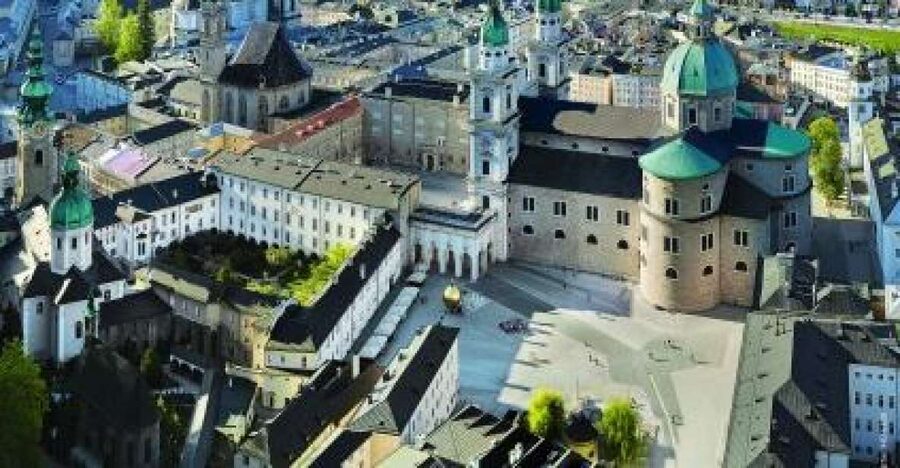
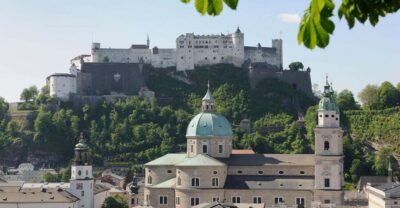
The cathedral and Residenz occupy the symbolic heart of Salzburg. For centuries, they were part of one ruling and religious complex, but the connecting passages were closed or walled off after the Prince Archbishopric of Salzburg ended in 1803.
DomQuartier restores that older arrangement. You are not simply moving from one museum room to another. You are following the route that once linked the prince archbishops’ home, their official rooms, the cathedral, the art galleries, and St. Peter’s Abbey.
That layout gives the visit its real value. The palace interiors make more sense after you understand their connection to the cathedral. The cathedral collections feel less isolated when you have just crossed from the secular seat of power. The route itself becomes part of the story.
The complex opened this public circuit on May 17, 2014. Its design reflects the work of Prince Archbishop Guidobald von Thun, who ruled from 1654 to 1668 and shaped much of Baroque Salzburg. He commissioned the cathedral arches, the Residenz and cathedral squares, the art gallery, and the passageways linking the main institutions.
You can still see his ambition in the scale of the rooms and the carefully planned movement through the buildings. This was power on display, not private comfort alone.
More Salzburg trips:
- The Original Sound of Music Tour in Salzburg
★ 4.5 · 6,129 reviews - Salzburg: Original Sound of Music Tour
★ 4.8 · 5,059 reviews - From Salzburg: Half-Day Tour to Hallstatt
★ 4.6 · 3,596 reviews
Start with the Residenz state rooms
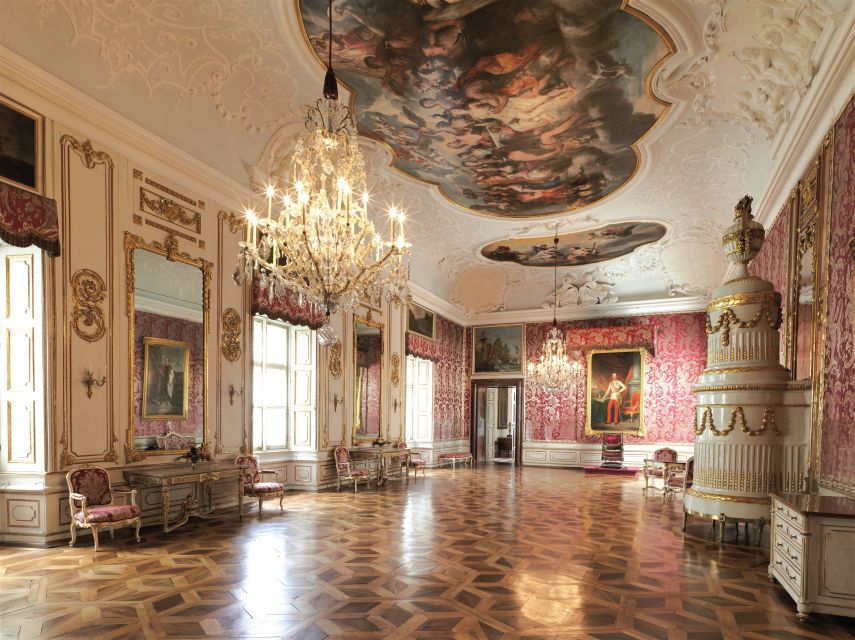
Begin at the Salzburg Residenz, the former living quarters and official seat of the prince archbishops. The state rooms are the first major section of the route, and they establish the tone immediately: polished surfaces, grand proportions, elaborate stucco, and ceiling frescoes designed to impress.
I would take the audio guide seriously here. A room can look beautiful at first glance, but the explanation helps you understand why these spaces were built with such force. The decoration was part of the rulers’ public image. It communicated authority to visitors, officials, and church representatives.
The route is well organized. You follow a clear sequence rather than guessing which doorway matters. That is helpful in a large historic building, especially when several doors and corridors begin to look alike.
The rooms are also a good place to slow down and look upward. The ceilings often carry as much meaning as the furnishings and walls. If you rush through because the rooms appear similar, you will miss the visual program that links one space to the next.
The main limitation is that partial closures can occur. Conversion work or events may close a few rooms in the state apartments or cathedral. If a particular interior is your main reason for visiting, check ahead before you go.
The Residenz Gallery and its Baroque focus
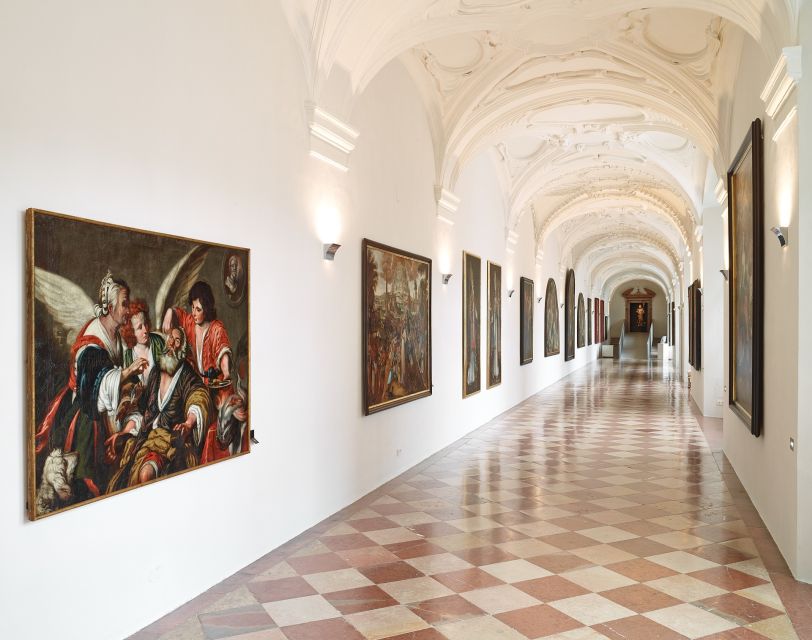
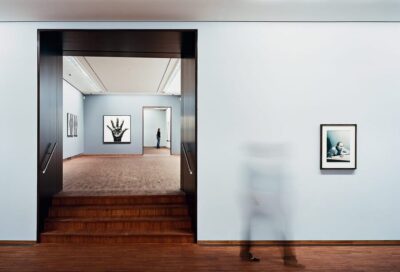
The Residenz Gallery follows the state rooms and shifts attention from architecture to European painting. Its collection covers the 16th through 19th centuries, with a clear emphasis on the Baroque period.
This is a useful pairing. First, you see how Salzburg’s rulers presented themselves through buildings and decoration. Then you encounter the paintings that fit the same cultural world. The gallery gives you a chance to compare the palace’s ceiling art, formal interiors, and religious imagery with works displayed in a more traditional gallery setting.
You should not expect the entire museum to feel like a single specialist collection. DomQuartier combines several institutions, so the gallery is one chapter in a larger route. That variety is a strength if you like changing subjects. It may feel like a lot if you prefer to focus on one painter or one period.
The museum shop is located in the Residenz Gallery on the third floor. Drinks can be purchased there, with access to the terrace. Food and drinks are not allowed through the museum galleries, so use the shop area according to the site’s rules rather than carrying refreshments into the exhibits.
Cross the Cathedral Arches Terrace
The Cathedral Arches Terrace is one of the most memorable parts of the visit because it changes your point of view. After the enclosed palace rooms and gallery, you step into a passage above the surrounding spaces and look across Salzburg from between the city’s secular and spiritual centers.
The terrace is more than a photo stop. It helps you understand the physical relationship between the Residenz and Salzburg Cathedral. From this height, the complex feels like a planned whole rather than a group of separate attractions.
I would make time here instead of treating it as a quick pause between galleries. The view is one of the few moments in the route when the city itself becomes the exhibit. You may find it especially useful early in your visit because it helps you get your bearings before continuing into the museum sections.
Access can be suspended in exceptional cases, including a special event or storm warning. That is worth remembering if the terrace is your top priority. The rest of DomQuartier can still provide a substantial visit, but this particular outlook is not guaranteed every day.
A few more options to weigh up in Salzburg
- Salzburg: Hohensalzburg Fortress Admission Ticket
★ 4.6 · 2,236 reviews - Salzburg: Salt Mine Entrance Ticket
★ 4.8 · 258 reviews - Salzburg: The Magic Flute at Marionette Theater Ticket
★ 4.7 · 255 reviews - Salzburg: Cathedral Entry Ticket with Audio Guide Option
★ 4.4 · 134 reviews
The North Oratory and changing exhibitions
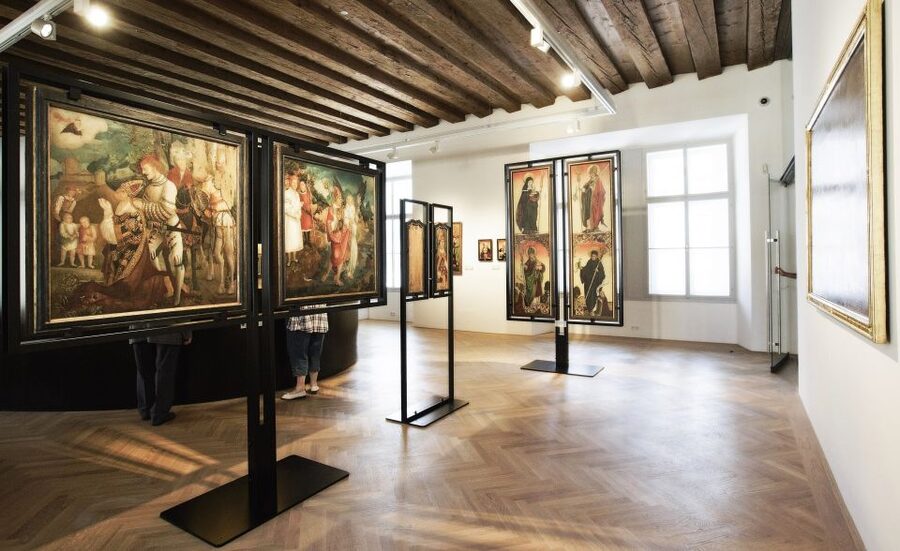
The North Oratory preserves an original cathedral structure and is used for special exhibitions. The material shown there can change, so the experience depends partly on what is scheduled during your visit.
Initially, the Salzburg Museum’s Rossacher collection is presented in this space. The North Oratory adds variety to the route because it is not simply another permanent room filled with the same type of object. It connects the building’s original purpose with temporary or guest displays.
I like this part for readers who want their visit to include something beyond palace decoration. At the same time, you should not plan your entire day around one temporary exhibition unless you have checked the current program. The space is specifically intended for special presentations, so the contents are not fixed in the same way as the Residenz state rooms.
See Salzburg Cathedral from the organ loft
The route then leads toward the cathedral collections, including the organ loft. This section gives you an impressive view into Salzburg Cathedral, allowing you to study the interior from a position different from the usual floor-level visit.
That change in height matters. It makes the cathedral’s scale easier to read and shows how the surrounding buildings relate to it. The DomQuartier route repeatedly shifts your viewpoint, from palace rooms to terrace, from gallery to loft, and from secular collections to church treasures.
The Cathedral Museum displays centuries-old art treasures. It provides the spiritual and artistic counterpart to the Residenz, where the focus is on the public image of the prince archbishops.
The collection is particularly useful if you want to understand Salzburg beyond its famous views and musical associations. Religious art, ceremonial objects, and cathedral history reveal how much of the city’s identity was shaped by church institutions.
The Kunstkammer and Cathedral Museum collections
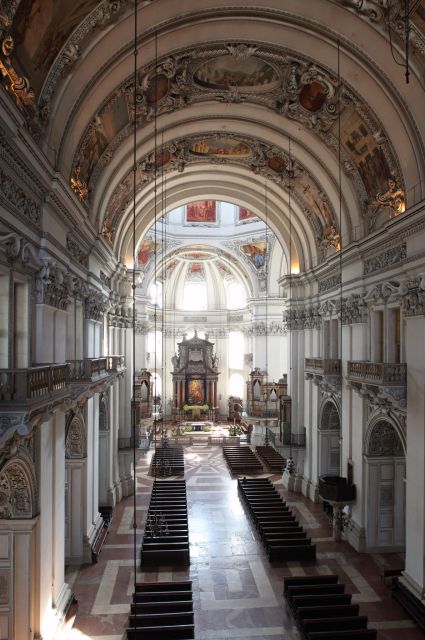
The Kunstkammer adds another layer to the cathedral complex. Historically, such collections brought together unusual, valuable, and carefully chosen objects. Here, it forms part of the larger route through the cathedral and former archiepiscopal complex.
You should allow time for small objects, not only large paintings and grand rooms. The state apartments make an immediate impression, but the collections reward closer looking. Objects in a treasury or art chamber often carry their value through materials, craftsmanship, age, or unusual purpose.
The online audio guide can help you make sense of those details. Since the ticket does not include a live guide, the audio commentary is your main built-in source of interpretation. It is available through your smartphone, with German, English, Dutch, Italian, French, Spanish, Russian, Mandarin, Korean, and Japanese listed as options.
A children’s audio guide is also available in German, English, and Italian. Families should note that children may get more from a guided story than from simply following adults through a long museum route.
The Long Gallery at St. Peter’s Abbey
The Long Gallery connects the museum route with St. Peter’s Abbey. The gallery was created as part of the Baroque building program and is now included in the DomQuartier circuit.
This is an important transition. You have moved through the archiepiscopal residence and cathedral collections, and now you reach the institution that helped shape Salzburg’s intellectual and cultural life. St. Peter’s is considered the oldest continuously operating monastery in the German-speaking countries.
The Long Gallery makes the abbey’s role visible through art and architecture. It also prevents the visit from becoming only a palace tour. You see the wider network of institutions that supported Salzburg’s culture and religious life.
The walk through the gallery is part of the pleasure, but it also adds distance. If you have limited mobility or tire easily, use the option to stop and return later the same day. The route is wheelchair accessible, but the overall size of the complex still makes pacing important.
Museum St. Peter and its monastic treasures
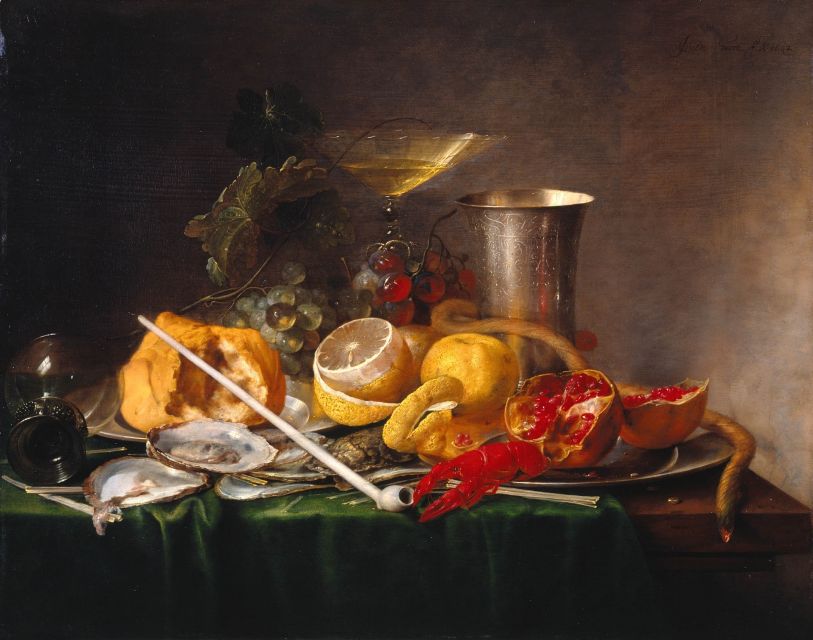
Museum St. Peter presents selected treasures from the Benedictine monastery’s estimated collection of 40,000 objects. The most prized pieces are now shown in a permanent museum designed for the collection.
For me, this is one of the strongest reasons to choose DomQuartier over a palace-only visit. The Residenz explains political power. Museum St. Peter shows how a long-running monastery preserved and shaped artistic and intellectual life.
The objects also offer a different feel from the formal state rooms. You may find religious works, historic artifacts, and monastic treasures that are more closely tied to daily institutional life and long-term preservation. The collection was presented in this dedicated form after 1982, making it a significant part of the restored museum plan.
Do not expect to see all 40,000 objects. The museum presents the most beautiful and important selections, not the entire abbey collection. That is enough for a clear introduction without turning the visit into an exhausting catalog.
End in the Carabinieri Hall
The route ends in the Carabinieri Hall of the Salzburg Residenz. Returning to this grand palace space gives the visit a satisfying architectural finish.
By this point, you have seen the rulers’ apartments, European paintings, cathedral art, special exhibitions, a lofty cathedral view, a historic gallery, and St. Peter’s treasures. Ending in the Residenz brings those strands back together.
The route is designed so you are unlikely to miss a major section. One visitor described it as very organized, with no feeling of getting lost or leaving important spots unseen. That is a fair description of the layout. You follow a planned sequence through the complex, and the passageways themselves explain how the institutions were connected.
How much time should you allow?
The ticket is valid for one day and permits multiple admissions on that day. You can stop the tour, leave, and return later, which gives you more control than a fixed guided tour.
Although the exact duration is not set, I would reserve at least two hours. That allows a brisk but sensible circuit. If you listen to much of the audio guide, study the paintings, pause on the terrace, and take your time in Museum St. Peter, half a day is reasonable.
One person found there was enough to see for half a day. That matches the scale of the complex. You are covering 15,000 square meters and about 2,000 exhibits connected to 1,300 years of art and culture.
Do not arrive only one hour before closing. Admission may be refused that late, even though the ticket itself is valid for the day. I would arrive at least two hours before closing so you have a fair chance to see the main route without racing through the final rooms.
Audio guide, access, and practical restrictions
The audio guide is included online, and you can use it on your own smartphone. You do not need to install an application. You need an up-to-date web browser, an internet connection, and enough phone battery for the visit.
Free WiFi is available in the museum, which helps if your mobile connection is weak. From 2025, borrowing a physical audio guide costs €2, so using your own phone is the simpler option if you are comfortable with it.
A live guide is not included. Booklets can be purchased on site. If you prefer personal explanations and questions, this format may feel less satisfying than a guided tour. If you like moving at your own pace, the online guide is a good fit.
Large bags and luggage are not allowed. Smoking, food, drinks, flash photography, cameras, selfie sticks, umbrellas, and pets are also prohibited, with assistance dogs allowed. Wheelchair access is available, though partial closures and the size of the complex may affect the exact route on a particular day.
The meeting point and end point are both at DomQuartier Salzburg. Transfers are not included, so you arrange your own way to the central site.
Is $14 good value?
At $14, the ticket is inexpensive for the amount included. You are not paying for one palace room or a short cathedral exhibit. You are getting access to a connected complex with state rooms, the Residenz Gallery, the North Oratory, the Cathedral Museum, the Kunstkammer, the Long Gallery, and Museum St. Peter.
The value improves if you use the same-day re-entry. You can split the visit around lunch or another Salzburg activity instead of trying to absorb everything in one stretch.
The price is less compelling if you only have a short window or mainly want a single city viewpoint. In that case, the number of collections may feel like too much. But if you want context for the buildings you see around central Salzburg, the ticket gives you a great deal of material for a modest cost.
Who should book DomQuartier?
I would choose this experience if you like architecture, church art, palace interiors, or the political story behind Salzburg’s Baroque center. It also suits families who can use the children’s audio guide and anyone who prefers independent exploration to a scheduled group.
It is a particularly good choice for repeat visitors who have already walked around the cathedral and Residenz from outside. DomQuartier explains what those buildings were for and how they once worked together.
You may want to skip it if you dislike large museum complexes, cannot spare at least two hours, or prefer a live guide. Also check for partial closures before booking if you have a must-see room or exhibition.
FAQ
Where is DomQuartier located?
DomQuartier is in the historic center of Salzburg, Austria, at the complex formed by the Salzburg Residenz, Salzburg Cathedral, and nearby St. Peter’s Abbey.
How long is the DomQuartier ticket valid?
The ticket is valid for one day. It allows multiple admissions on the day of validity, so you can interrupt your visit and return later that same day.
Is an audio guide included?
An online audio guide is included. You can use it on your own smartphone without installing anything, provided you have an up-to-date web browser and an internet connection.
Which languages are available for the audio guide?
The audio guide is available in German, English, Dutch, Italian, French, Spanish, Russian, Mandarin, Korean, and Japanese. A children’s audio guide is available in German, English, and Italian.
Is the Cathedral Arches Terrace always open?
The terrace is included, but it can close in exceptional cases such as a special event or a storm warning.
Can I bring luggage, food, or drinks inside?
No. Luggage or large bags, food, and drinks are not allowed inside. Drinks can be purchased in the museum shop located in the Residenz Gallery, with access to the terrace.
Is DomQuartier wheelchair accessible?
Yes, the activity is wheelchair accessible. Some areas may have limited access on certain days because of conversion work or events in the state rooms or cathedral.
Should you book DomQuartier?
Book it if you want Salzburg’s grand center explained from the inside. The best parts are the connected route, the palace state rooms, the terrace view, and the chance to see St. Peter’s monastic treasures alongside cathedral art and archiepiscopal collections.
Give yourself at least two hours, arrive well before closing, and bring a charged smartphone for the audio guide. At $14, DomQuartier is a practical choice for understanding how Salzburg’s political, religious, and artistic centers once operated as one powerful complex.
Just added in Salzburg
- Werfen: Hohenwerfen Castle Entrance Ticket★ 4.5 · 84 reviews
- Vienna: Private tour from Vienna to Hallstatt and Salzburg★ 5.0 · 1 review
- Private Melk Hallstatt, Salzburg tour from Vienna★ 4.9 · 22 reviews
- Vienna: Hallstatt & Salzkammergut Trip with Ossuarry Option★ 5.0 · 1 review
- Private Full Day Trip to Hallstatt ,Salzburg and Melk from Vienna★ 4.5 · 58 reviews
- Day Tour from Vienna to Hallstatt and Salzburg with Photographer★ 3.0 · 10 reviews
- From Vienna ,Lakes to Mountains,Melk,Hallstatt and Salzburg Tour★ 3.5 · 7 reviews
- Transfer from Vienna to Salzburg with 2 hours for sightseeing★ 5.0 · 24 reviews
Tickets, compared.
Classic Ensemble Vienna in St. Peter’s Church Ticket
Read our review →
Vienna Kunsthistorisches Museum Day Admission Ticket
Read our review →
Tickets for Mozarthaus Vienna with Audio Guide
Read our review →
Skip-the-Line Entrance Ticket to the Danube Tower
Read our review →