
Reviewed · GRAZ TOURS
Universalmuseum Joanneum Pass in Graz
Graz rewards curious museum hoppers. The Universalmuseum Joanneum Pass gives you access to 12 museums and cultural sites across Graz and Styria, so you can shape two days around art, science, local culture, or old weapons. I like the freedom to skip what does not interest you, and I like that one pass links major sights such as Eggenberg Palace, the Styrian Armoury, Kunsthaus Graz, and the Natural History Museum.
The biggest consideration is planning. Several sites lie outside central Graz, and the pass does not include guided tours or audio guides. A digital-ticket problem also appears in the feedback: one purchaser complained that no usable QR code arrived within two days. You are told to print your Viator booking confirmation and show it at the cashier, so do not rely on a phone-only plan.
In This Review
- Key points to know before you buy
- What the Joanneum Pass actually gives you
- Start in central Graz with the Armoury and old town museums
- Eggenberg Palace turns the pass into a full afternoon
- Kunsthaus Graz brings contemporary art into the mix
- Roman Styria at Flavia Solva
- Two Rosegger sites, two views of rural Styria
- Stainz and Trautenfels offer castles with different subjects
- The Austrian Sculpture Park is a relaxed family stop
- How to plan the 24-hour and 48-hour options
- Ticket instructions and the one digital snag
- Who will get the best value
- Should you book the Joanneum Pass?
- FAQ
- What is included in the Universalmuseum Joanneum Pass?
- Is the pass valid for 24 or 48 hours?
- How much does the pass cost?
- Does the pass include guided tours?
- What languages are available for guides and audio guides?
- How do I receive the paper pass?
- Does the pass include Eggenberg Palace?
- Does the pass include the Styrian Armoury?
- Can I visit museums outside Graz with the pass?
- Can I cancel the booking?
Key points to know before you buy
- Twelve very different sites: The pass covers palaces, art museums, Roman archaeology, natural science, folk culture, sculpture, and Austria’s largest hunting museum.
- Choose 24 or 48 hours: The longer option gives you a better chance to visit sites outside central Graz without rushing.
- Eggenberg Palace needs planning: Its 24 state rooms and more than 500 ceiling paintings make it one of the pass’s major attractions.
- The Styrian Armoury is a major draw: It houses the world’s largest historical weapons arsenal.
- Guides cost extra: Guided tours and audio guides are not included and cost 2.50 euros per person.
- Print your confirmation: The instructions specifically ask you to present a printed Viator booking confirmation at the cashier point to receive the paper pass.
What the Joanneum Pass actually gives you
The Universalmuseum Joanneum is not one building. It is a group of museums and historic sites spread across Graz and the wider province of Styria. The pass works like a short-term cultural ticket, letting you visit 12 included locations during either a 24-hour or 48-hour period.
That setup suits you if you want variety. One morning can focus on medieval weapons and courtly interiors. The afternoon can shift to modern art or fossils. Another day can take you beyond the city to Roman ruins or a country castle.
The listed price is $24.08 per person. That can be good value if you visit several of the included places, but the value depends on your pace and route. If you only have time for one museum, buying a single admission may make more sense. If you visit three or four substantial sites, the pass becomes easier to justify.
I would choose the 48-hour version for most people who want to explore beyond central Graz. The 24-hour option can work well if you plan to remain in the old town and select nearby museums. The pass is less useful as a casual maybe we will stop somewhere purchase because you need to use enough admissions to make the fixed price worthwhile.
More Graz trips:
- Kunsthaus Graz Museum Entrance Ticket
★ 3.5 · 19 reviews - Graz: Old Town Highlights Private Walking Tour
★ 4.6 · 16 reviews - Fun & mobile scavenger hunt through Graz
★ 4.5 · 12 reviews
Start in central Graz with the Armoury and old town museums
The pass fits naturally into time spent in Graz’s old town. The itinerary allows about two hours for the Universalmuseum Joanneum and another two hours around the Altstadt, or old town. These are not separate guided activities. They describe a practical way to combine museum time with your own sightseeing.
The Styrian Armoury is one of the strongest reasons to buy the pass. It is described as the world’s largest historical weapons arsenal, giving you a chance to see an enormous collection of weapons and military equipment in a historic setting. Even if you are not a military-history enthusiast, the sheer scale makes this a memorable stop.
Do not treat it like a quick room on the way to lunch. Allow enough time to look at the equipment as a collection rather than a handful of individual objects. The Armoury also gives you a useful sense of Styria’s political and military past, without requiring a full-day commitment.
The Neue Galerie provides a sharp change of mood. Its collection covers Biedermeier, Jugendstil, expressionism, classic modernism, and Austrian and international painting after 1945. This is a good choice if you want to connect Graz with broader European art movements rather than focus only on local objects.
The Natural History Museum offers another change of pace. Its displays include wild cats, birds in flight, unusual plants, fossils, and other examples of the planet’s variety. It should suit families and anyone who prefers visible, hands-on subject matter to long rows of paintings.
The Folk Life Museum looks at social life through material objects and personal stories. It has collected and interpreted items connected with everyday life and human experience since 1913. This may be the most useful stop for understanding how people in the region lived, worked, and organized their homes.
Eggenberg Palace turns the pass into a full afternoon
Eggenberg Palace is set at the edge of Graz’s city center in a park. Its 24 state rooms contain original interiors, historic furniture, and more than 500 ceiling paintings. That combination gives the palace more weight than a simple walk through a grand residence.
I would make Eggenberg a priority and plan around its opening schedule, although the supplied information does not provide specific hours. The palace is one of the sites most likely to reward a slower visit. You are not just looking at one decorated room. You are moving through an organized sequence of rooms and ceilings, with the building itself helping explain the world of its former owners.
The park adds breathing room before or after the indoor visit. The pass description does not promise a guided experience, so you should expect to explore independently unless you purchase a tour on site. Guided tours and audio guides in English, German, and partly Italian and Slovenian cost an additional 2.50 euros per person.
That small extra fee may be worthwhile at Eggenberg, especially if you want more help interpreting the rooms and ceiling paintings. If you prefer to move at your own speed, the pass still lets you visit without paying for a guide.
Kunsthaus Graz brings contemporary art into the mix
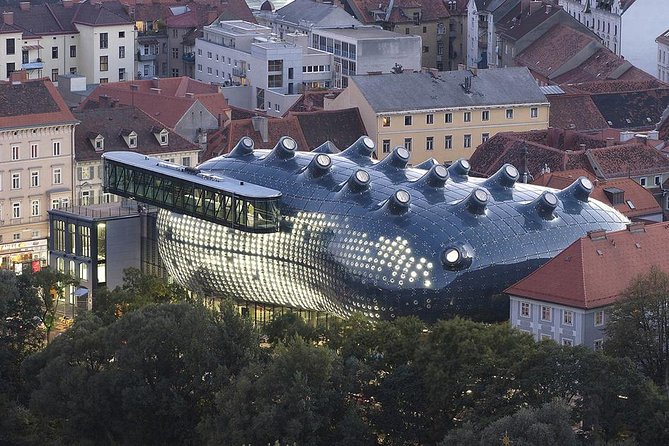
Kunsthaus Graz occupies a striking blue building that appears to float among the roofs of the historic center. Its appearance alone makes it easy to identify, but the real reason to visit is its focus on contemporary art.
This is a useful counterpoint to Eggenberg Palace and the Armoury. The pass does not push you toward one period or style. You can compare old collections with current artistic work in the same short trip.
Contemporary art can be a gamble if you prefer clear historical explanations. Some displays may appeal strongly to you, while others may not. That is one advantage of a multi-site pass: you do not need every museum to be your favorite. You can spend less time at Kunsthaus Graz and use the remaining hours elsewhere.
A completely different kind of day:
- Graz Scavenger Hunt and Sights Self Guided Tour
★ 4.0 · 9 reviews - Graz city tours
★ 3.5 · 9 reviews - Explore Graz in 60 minutes with a Local
★ 5.0 · 7 reviews - Graz Private Walking Tour With A Professional Guide
★ 5.0 · 5 reviews
Roman Styria at Flavia Solva
The Roman Museum Flavia Solva takes you outside the city to the only Roman city within modern Styria. Its displays include archaeological finds, inscriptions, and reliefs from the Roman province of Noricum.
This site matters because it widens your view of the region. Graz is not only a medieval old town and an Austrian art center. The Roman remains connect Styria to a much older provincial world.
The drawback is simple: this is one of the sites where location matters. The supplied information does not give travel times or transport instructions, so check the current route before setting out. Do not squeeze Flavia Solva into a tight 24-hour plan unless you have already worked out the journey.
The Roman museum is best for you if archaeology is a real interest, or if you want to see a part of Styria that central Graz cannot provide. It is less practical for a short city break built around walking between old-town sights.
Two Rosegger sites, two views of rural Styria
The pass includes Rosegger’s Birthplace in Alpl and the Rosegger Museum in Krieglach. Both relate to Peter Rosegger, the Styrian poet born in 1843 and deceased in 1918, but they serve different purposes.
At Rosegger’s Birthplace Alpl, furnishings and household items show rural life in the 19th century. The appeal is domestic and direct. Instead of grand rooms, you get a look at the objects and surroundings connected with everyday life.
The Rosegger Museum Krieglach occupies the poet’s former country home. It traces different stages of his life and work, making it the more focused choice if you already know his writing or want a biographical visit.
These sites are outside the central museum cluster. They make the most sense during a 48-hour visit, especially if you have a car or are comfortable arranging regional transportation. With only one day in Graz, I would put them behind the Armoury, Eggenberg Palace, and one central art or science museum.
Stainz and Trautenfels offer castles with different subjects
Schloss Stainz houses Austria’s largest Hunting Museum. The collection features historic weapons and hunting equipment inside Stainz Castle. It pairs well with the Styrian Armoury, but the two are not interchangeable.
The Armoury focuses on a vast historical weapons arsenal. Stainz adds the hunting context and the setting of a castle. If you have an interest in historic equipment, rural traditions, or aristocratic life, visiting both can give you a broader picture.
Schloss Trautenfels takes another route. Its collections include zoological, geological, and mineralogical items, along with archaeological finds from the region. The castle also contains high-quality Baroque interiors and views of the surrounding mountains.
Trautenfels may be one of the most varied stops in the pass. You can see natural specimens, objects from the human past, decorated rooms, and mountain views in one visit. The same warning applies as with Flavia Solva and the Rosegger sites: it is beyond the central Graz circuit, so the 48-hour option is more comfortable.
The Austrian Sculpture Park is a relaxed family stop
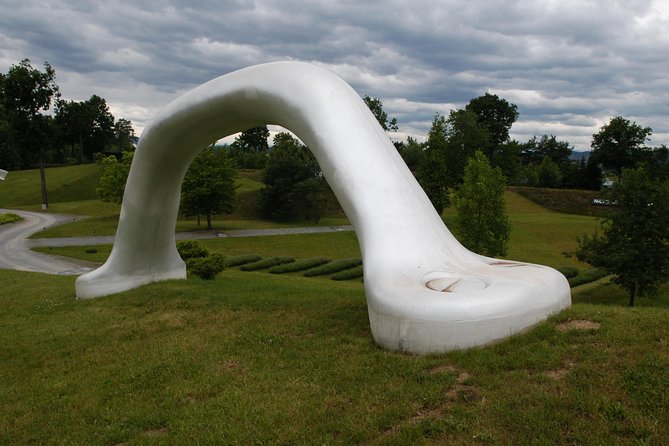
The Austrian Sculpture Park presents contemporary works that range from abstract forms and human figures to pieces based on household and practical objects. It is designed as a place for relaxation and is described as child-friendly.
That setting changes how you experience the art. You are not confined to a quiet indoor gallery, and children have more room to move. The park can also provide a break after several indoor museums.
Your response to the sculptures will depend on your taste. Some works may be immediately appealing, while others may seem puzzling. That is normal for contemporary art, and the open setting makes the visit less demanding than a long indoor exhibition.
The park is a good choice for families and for anyone who wants a slower, less formal stop. It is not the strongest use of a tightly packed 24-hour pass if your priorities are major historic interiors and central Graz museums.
How to plan the 24-hour and 48-hour options
The 24-hour pass works best with a compact plan. Concentrate on central Graz and choose two or three museums that genuinely interest you. A possible mix is the Styrian Armoury, Neue Galerie, Natural History Museum, and Kunsthaus Graz, though the right combination depends on opening times and how long you spend at each site.
Add Eggenberg Palace if you can give it proper time. Its 24 rooms make it a poor candidate for a rushed final stop.
The 48-hour pass gives you room to include one or more out-of-town sites. You could spend one day in central Graz and use the second for Eggenberg Palace, Flavia Solva, Stainz, Trautenfels, Alpl, Krieglach, or the Austrian Sculpture Park.
Do not assume you can see all 12 locations. The pass offers choice, not a promise that every stop fits into two days. Several sites are spread across Styria, and transport time will reduce your museum time.
A practical approach is to group stops by area before activating the pass. Begin with a short list of three priorities, then add nearby options. Keep at least one flexible slot for a museum that catches your interest once you are in the city.
Ticket instructions and the one digital snag
The ticket is described as a paper ticket. To receive your 24-hour or 48-hour pass, print your booking confirmation from Viator and show it at the cashier point.
That instruction deserves attention. One negative rating, written in German, complained that no email with a QR code arrived within two days and that the museums could not process it. The complaint points to a practical problem with assuming a digital code will automatically appear.
Printing the confirmation is the safest move. Keep the paper with you until you have collected the pass. Confirmation is received at booking, and the experience is near public transportation. Service animals are allowed, and most people can participate, but the information does not provide detailed accessibility notes for every separate museum.
Guided tours and audio guides are extra at 2.50 euros per person. They are available in English and German, with some Italian and Slovenian coverage. If interpretation matters to you, budget for that small addition rather than assuming the pass includes it.
Who will get the best value
I would recommend the pass to you if you enjoy choosing your own museums and want more than a single palace or gallery. It is especially useful for:
- Museum fans who want art, science, local culture, and historic collections in one ticket
- Families interested in the Natural History Museum or Austrian Sculpture Park
- Visitors staying 48 hours who can reach sites outside central Graz
- People who want to compare the Armoury, Eggenberg Palace, and Kunsthaus Graz
- Anyone comfortable exploring without a guide
I would be more cautious if you have only a few hours in Graz, dislike planning, or want one highly structured guided tour. The pass gives flexibility, but it also puts the route planning in your hands.
The average booking lead time is about 23 days. That does not mean you must book that far ahead, but it suggests that many people arrange this part of their Graz plans before arrival. Since free cancellation is available up to 24 hours before the start time, you have some room to adjust if your schedule changes. Cancellations made less than 24 hours ahead are not refunded, and late changes are not accepted.
Should you book the Joanneum Pass?
Book it if you can name at least three included sites you want to see, or if you have 48 hours for a wider Styria plan. The strongest reasons are Eggenberg Palace, the Styrian Armoury, and the range of museums available under one pass.
Choose the 24-hour option for a focused city visit. Choose 48 hours if you want Flavia Solva, Stainz, Trautenfels, the Rosegger sites, or the Austrian Sculpture Park without turning the trip into a race.
At $24.08 per person, the pass offers good value for an active museum schedule. It is not a shortcut to seeing everything. Print your confirmation, check locations and opening times, and pick your priorities before the clock starts. If you do that, the Joanneum Pass can turn Graz into a well-paced cultural visit rather than a single-sight stop.
FAQ
What is included in the Universalmuseum Joanneum Pass?
The pass includes admission to 12 museums and cultural institutions in Graz and Styria. Included sites include Eggenberg Palace, the Styrian Armoury, Kunsthaus Graz, the Natural History Museum, Neue Galerie, and other listed locations.
Is the pass valid for 24 or 48 hours?
You can select a 24-hour or 48-hour pass. The longer option is more useful if you plan to visit sites outside central Graz.
How much does the pass cost?
The listed price is $24.08 per person. The final value depends on how many included museums and sites you visit.
Does the pass include guided tours?
No. Guided tours and audio guides are not included. They can be purchased separately on site for 2.50 euros per person.
What languages are available for guides and audio guides?
Guides and audio guides are available in English and German, with some Italian and Slovenian availability.
How do I receive the paper pass?
Print your Viator booking confirmation and show it at the cashier point to receive your 24-hour or 48-hour pass.
Does the pass include Eggenberg Palace?
Yes. Eggenberg Palace is one of the included sites. It contains 24 state rooms, original interiors, historic furniture, and more than 500 ceiling paintings.
Does the pass include the Styrian Armoury?
Yes. The Styrian Armoury is included and is described as the world’s largest historical weapons arsenal.
Can I visit museums outside Graz with the pass?
Yes. The included sites extend beyond Graz and include Flavia Solva, Rosegger’s Birthplace in Alpl, the Rosegger Museum in Krieglach, Schloss Stainz, Schloss Trautenfels, and the Austrian Sculpture Park.
Can I cancel the booking?
You can cancel for a full refund up to 24 hours before the experience start time. Cancellations or changes made less than 24 hours before the start time are not accepted for a refund.
Just added in Graz
- Vienna: Private tour from Vienna to Graz★ 5.0 · 1 review
- Vienna: Private tour to Graz★ 5.0 · 1 review
- Graz Scavenger Hunt and Sights Self Guided Tour★ 4.0 · 9 reviews
- Historic Graz: Exclusive Private Tour with a Local Expert★ 5.0 · 1 review
- Sightseeing flight over Graz★ 5.0 · 1 review
- Graz – Private tour including Castle visit★ 5.0 · 1 review
- Graz: Schlossberg Private Guided Tour★ 5.0 · 2 reviews
- Graz city tours★ 3.5 · 9 reviews
Graz Tours, compared.

Graz Funicular Ride and Schlossberg Picnic Experience
Read our review →
Graz Private Walking Tour With A Professional Guide
Read our review →Browse the lists this tour appears in